
Winter Blooming Salvias (Part II)
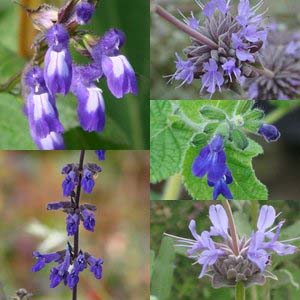
Many of the California native Salvias are Winter blooming, as befits plants from a Mediterranean climate. When the rains soak the ground, new growth starts and blooming soon follows. Most of these are from the mountain ranges of the Pacific Coast.
Our very favorite species in this group is Salvia clevlandii or Clevland Sage, found over a large range in the mountains of Southern California. It is a tough shrub, four to six feet tall and six feet across. The large airy clusters of blue to lavender-blue flowers are important nectar sources for both honeybees and hummingbirds. The foliage is silvery and highly aromatic.
Surprisingly hardy and adaptable to a garden setting, there are a host of varieties available in the nursery trade. Confusion over the names, origins and parentage of these clones is rampant. Many of them are identical, and improper labeling is common. We have worked hard to identify a couple of properly-named, garden-worthy cultivars that are different and worthwhile: 'Winnifred Gilman', ‘Pozo Blue’ and ‘Deer Springs Silver’.
Clevland Sage shares its range with a number of other Salvias, notably Salvia melifera (Black or Bee Sage), Salvia apiana (Sacred White Sage) and Salvia leucophylla (Purple Sage). Hybrids between these species abound, further complicating the nomenclature of this group.
Others of merit are Salvia ‘Vicki Romo’ , Salvia ‘Dara’s Choice’, Salvia leucophylla ‘Point Sal’, Salvia sonomensis ‘Mrs. Beard’ and Salvia sonomensis ‘Farmar-Bower’. We’ll discuss these in Part 5 of this series.
No matter what they are botanically, these Salvias are uniformly drought and heat resistant, needing only well drained soil and full sun to grow. Some of the hybrids are Zone 8 hardy, but most are best in Zone 9.
Now to Mexico, where many of the blue & purple Winter blooming Salvias grow at relatively high elevations in the Coastal ( Sierra Madre Oriental) or Central (Sierra Madre Occidental) mountain ranges. There are a goodly number of these – let’s discuss four.
Salvia falax is also known as S. roscida features uncountable numbers of small, light blue flowers. It is a tidy shrub to five feet tall, somewhat smaller in spread. A nice middle-of-the-border plant.
Salvia concolor from Michoacán is my favorite of this group. The petioles are iridescent purple, as are the young stems. The general habit of this open shrub – which can grow to 10 by 10 feet – is graceful and inviting. Foot long flower stems of dark blue cover the plant, accented by calyx that start blue but age to almost black. Spectacular in a sunny Coastal spot or in partial shade in warmer areas, we just dote on this one – as do the hummers.
Lastly, we have Salvia caudata 'El Cielo Blue', a very fine variety of this species from Neuevo Leon & Tamaulipas, Mexico. Flowers to die for, great foliage – this is one destined to become more popular in warm Zone gardens. Another mid-size shrub that does well in partial shade.
More to come in the Winter Blooming Salvia series – Pink varieties, red & orange varieties and the rest of the Californians.
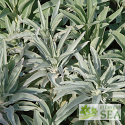 Salvia apiana
 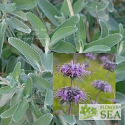 Salvia leucophylla
 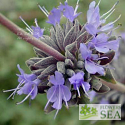 Salvia x 'Pozo Blue'
 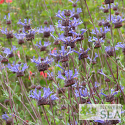 Salvia clevelandii 'Winnifred Gilman'
 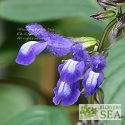 Salvia caudata 'El Cielo Blue'
 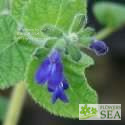 Salvia myriantha
 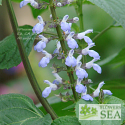 Salvia fallax
Comments
There are no comments yet.