
(Candelabra Spanish Sage) Tall, well-branched spikes display large two-tone blue flowers above a compact shrubby mass of attractive, furry white leaves. When in bloom, this compact, drought-resistant native of Spain will awe every visitor to your garden.
Candelabra Spanish Sage is a rare beauty that does well in warm, dry locations and blooms abundantly from mid-summer through fall. It does well as a compact container plant or can grow up to 6 feet tall in the ground. We also highly recommend it as a border plant and for cut-flower gardens.
Colors
RHS# 76D
RHS# 90C
RHS# 93B
RHS# 138B
RHS# 138B
Learn more about how we analyze plant colors
We based our analysis of this plant’s floral and foliar color on the internationally standardized color system published by the U.K.’s Royal Horticultural Society. Called the RHS Large Colour Charts, this publication is a boxed set of color swatches arranged in fans and containing all the colors that RHS has identified in horticulture. RHS gives each color a common name and code number.
Each swatch has a small hole punched into it. We place the swatch over a flower petal and compare the blossom’s color to that of the card. When using RHS colors to compare plants that you want to combine in a flowerbed, in bouquets or in some other manner, RHS says to view them indoors in north light. If you are matching our digital swatches to flowers already in your garden, pluck two or three fully open blossoms of each plant that requires analysis.
You may find that the plant you receive from FBTS varies somewhat in color from what appears in our color analysis or our photograph due to a number of factors, including:
- Variations in photographic colors based on lighting level at different times of day
- Differences in the resolution of digital screens
- Seasonal changes in plant color due to changes in temperature and plant cycle and
- pH or soil chemistry that varies from one locale to another and causes color shifts.
Finally, RHS notes that you shouldn’t attempt color matching when your eyes are fatigued.
Here are some guidelines for success with this plant in your garden.
Click on an individual icon for more detailed information.
Exposure

This plant needs or tolerates more than six hours of intense sunlight daily. Many Salvias only thrive in wide-open locations where they receive long hours of full sun. However, full-sun species sometimes tolerate a bit of partial shade. Or a Salvia that loves partial shade may be amenable to spending part of its time in full sun.
In general, this sun/shade adaptability shows up in Salvias that do best in cooler climates when grown in full sun and thrive in hot climates when partial shade is available. So full-sun Salvias sometimes are also categorized as partial-shade plants and vice versa.

This plant can handle extreme heat.
Full-sun Salvias that don’t like any shade are among the most heat tolerant. Heat-loving Salvias also are often drought tolerant. Moisture-conserving features, such as fuzzy leaves, help them stay perky at high temperatures.
Heat-tolerant Salvias are fine choices for western and southern exposures.
Garden Uses

The foliage and/or flowers of this plant add good flavor to cooked and baked foods.
Some types of perennial Culinary Sage are native to the Mediterranean. FBTS also grows culinary species from other parts of the world.
All kitchen Salvias are powerfully fragrant and flavorful, so remember that a tablespoon of finely chopped leaves may suffice to enliven a recipe.
Growing Habit

Plant hardiness Zones defined by the U.S. Department of Agriculture tell you the minimum temperatures a plant can withstand in your garden. The USDA divides the nation into winter climate areas from coldest (Zone 1) to warmest (Zone 11).
However, it is sometimes possible to grow a Zone 6 Salvia as a perennial in Zone 5 if you provide preferential care, such as winter mulching and a location sheltered from harsh winds. In contrast, a Zone 9 Salvia may act like a perennial in Zone 10 if given a bit of shade or extra water.

To create a harmonious landscape plan, it is important to consider the heights of individual plants.
Height also affects function. Short Salvias often make excellent ground covers that conserve soil moisture and discourage weeds while also brightening your yard. Medium-height Salvias, such as ones 36 inches tall, often are ideal border plants. A tall Salvia planted singly can highlight a landscape; multiple plantings can form an attractive screen.

By considering the width of a plant, you can determine how many to place in a row or what other plants to grow with it.
For example, a narrow, moderate-height Salvia may look good interplanted with bushier species, kind of like Mutt and Jeff.
In contrast, wide-spreading Salvias are economical for hiding lengths of wall and fence or for creating hedge-like divisions in a yard.

Plant this herbaceous species in the USDA Zones where it grows as a perennial, returning year after year.
After dying back to the ground at frost, herbaceous perennials emerge in the Spring with soft, new growth. A Salvia that is perennial in one region, may be an annual in another depending on local conditions, such as winter temperatures.
If you live in USDA Zone 5, for example, Salvias in our catalog cited as growing well in Zone 5 or lower will be perennial. Those cited as doing well in Zones 6 or higher may do well in Zone 5, but generally will act like annuals coming back from seed instead of the parent plant’s roots.
Water Needs

This plant needs regular watering based on what is appropriate to your local conditions.
In some extremely hot, arid climates, this may mean daily watering in Summer. Although many drought-resistant Salvias survive on little to no watering due to local rainfall and deep roots meeting their moisture needs, others need regular doses. The size and frequency of the dose depends on your climate.

In the right locale, this plant survives and thrives despite minimal summer water.
Drought resistance is an important characteristic of xeriscapic – dry landscape – plants, a category that includes a multitude of Salvias. Many low-water Salvias are native to parts of the world with little rainfall all year or regions where summers are dry and winters are wet.
Nevertheless, there are also drought-resistant Salvias for places such as Florida where winters are dry and summers are wet.
Blooming Season

This plant reaches peak bloom in Summer or flowers for much of the season.
Lots of Summer bloomers start flowering in Spring; others begin in Summer and keep up the show of color until frost.
There is a great deal of overlap in blooming seasons for Salvias.
Wildlife

Honeybees love this plant’s nectar. As a honeybee burrows down into a Salvia’s nectar-rich flowers to reach dinner, it accidentally gathers pollen and drops it on the stigma of that blossom or of ones on other nearby Salvias. Fertilization results in seed production.
By growing honeybee favorites, you attract these helpful pollinators to all your flowering plants and increase productivity

This plant attracts butterflies whether for nectar or as a host for their caterpillars. Some butterflies feed on a limited range of flowering plants and only lay eggs on one kind of host plant. Salvia nectar lures adult butterflies. Placing host plants, such as Milkweeds (Asclepias spp.), next to nectar plants builds butterfly habitat. In exchange, the butterflies improve fertility in your garden through pollination.

Unless local forage is in short supply, most deer likely will avoid this plant.
It appears that deer dislike Salvias, in general, due to their volatile oils that make the plants so fragrant and savory in cooking. However, the only completely deer-proof plants are the ones grown beyond reach.
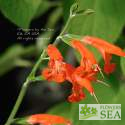
(Mystery Peruvian Sage) Airy spikes of fuzzy, bright orange-red flowers and grassy green calyxes mark this Peruvian sage as a mystery worth pursuing. Little is certain about its parentage.
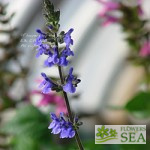
(Paula Flynn Sage) Floral spikes with whorls of bluish-purple flowers rise up amid the slightly relaxed, upright foliage of the mystery plant Salvia ‘Paula Flynn’. It features pebbly, deep green leaves with white, fuzzy undersides.
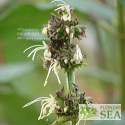
(Tree Sage)Whether you call it a shrub or a tree, Salvia arborsecens rises up to an impressive 12 feet tall and 5 feet wide. Commonly known as Sage Tree, this Salvia grows well in full sun, but prefers partial shade.
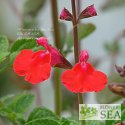
(Majestic Pink Sage) Very large richly colored hot pink blossoms and broad, glossy, intricately textured leaves are part of what makes Salvia x 'Majestic Pink' a standout. This is a complex hybrid involving several Salvia species from the ongoing breeding program at FBTS.
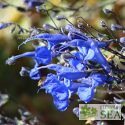
(Arrowleaf Sage) Brilliant royal blue flowers and unusual foliage attract the eye to Arrowleaf Sage. This large herbaceous perennial is found at elevations up to 10,500 feet in the Cordillera de los Andes of Chile, Ecuador and Peru.
Posted: Thursday, May 23, 2013
Synopsis:
Purples are cool yet quietly passionate. This includes African Violet 16-3520, a spring 2013 designer color created by the Pantone Corporation. Shades in the blue and purple color range are tranquil and soothing yet commanding, because they calm the garden. Here are a number of choices from our catalog that fashionably match Pantone's African Violet.
Read the Article