
(Hidalgo Roseleaf Sage) The earliest flowering, hardiest and strongest growing cultivar of its species, Hidalgo Roseleaf Sage starts blooming in June on the Northern California coast. It continues into spring, becoming more spectacular every day, unless cut down by hard frost. In our mild climate, it never stops blooming some years. In climates where it is marginally hardy it is a fall bloomer.
This Salvia involucrata requires a bit of high shade in the hottest climates. It also appreciates rich soil and regular watering. Hidalgo differs from Salvia involucrata 'Bethellii' in having stems that are more lax and an earlier bloom time.
Thanks go to North Carolina Salvia guru Richard Dufresne, who collected this plant in Mexico.
Growing up to 6 feet plus tall and 4 feet wide, it makes a fine screen or background planting, such as at the back of borders.
Use this sage where you want a bold, strong statement. We like to pair it with Salvia mexicana varieties for contrasting color and foliage and the ornamental grass Stipa arundinacea 'Sirocco.'
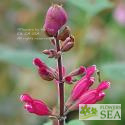
(Rosebud Pink Hybrid Sage) Protective, magenta pink, leaf-like bracts surround the buds of Salvia pulchella x involucrata like a hug, bursting open and eventually falling away as the fuzzy flowers blossom.
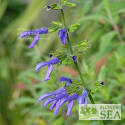
(Margie Griffith Sage) Salvia x 'Margie Griffith' is a big, purple-flowered beauty with glossy green, ribbed foliage. It feeds hummingbirds year round down South and on our coastal, Northern California farm where winter temperatures are moderate.
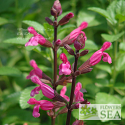
(Mulberry Jam Roseleaf Sage) Magenta flower buds burst into fuzzy, hot pink blossoms in this hybrid sage from the gardens of Betsy Clebsch, author of The New Book of Salvias.
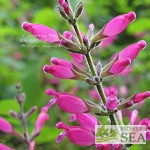
(Roseleaf Sage) A glorious bloomer, Roseleaf Sage starts producing hot pink blossoms in late summer and continues into spring -- growing more spectacular every day -- unless cut down to the ground by hard frost.
Send to friend

Posted: Monday, January 21, 2013
Synopsis:
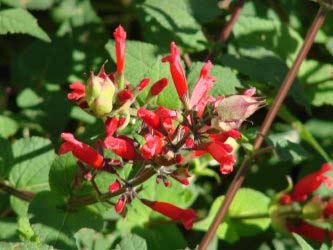
Flowers by the Sea grows Salvias that are already popular in the Southeast as well as others we would like to introduce to gardeners seeking thirsty flowering plants that can also adjust to dry spells. Many are fine choices for Florida hummingbird gardens. Our suggestions are organized into categories based on moisture tolerance – average and ample -- as well as sun requirements.
Read the Article
Posted: Saturday, November 26, 2011
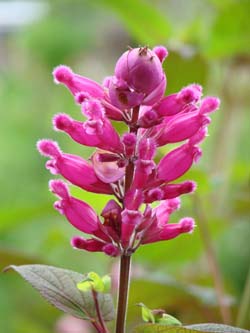
Synopsis: Some of the most dramatic Salvias bloom in the Winter. Most of these are from Southern Mexico, and are very well adapted to grow in Zone 9 gardens.
Read the Article
Posted: Sunday, June 28, 2015
Synopsis:
Differentiating between the plants in a closely related group can feel similar to being an outsider attending a large family reunion. Identifying who's who and how they are connected is a challenge. That's the way it is with Mexico's Roseleaf Sage (Salvia involucrata) Group, which is well loved by hummingbirds. FBTS Online Plant Nursery grows a number of species from this winter-blooming group.
Read the Article
Posted: Wednesday, October 8, 2014
Synopsis:
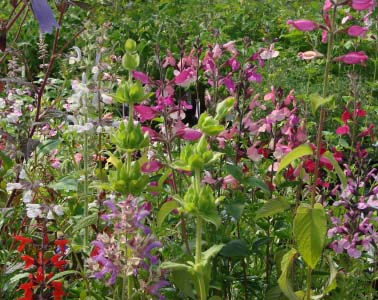
You don’t have to be a florist to create eye-catching designs with dramatic Salvias. By planting the right Salvias and complementary flowers in your garden as well as gaining a little knowledge about color combinations, well-balanced compositions, simple tools and cut-flower preservation, you are on your way.
Read the Article
Here are some guidelines for success with this plant in your garden.
Click on an individual icon for more detailed information.
Exposure

This plant needs or tolerates more than six hours of intense sunlight daily. Many Salvias only thrive in wide-open locations where they receive long hours of full sun. However, full-sun species sometimes tolerate a bit of partial shade. Or a Salvia that loves partial shade may be amenable to spending part of its time in full sun.
In general, this sun/shade adaptability shows up in Salvias that do best in cooler climates when grown in full sun and thrive in hot climates when partial shade is available. So full-sun Salvias sometimes are also categorized as partial-shade plants and vice versa.

This plant grows well in partial shade, such as the kind on the edge of woodlands or under deciduous trees with breaks in the foliage through which dappled sunlight penetrates. Many Salvias thrive in partial shade, including ones that spend part of their day in full sunlight. Some species need partial shade to overcome severe heat and dry soil.
Growing Habit

Plant hardiness Zones defined by the U.S. Department of Agriculture tell you the minimum temperatures a plant can withstand in your garden. The USDA divides the nation into winter climate areas from coldest (Zone 1) to warmest (Zone 11).
However, it is sometimes possible to grow a Zone 6 Salvia as a perennial in Zone 5 if you provide preferential care, such as winter mulching and a location sheltered from harsh winds. In contrast, a Zone 9 Salvia may act like a perennial in Zone 10 if given a bit of shade or extra water.

To create a harmonious landscape plan, it is important to consider the heights of individual plants.
Height also affects function. Short Salvias often make excellent ground covers that conserve soil moisture and discourage weeds while also brightening your yard. Medium-height Salvias, such as ones 36 inches tall, often are ideal border plants. A tall Salvia planted singly can highlight a landscape; multiple plantings can form an attractive screen.

By considering the width of a plant, you can determine how many to place in a row or what other plants to grow with it.
For example, a narrow, moderate-height Salvia may look good interplanted with bushier species, kind of like Mutt and Jeff.
In contrast, wide-spreading Salvias are economical for hiding lengths of wall and fence or for creating hedge-like divisions in a yard.

Shrubs are characterized not only by bushy foliage but also by woody stems.
Shrubby Salvias may be evergreen or deciduous. Some Winter-blooming, deciduous species lose their foliage during hot weather. Some Salvias, classified as subshrubs, have a combination of woody and tender, herbaceous growth.
Salvia shrubs range from tall, upright species to ground covers of short to moderate height. Their spread may match or exceed their height
Water Needs

This plant needs regular watering based on what is appropriate to your local conditions.
In some extremely hot, arid climates, this may mean daily watering in Summer. Although many drought-resistant Salvias survive on little to no watering due to local rainfall and deep roots meeting their moisture needs, others need regular doses. The size and frequency of the dose depends on your climate.
Blooming Season

This plant reaches peak bloom in Fall or flowers for much of the season.
It may begin flowering much earlier in the year. Bloom time for some Salvias lasts from Spring till first frost. Others begin flowering in Summer and continue into Fall. There are also Salvias that don’t bloom until late Fall and continue into Winter if grown in mild-Winter areas.
There is a great deal of overlap in blooming seasons for Salvias.

This plant flowers throughout Winter.
Many winter-blooming Salvias begin flowering in late Fall and continue on into Spring; there is a lot of overlap in blooming seasons for Salvias. Winter bloomers include evergreen as well as deciduous perennial Salvias.
Depending on type, they grow well in USDA Zones ranging from 8 to 11 with some tolerating the chill of Zone 7.
Wildlife

Unless local forage is in short supply, most deer likely will avoid this plant.
It appears that deer dislike Salvias, in general, due to their volatile oils that make the plants so fragrant and savory in cooking. However, the only completely deer-proof plants are the ones grown beyond reach.

Based on our experience and reports from customers, hummingbirds (Trochilidae spp.) love this plant.
Hummingbirds exist only in the Americas where their 300-plus species are particularly fond of the nectar in brightly colored Salvias from the Western Hemisphere. However, if favorites aren’t available, they dine on the nectar of most Salvias.
Hummingbirds repay thoughtful plantings by helping to pollinate your garden