
(Apricot Rose Hummingbird Sage) Large clusters of warm, apricot colored blossoms that age to a warm pink top the tall, thick flower spikes of this sage. This variety was selected from our warm apricot to peach seed strain and has truly unique coloration.
This plant's basal foliage mounds and spreads by underground runners. In favorable conditions, it can spread 3 feet across. The leaves are less lobed than those of the species, but are still sticky and richly scented.
This drought-tolerant, heat-resistant sage is adaptable to light conditions ranging from full sun to partial shade and grows particularly well in morning sun and afternoon shade. It blooms from winter into spring. As with other types of Salvia spathacea it likes the temperatures of USDA Zones 8 to 11.
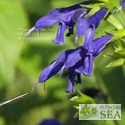
(Sapphire Blue Anise-Scented Sage) The large, sapphire blue flowers of this Anise-Scented Sage glow in the full-sun or partial-shade garden from summer into fall. Similar to Salvia guaranitica 'Blue Ensign', this is a somewhat taller variety of the water-loving species.
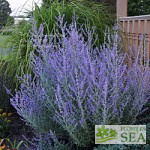
(Rocketman Russian Sage) A cloud of cool, lavender-blue flowers shoot upward from the fine-leafed, gray-green foliage of Salvia yangii ‘Rocketman’. This is a shorter, more upright form of Russian Sage, which was known botanically as Perovskia atriplicifolia until 2019 when the species was reclassified as a Salvia.
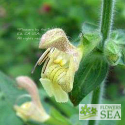
(Himalayan Cloud Sage) Nepal's Muktinath Valley -- a sacred site for Hindus and Buddhists -- is the place to go to see this majestically tall shade perennial in the wild. It grows at altitudes up to 14,000 feet and often emerges while the ground is still snowy.
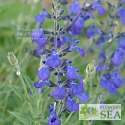
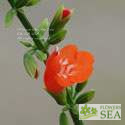
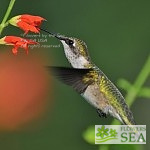
(Giant Brazilian Sage) Yes, this one is gigantic. The first season we grew this heat-tolerant sage, it reached 8 feet tall by July! Masses of small, red-orange, trumpet-shaped flowers attract hummingbirds and honeybees to long, upward curving flower spikes towering over heart-shaped foliage.
Here are some guidelines for success with this plant in your garden.
Click on an individual icon for more detailed information.
Exposure

This plant needs or tolerates more than six hours of intense sunlight daily. Many Salvias only thrive in wide-open locations where they receive long hours of full sun. However, full-sun species sometimes tolerate a bit of partial shade. Or a Salvia that loves partial shade may be amenable to spending part of its time in full sun.
In general, this sun/shade adaptability shows up in Salvias that do best in cooler climates when grown in full sun and thrive in hot climates when partial shade is available. So full-sun Salvias sometimes are also categorized as partial-shade plants and vice versa.

This plant grows well in partial shade, such as the kind on the edge of woodlands or under deciduous trees with breaks in the foliage through which dappled sunlight penetrates. Many Salvias thrive in partial shade, including ones that spend part of their day in full sunlight. Some species need partial shade to overcome severe heat and dry soil.
Garden Uses

This plant grows well in an outdoor container, such as on a patio.
Some containerized Salvias leaf out and flower year after year following a period of dormancy. Annuals in containers may die back and appear to grow again when they reseed.
During extreme heat, check the soil in container plantings once or twice daily to be sure it doesn't completely dry out. Feel its surface for coolness, then gently poke a finger into the soil to check for dryness.

When growing a fragrance garden, this is a good selection.
Most Salvias have pleasant scents, but some are intoxicatingly fragrant. Some are short enough for border plantings that release a heady perfume as you brush against them when strolling along a path. Other taller types make good landscape highlights, particularly by doors where their scent can be enjoyed on entry and exit.
Growing Habit

Plant hardiness Zones defined by the U.S. Department of Agriculture tell you the minimum temperatures a plant can withstand in your garden. The USDA divides the nation into winter climate areas from coldest (Zone 1) to warmest (Zone 11).
However, it is sometimes possible to grow a Zone 6 Salvia as a perennial in Zone 5 if you provide preferential care, such as winter mulching and a location sheltered from harsh winds. In contrast, a Zone 9 Salvia may act like a perennial in Zone 10 if given a bit of shade or extra water.

To create a harmonious landscape plan, it is important to consider the heights of individual plants.
Height also affects function. Short Salvias often make excellent ground covers that conserve soil moisture and discourage weeds while also brightening your yard. Medium-height Salvias, such as ones 36 inches tall, often are ideal border plants. A tall Salvia planted singly can highlight a landscape; multiple plantings can form an attractive screen.

By considering the width of a plant, you can determine how many to place in a row or what other plants to grow with it.
For example, a narrow, moderate-height Salvia may look good interplanted with bushier species, kind of like Mutt and Jeff.
In contrast, wide-spreading Salvias are economical for hiding lengths of wall and fence or for creating hedge-like divisions in a yard.

Try this plant to control weeds, limit erosion, conserve soil moisture and add color to your landscape.
From short perennials that form dense mats spread by underground stoloniferous roots to thickets of medium-size shrubs, many Salvias are efficient ground covers.

Plant this herbaceous species in the USDA Zones where it grows as a perennial, returning year after year.
After dying back to the ground at frost, herbaceous perennials emerge in the Spring with soft, new growth. A Salvia that is perennial in one region, may be an annual in another depending on local conditions, such as winter temperatures.
If you live in USDA Zone 5, for example, Salvias in our catalog cited as growing well in Zone 5 or lower will be perennial. Those cited as doing well in Zones 6 or higher may do well in Zone 5, but generally will act like annuals coming back from seed instead of the parent plant’s roots.
Water Needs

This plant needs regular watering based on what is appropriate to your local conditions.
In some extremely hot, arid climates, this may mean daily watering in Summer. Although many drought-resistant Salvias survive on little to no watering due to local rainfall and deep roots meeting their moisture needs, others need regular doses. The size and frequency of the dose depends on your climate.

In the right locale, this plant survives and thrives despite minimal summer water.
Drought resistance is an important characteristic of xeriscapic – dry landscape – plants, a category that includes a multitude of Salvias. Many low-water Salvias are native to parts of the world with little rainfall all year or regions where summers are dry and winters are wet.
Nevertheless, there are also drought-resistant Salvias for places such as Florida where winters are dry and summers are wet.
Blooming Season

This plant reaches peak bloom during Spring or flowers for much of the season.
However, it may begin flowering sooner. Some Spring-blooming Salvias begin flowering in Winter; others start in Spring, keep producing color through summer and may continue on into autumn and first frost. Still others flower only in Spring.
There is a great deal of overlap in blooming seasons for Salvias.

This plant reaches peak bloom in Summer or flowers for much of the season.
Lots of Summer bloomers start flowering in Spring; others begin in Summer and keep up the show of color until frost.
There is a great deal of overlap in blooming seasons for Salvias.

This plant flowers throughout Winter.
Many winter-blooming Salvias begin flowering in late Fall and continue on into Spring; there is a lot of overlap in blooming seasons for Salvias. Winter bloomers include evergreen as well as deciduous perennial Salvias.
Depending on type, they grow well in USDA Zones ranging from 8 to 11 with some tolerating the chill of Zone 7.
Wildlife

Unless local forage is in short supply, most deer likely will avoid this plant.
It appears that deer dislike Salvias, in general, due to their volatile oils that make the plants so fragrant and savory in cooking. However, the only completely deer-proof plants are the ones grown beyond reach.

Based on our experience and reports from customers, hummingbirds (Trochilidae spp.) love this plant.
Hummingbirds exist only in the Americas where their 300-plus species are particularly fond of the nectar in brightly colored Salvias from the Western Hemisphere. However, if favorites aren’t available, they dine on the nectar of most Salvias.
Hummingbirds repay thoughtful plantings by helping to pollinate your garden