
Advanced Search
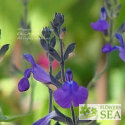
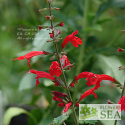
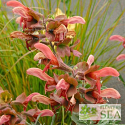
(Cedar Sage) Scarlet flowers abound on this small, mounding, woodland sage that is native to Texas, Arizona and Northern Mexico. Grow it as a small scale groundcover or mix it with other shade-loving sages in a perennial border or along a path.
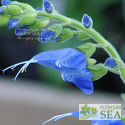
(Tall Big Leaf Sage) Cobalt blue flowers seem to float in airy clusters on 12-inch-tall branching spikes above the bright green, velvety foliage of this South American native. Up to 5-feet tall, tidy and upright in habit, this sage makes a fine background or border planting when massed.
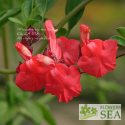
(Big Orange Autumn Sage) Standout color is the big draw for this large growing Autumn Sage. Collected in the mountains of Northern Mexico, it grows well in a wide range of climates, including the hot dry Southwest and the cool moist Pacific Northwest. A difficult color to capture in a photo, it is well described as a warm orange with a scarlet overlay.
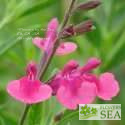
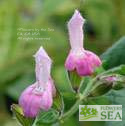
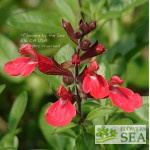
(Lipstick Autumn Sage) Similar to a little bit of lipstick on a pretty face, the rosy flowers of this hardy, heat-tolerant sage add a finishing touch to a perennial Salvia border. The creamy pinkish-red blossoms have a contrasting white throat and are cupped by rosy brown calexes on long spikes.
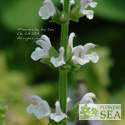
(Iranian Sage) Mixed in with short perennials that bloom over a wide range of seasons, Salvia staminea makes an attractive contribution to short borders during its summer bloom time. Our strain has dark bracts surrounding pastel white-to-blue-to-lavender flowers. The dark green, branching foliage has oblong to oval-shaped leaves.
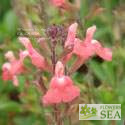
(Salmon Autumn Sage) Creamy salmon-colored flowers with white throats make this elegant Autumn Sage perfect for a pastel garden or as a cooling color in a mixed sage border. Bloom time is spring into fall for this petite Salvia greggii native to the American Southwest and Mexico.
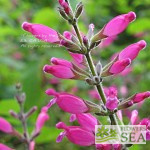
(Roseleaf Sage) A glorious bloomer, Roseleaf Sage starts producing hot pink blossoms in late summer and continues into spring -- growing more spectacular every day -- unless cut down to the ground by hard frost.
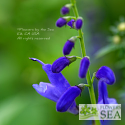
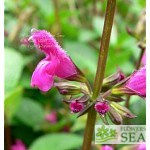
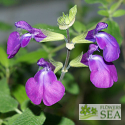
(Christine Yeo Sage) A chance hybrid of two Mexican sages --Salvia microphylla and S. chamaedryoides -- Christine Yeo Sage is long blooming and features deep purple flowers with white eyes.
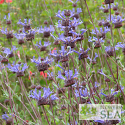
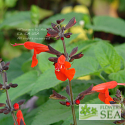
(Forest Fire Tropical Sage) Butterflies love the abundant, fire engine red flowers of this mostly annual sage. It's a popular cultivar of one of the first Salvias used for ornamental purposes -- Tropical Sage. The flowers are dramatically framed by reddish black bracts.
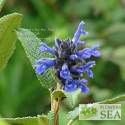
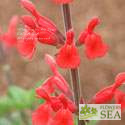
(Vermilion Bluffs® Mexican Sage) The brilliant red flowers of Vermilion Bluffs bloom abundantly from August to October. This variety of the Mexican native Salvia darcyi is cold hardy to Zone 5b at altitudes up to 5,500 feet.
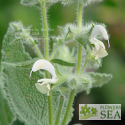
(Dominican Sage) Native to Israel, Jordan, Lebanon and Syria, this candelabra-shaped, perennial sage may have inspired the design of the menorah, (Exodus 37:17). It is a tough, drought-resistant plant with silver-haired foliage and bright white flowers that seem to blaze.
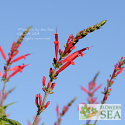
(Pineapple Sage) An indispensable fall-blooming addition to the garden, this tender perennial is, perhaps, the best of all hummingbird plants. When in bloom, it is covered in 3-inch-long red flowers.
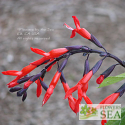
(Big Mexican Scarlet Sage) This heavily blooming Salvia from Mexico has heart-shaped leaves and spectacular flower spikes up to 18 inches long from winter through spring. The blooms are bright red-orange with rich purple-black calyxes.
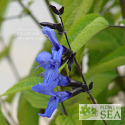
(Black & Blue Anise-Scented Sage) Hummingbirds go crazy for this variety of Salvia guaranitica. The black calyxes contrast handsomely with the rich, royal blue flowers. We highly recommend the much improved Salvia BODACIOUS 'Rhythm and Blues' as an alternative to this older variety.
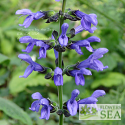
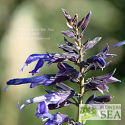
(Van Remsen's Anise-Scented Sage) Big and beautiful, this Anise-Scented Sage grows up to 7 feet tall in rich soil and has lavender-to-purple flowers. In our garden, it blossoms from late spring to fall, attracting both honeybees and hummingbirds.
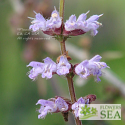
(Japanese Woodland Sage or Shu Wei Cao) This short, lavender-flowered, ornamental sage has purple-to-green foliage. In Asia, this woodland plant has long been an important medicinal herb, used in the treatment of conditions such as diabetes.
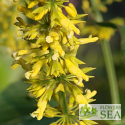
(Forysthia Sage) This statuesque perennial grows up to 10 feet tall, but spreads only 3 feet wide. It is a late bloomer from Mexico's Sierra Madre Oriental mountains where it grows at altitudes of 4,000 to 5,000 feet and tolerates temperatures down to 20 degrees F.
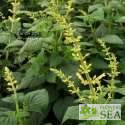
(Red Stem Forsythia Sage) The thick, square, red stems of this variety of Forsythia Sage make it conspicuously different from the species and from everything else in your garden. Its jointed stalks look a little like rhubarb gone mad!
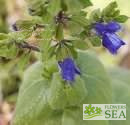
(Little Mexican Sage) This low-growing sage is a shrub in its warmest zones and a perennial in the cooler ones. It's just right for small spaces or tiny gardens. Short and compact, its flowers are similar to but smaller than those of S. mexicana 'Limelight'.
(Red Sage, Chinese Sage, Dan-shen) The bright red, finger-like roots of Salvia miltiorrhiza have a long history in traditional Chinese herbal medicine.
The following terms were added to your search to help improve the result. Click here to exclude these extra terms from the search.
- border, borders
Common terms in this search: coahuila sage such pretty little shrub its beet-purple flowers will amaze from june until autumn frost coahuilla ideal ground cover sunny border plant inches tall wide small shiny deep green leaves clothe densely branched mounding beauty comes mountains mexico aside full sun watering well-drained soil undemanding find most attractive when kept lean side gentle shearing after blooming keeps tidy tight