
Advanced Search
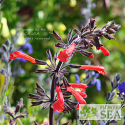
(Venezuelan Red Sage) Purple stems and calyxes so dark that they almost look black contrast dramatically with the deep red-orange flowers of this South American beauty. This tall, spectacular sage has been in cultivation for decades but is still rare in gardens. We'd like to see that change.
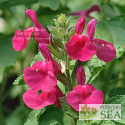
(St. Charles Day Mountain Sage) Especially in spring and fall, masses of red-violet flowers bloom amid the silvery green foliage of Salvia microphylla 'San Carlos Festival'. Put this one into the "must have" column.
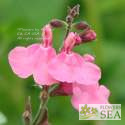
(Scorching Pink Mountain Sage) Compact and small, this Mountain Sage is another fine groundcover for Southern California, the Southwest and Texas. Similar to Salvia microphylla 'Heatwave Glimmer', it not only survives but thrives in extreme heat.
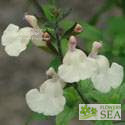
(Glimmering White Mountain Sage) Heatwave Glimmer isn't a mirage. It is a Salvia microphylla that tolerates extremely hot climates as well as cooler regions. It doesn't just survive; it thrives in the heat of Southern California, the Southwest and Texas.
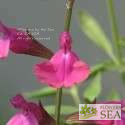
(Plum Wine Autumn Sage) Frilly, lavender-tinged, pink flowers with a pretty white dot at the throat make this another outstanding contribution from North Carolina nurseryman Richard Dufresne.
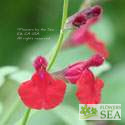
(Cherry Red Mountain Sage) This isn't just another red sage. Brilliant cherry-red flowers with dark purple bracts and cold weather tolerance to USDA Zone 6 make this a valuable landscaping plant.
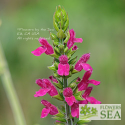
(Shaggy Chiapas Sage) This is a sweetheart! Glowing magenta flowers lure the eye as well as hummingbirds to this heat-tolerant sage. It begins blooming in late summer where weather is warm and in fall where it is cooler.
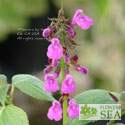
(Bolivian Mountain Sage) Neon lilac-pink flowers light up the handsome, furry foliage of this distinctive sage from high in the Andes cloud forests. Its large, textured leaves have dark, velvety purple undersides. Unhappy in dry heat, this is a very showy plant for humid climates.
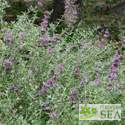
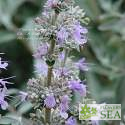
(Gayle Nielson Hybrid Sage) Whorl-like clusters of violet-blue flowers on slender stems as well as its height and width indicate that Gayle Nielson Hybrid Sage is related to some form of Salvia clevelandii.
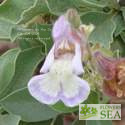
(Pilgram's Rest Pink Sage) Spring into summer, this heat-tolerant sage from South Africa produces lilac and white blossoms with profuse, fragrant, gray foliage. It's the burgundy calyxes, which turn a rusty pink after the flowers blossom, that give this sage part of its common name.
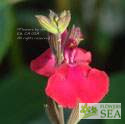
(Heatwave Red Mountain Sage) Compact and small, this Mountain Sage is another fine groundcover for Southern California, the Southwest and Texas. Similar to Salvia microphylla 'Heatwave Glimmer', it not only survives but thrives in extreme heat.
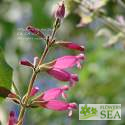
(Nuevo Leon Downy Sage) From the high mountains of Nuevo Leon, Mexico. This unusual variety has very large flowers in loose clusters. Early to bloom and more cold tolerant than other Downy Sage varieties, it is ideal for gardens on the edge of it's climatic adaptability.
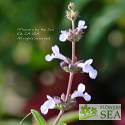
(Pacific Blue Sage) Whorls of deep lavender-blue flowers contrast brightly against the dark maroon stems of this likely hybrid of Salvia brandegeei and Salvia munzii.
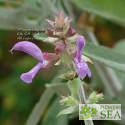
(Wooly Canary Island Sage) The pale magenta, parrot-beak flowers of this sage, supported by deeper magenta bracts, heat up the landscape. But when you get close, it may be the velvety texture of the foliage that makes you sigh.
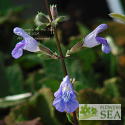
(Turkish Tea Sage) Sometimes an attractive plant is also medically powerful. That's true of the lavender flowered Salvia aucheri, which has strong white beelines. This Turkish native is consumed as an ingredient in teas used as folk remedies for many problems, including abdominal bloating and infections.
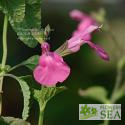
(Rosie O'Grady Mountain Sage) Honeybees and hummingbirds love the large, bright pink flowers of Salvia microphylla 'Rosie O'Grady', a drought-resistant sage. Dense and fragrant, it's large, glossy green leaves are veined and have finely serrated edges. This is a lush choice for dry gardens.
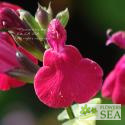
(Killer Cranberry Mountain Sage) Masses of magenta flowers on tall spikes lure honeybees and hummingbirds to the rich nectar of Salvia microphylla 'Killer Cranberry'. Its prolific flowers are a killer attraction for people too.
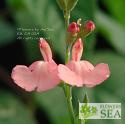
(Dyson's Orangy Pink Hybrid Jame Sage) Many Salvia x jamensis hybrids remind gardeners of sunrise, such as Dyson's Orangy Pink. Light green calyxes faintly striped with red cup its luminous pale salmon pink blossoms with creamy throats.
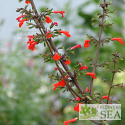
(Tall Red Colombian Sage) Salvia rubescens subsp. dolichothrix may tower over your head when in full bloom with its creamy red trumpet blossoms and dark calyxes. Its leaves are large and attractively textured.
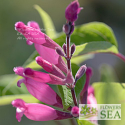
(Boutin Roseleaf Sage) Boutin means "button" in French. Perhaps the creamy, mulberry pink flowers of Salvia involucrata 'Boutin' looked cute as buttons to whoever named the cultivar.
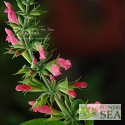
(Giant Karwinski's Sage) San Francisco arborist and gardener extraordinaire Ted Kipping developed this tower of creamy pinkalicious power that hummingbirds love. It's lush with bright green leaves that are large, pebbly and hairy on the underside.
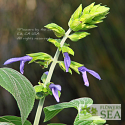
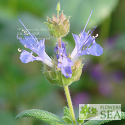
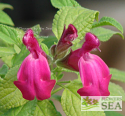
(Alice's Sage) We have John Fisher of Australia to thank for this fascinating intraspecific cross, which he named after his daughter. It really looks to be intermediate between the parents, and the fragrance of the leaves is divine.
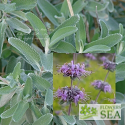
(Spreading California Purple Sage or Spreading California Gray Sage) Songbirds love this California native as do honeybees and hummingbirds. This Salvia leucophylla clone was collected in 1982 by Dr. Dale Smith of University of California Santa Barbara (UCSB #82152) at Point Sal near Santa Barbara.
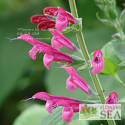
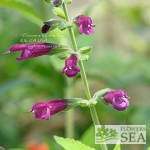
(Envy Hybrid Sage) A natural hybrid found in Peru and Bolivia, the parentage of this special variety is at this point unknown. The uniquely colored flowers are abundant all season long, and the hummingbirds love it.
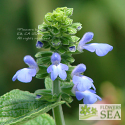
(Elk Blue Hard Leaf Sage) Soft baby blue & white flowers in abundance coupled with strong growth make this an ideal new variety for hummingbird gardeners. the specific epitaph, durifolia, means hard leaf. We don't find the leaf exactly hard but it is lovely and durable.
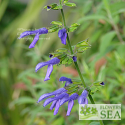
(Margie Griffith Sage) Salvia x 'Margie Griffith' is a big, purple-flowered beauty with glossy green, ribbed foliage. It feeds hummingbirds year round down South and on our coastal, Northern California farm where winter temperatures are moderate.
The following terms were added to your search to help improve the result. Click here to exclude these extra terms from the search.
- sub-shrub, shrub, sub-shrubs
Common terms in this search: venezuelan red sage purple stems calyxes dark they almost look black contrast dramatically deep red-orange flowers south american beauty tall spectacular has been cultivation decades but still rare gardens we'd like see change heavily textured leaves large growing about inches long wide hairy which gives foliage silvery appearance flower spikes grow feet robust shrub requires full sun partial shade average