
Advanced Search
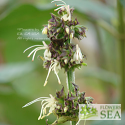
(Tree Sage)Whether you call it a shrub or a tree, Salvia arborsecens rises up to an impressive 12 feet tall and 5 feet wide. Commonly known as Sage Tree, this Salvia grows well in full sun, but prefers partial shade.
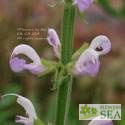

(Anatolian Cushion Sage) Rising up only 6 to 8 inches, this is a pixie-sized sage that loves gritty soils. It is perfect for dry gardens with gritty soils in USDA Zones 5 to 9. In fact, it seems to love the colder zones best. We think it is particularly fond of frozen ground in winter, because that helps keep its roots from getting too damp.
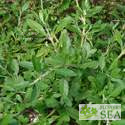
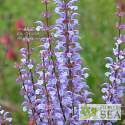
(Red Veined Sage) In 1827, John Wilkes referred to Salvia haematodes as "Bloody Sage" in his Encyclopaedia Londinensis, Volume 22. This might seem mysterious when first viewing the sage's upright yet somewhat relaxed spikes of whorled, violet-colored flowers.
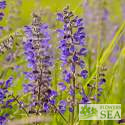
(Indigo Meadow Sage) When massed, this European sage compels attention during summer with its upright, foot-long spikes of deep violet-blue flowers and hairy, gray-green, basal foliage.
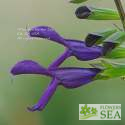
(Betsy's Choice Sage) Life and botany have their beautiful mysteries. Betsy's Choice Sage is one of them. We aren't certain of the parentage or history of this tall, attractive, fast-growing sage. However, we are certain that we love its long, royal purple flowers. Hummingbirds do as well.
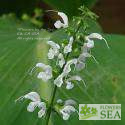
(White Meadow Sage) Whorls of pure white flowers shaped like parrot beaks rise on tall spikes from the wrinkly, basal foliage of Salvia pratensis 'Swan Lake'. The large, mid-green leaves have attractively serrated edges.
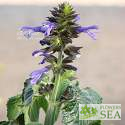
(Lolly's Mexican Sage) Our variety of Salvia mexicana 'Lolly' is the tall kind growing up to about shoulder height. A shorter form is often called "Lollie Jackson" or "Lolly Jackson." Who or what the mysterious Lolly is remains unclear.
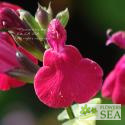
(Killer Cranberry Mountain Sage) Masses of magenta flowers on tall spikes lure honeybees and hummingbirds to the rich nectar of Salvia microphylla 'Killer Cranberry'. Its prolific flowers are a killer attraction for people too.
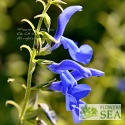
(Giant Gentian Sage) What makes Salvia patens 'De Flores Gigantes' truly giant is the size of its true blue flowers. However, this variety from Argentina is tall as well.
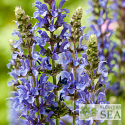
(Blau Hügel Meadow Sage) When in bloom, petite Salvia nemorosa 'Blue Hill' more than doubles in height. Its tall, spike-like racemes of violet-blue flowers are so dense and compact that this woodland sage is sometimes called "Blue Mound."
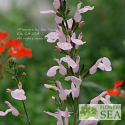
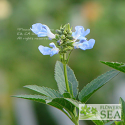
(Dwarf Bog Sage) Intense sky blue flowers with white beelines are set against mid-green foliage in this dwarf Bog Sage that is about half as tall and wide as its parent species when in bloom.
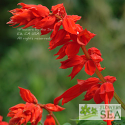
(Faye Chapel Scarlet Sage) A vivid red, the drooping blossoms of this sturdy, long flowering Salvia are large and numerous. Use it singly as a dramatic garden accent or container plant; mass it for a stunning effect. This is an heirloom plant from the Atlantic Coast, where it has been grown as a hummingbird plant for decades.
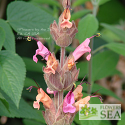
(Apricot Rose Hummingbird Sage) Large clusters of warm, apricot colored blossoms that age to a warm pink top the tall, thick flower spikes of this sage. This variety was selected from our warm apricot to peach seed strain and has truly unique coloration.
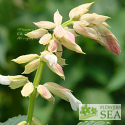
(Elk White Scarlet Sage) The first tall white Salvia splendens variety, this new introduction from Flowers by the Sea is vigorous and free flowering all season long.
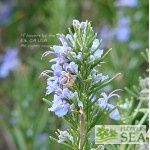
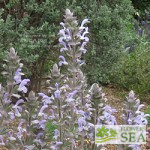
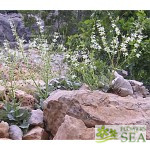
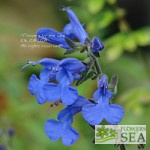
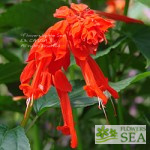
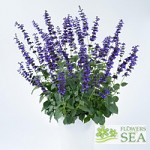
(Magic Wand Sage) Salvia x ‘Magic Wand’ is perky with vertical spikes of long blooming, rich purple flowers and dense, mid-green foliage. Overall, it reminds us of Salvia x ‘Big Blue’, but has smaller flowers and usually doesn’t grow as tall.
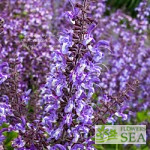
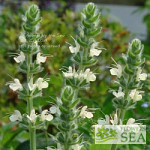
(Austrian Sage) Tall spikes of large, pale yellow flowers rise up from Salvia austriaca’s basal rosette of impressively large leaves. Deeply lobed, like the edges of a lacy collar, the leaves are broader and longer than those of any Salvia we have ever grown.
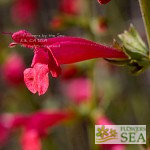
(Crimson Sage) Abundant and long blooming, the bright pink to red tubular flowers of Salvia henryi attract hummingbirds and form a pretty contrast with fuzzy, silvery foliage. This is a long blooming sage that is made for gritty soils, such as sandy loam.
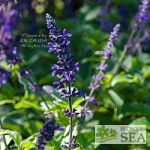
(Indigo Spires Sage) Salvia ‘Indigo Spires’ gains its name from long spikes of rich, deep purple-blue flowers that stand tall and also arch and twist gracefully. It is a chance hybrid discovered growing amid Salvia farinacea and Salvia longispicata at Southern California's Huntington Gardens.
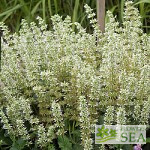
(White Lilac Sage) Dense whorls of white, instead of lavender, blossoms cover tall flower spikes of this long-blooming perennial that tolerates both heat and cold. They rise up from fragrant, mint-green foliage.
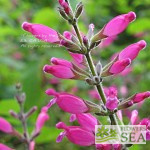
(Roseleaf Sage) A glorious bloomer, Roseleaf Sage starts producing hot pink blossoms in late summer and continues into spring -- growing more spectacular every day -- unless cut down to the ground by hard frost.
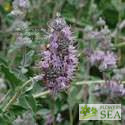
(Bee's Bliss Sage) If you are looking for a California native sage to use as a groundcover, Bee's Bliss is a fine choice. Low-growing, widespreading and colorful, it is ideal for choking weeds.
The following terms were added to your search to help improve the result. Click here to exclude these extra terms from the search.
- foot, tall
Common terms in this search: whether call shrub tree arborescens rises impressive feet tall wide commonly known sage grows well full sun but prefers partial shade size plant more than its floral display main attraction cream yellow tiny each flower has long graceful anthers extend far beyond corolla foliage bright green forest lance-shaped leaves works screen background planting rich well-drained soil also looks handsome shrubby