
Advanced Search
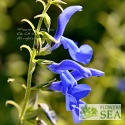
(Giant Gentian Sage) What makes Salvia patens 'De Flores Gigantes' truly giant is the size of its true blue flowers. However, this variety from Argentina is tall as well.
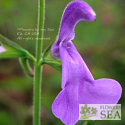
(Dorset Lavender Gentian Sage) Large, deep lavender flowers shaped like parrot beaks make Salvia patens 'Chilcombe' distinctive in the Gentian Sage group, which is dominated by true blues.
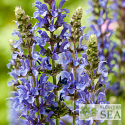
(Blau Hügel Meadow Sage) When in bloom, petite Salvia nemorosa 'Blue Hill' more than doubles in height. Its tall, spike-like racemes of violet-blue flowers are so dense and compact that this woodland sage is sometimes called "Blue Mound."
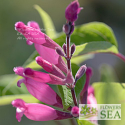
(Boutin Roseleaf Sage) Boutin means "button" in French. Perhaps the creamy, mulberry pink flowers of Salvia involucrata 'Boutin' looked cute as buttons to whoever named the cultivar.
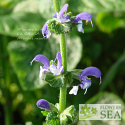
(Bi-Color Meadow Sage or Meadow Clary Sage) Exceptionally cold tolerant, Salvia pratensis 'Proud Mary' is our own seed-grown strain of a plant identical to the patented S. pratensis 'Madeline'.
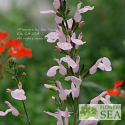
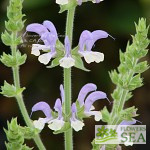
(Golden Leaf Sage) A tinge of gold in its fuzzy, pebbled foliage gives Salvia chrysophylla its common name. Abundant lavender flowers with pale cream lower lips make it stand out in the landscape.

(Dwarf Bog Sage) Intense sky blue flowers with white beelines are set against mid-green foliage in this dwarf Bog Sage that is about half as tall and wide as its parent species when in bloom.
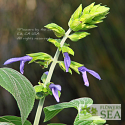
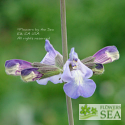
(Puna Sage) The deep violet-blue flowered Salvia calolophos has white beelines and oblong, mid-green leaves. It is a high-altitude native of northern Argentina.
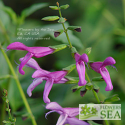
(Jean's Jewel Sage) An entirely new color in the Salvia guaranitica group, this chance hybrid with violet-pink blossoms was discovered by Kathleen Navarez at Cabrillo College in Aptos, California. It is compact, freely flowering and spreads gently via rhizomes.
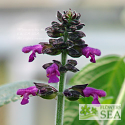
(Columbian Mountain Sage) Deep purple bracts support the small, lighter purple flowers of Salvia cuatrecasana, which is a rare Colombian sage. White beelines mark the flowers of this long-blooming shrub, which is a hummingbird favorite.
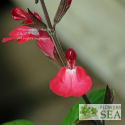
(Elk Bright Eyes Sage) Dark green and red calyxes support the raspberry-red flowers of Salvia x 'Elk Bright Eyes'. The pink throats of the blossoms are topped with white beelines, or eyes. This is a unique and eyecatching color.
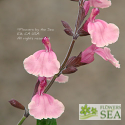
(Elk Peach Flambe Sage) Pale pink-to-peach edges surround the petals of Salvia x 'Elk Peach Flambe' like hints of petticoats. The deep maroon calyxes holding the flowers add drama to this small sage.
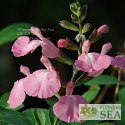
(Elk Pink Cloud Sage) Abounding with clusters of large, soft pink flowers on spreading branches, Salvia x 'Elk Pink Cloud' has a fluffy, cumulonimbus look when spilling over the edges of a hanging basket
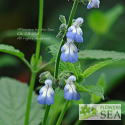
(River Sage) Native to partially shaded streamsides in Argentina and Bolivia, this is one of the few Salvia species that can tolerate wet soil. It makes a fine filler plant in a group of other partial shade growers, its wirey thin stems sending up floral displays here and there, much to the gardener's delight.
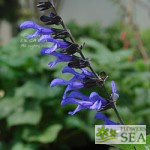
(Rhythm and Blues Anise-Scented Sage) The large, deep bluish-purple flowers of Salvia BODACIOUS ‘Rhythm and Blues’ are shaped like parrot beaks and supported by black calyxes. It's foliage smells sweet with a hint of licorice. It's superior to the old standby Salvia guaranitica 'Black and Blue'.
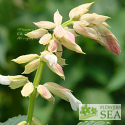
(Elk White Scarlet Sage) The first tall white Salvia splendens variety, this new introduction from Flowers by the Sea is vigorous and free flowering all season long.
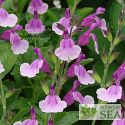
(Elk Chantily Lace Jame Sage) What color are the flowers of this FBTS introduction? Lavender? Periwinkle? Taffy? Yes to all for this hard to describe but easy to love plant.
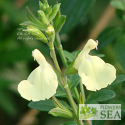
(Elk Lemon Sorbet Jame Sage) Unlike any other we have ever seen, this pale yellow flower seems at times to have a green tint. The foliege is typical of the Salvia microphylla parent - mid sized, round and textured. It is very different in flower and foliege from our popular variety 'Elk Lemon Lite'.
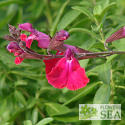
(Elk Crimson King Jame Sage) Sometimes words fail us when trying to describe a unique new color. Definitely red, but with a clear blue overlay and a blue eye. Featuring masses of flowers that delight pollinators, this FBTS introduction is new for 2017.
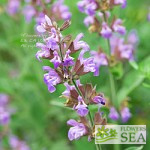
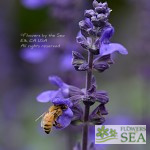
(Big Blue Sage) This new seed-grown strain can best be described as a much improved Indigo Spires Sage. It has deep blue-green, corrugated leaves and lots of deep blue flower spikes that bloom from summer till the end of the growing season.
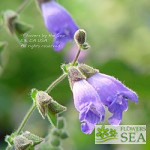
(Himalayan Sage or Kashmir Sage) The word "hians" in Salvia hians means "gaping" and refers to the hanging lip of this sage's flowers, which bloom from late spring through early fall. This may or may not the "true" species as it is described, hence the term aff or affnis in the name, which indicates that this plant is related to, has an affinity to, but is not identical to Salvia hians.
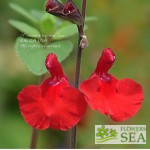
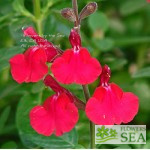
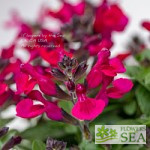
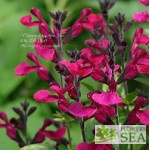
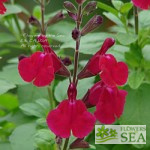
(Elk Raspberry Moose Sage) The deep raspberry flowers of this Salvia x Jamensis look good enough to eat, like spoonfuls of a silky, mouthwatering mousse dessert. Yet the 'moose' in its name isn't a misspelling. It refers to flowers that are larger than normal for a Jame Sage.
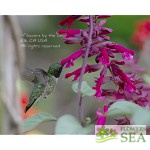
(Skyscraper Dark Purple Sage) Hummingbirds love Salvia x ‘Skyscraper Dark Purple’, which is brand new for 2019, blooms bountifully in shade, and is outstanding as a container plant.
(Russell’s Whorled Sage) Although similar in appearance to Salvia verticillata, which is commonly called Lilac Sage, Salvia russellii has whorls of smaller, purplish-blue flowers supported by deep purple calyxes.
The following terms were added to your search to help improve the result. Click here to exclude these extra terms from the search.
- sages
Common terms in this search: giant gentian sage what makes patens flores gigantes truly size its true blue flowers however variety from argentina tall well other big pluses about extended bloom time far greater heat tolerance than any species hot climates prefers partial shade requires rich well-drained soil thrives average supplemental watering based local rainfall sages began captivating mid- century following their discovery mexico around