
Advanced Search
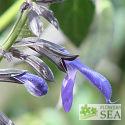
(Door of the Fox Mexican Sage) Purplish foliage contrasts attractively with the violet-to-purple flowers of this big sage, which grows 6 feet tall and 4 feet wide. Bloom time is autumn. This darkly dramatic Mexican Sage makes a particularly attractive entryway accent.
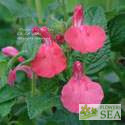
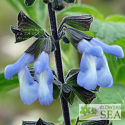
(Confused Argentine Sage) Similar in many ways to the indispensable garden favorites of the Anise Scented Sage (Salvia guaranitica spp.) group, this plant is a perfect companion for its better known cousin.
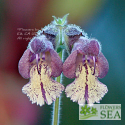
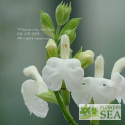
(Texas Wedding White Autumn Sage) This is our best white-flowered Autumn Sage. It is compact, hardy and blooms abundantly. We love it as a contrast to the generally bright colors of its group. Texas Wedding seems to always be blooming, with massive displays in spring and fall.
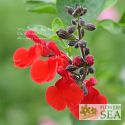
(Red Velvet Mountain Sage) This is one of the most intense red-flowering variety of Mountain Sage we grow. Medium-sized flowers are profuse on this large, vigorous plant -- particularly in spring and fall. Dark stems and calyxes intensify the plant's drama along with glossy green foliage.
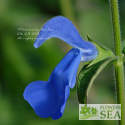
(Oxford Blue Gentian Sage) Only Salvia patens 'Blue Angel' comes close to the hard-to-believe, rich gentian blue of this sage from Mexico. Oxford Blue also grows taller and spreads wider than Blue Angel.
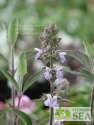
(Kellerman's Sage) Rare in the United States, this wooly leafed, upright shrub comes from Southern Mexico and Guatemala. Mid-size, powder-blue flowers bloom on its long, airy stems from summer through winter in mild climates. It's lovely in mixed, drought-resistant plantings.
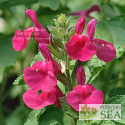
(St. Charles Day Mountain Sage) Especially in spring and fall, masses of red-violet flowers bloom amid the silvery green foliage of Salvia microphylla 'San Carlos Festival'. Put this one into the "must have" column.
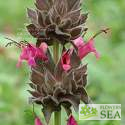
(Giant Hummingbird Sage or Pitcher Sage) Powerline Pink is the largest variety of Salvia spathacea that we grow. Its large, dark pink flowers are surrounded by bracts so furry that they look silvery.
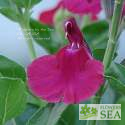
(Elk Pomegranate Autumn Sage) We're proud to say that this is an FBTS cultivar. It is one of the finest dark flowered, compact Autumn Sage varieties we have seen. Its extraordinarily large, raspberry blossoms bloom from spring into fall.
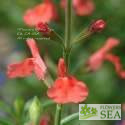
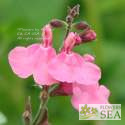
(Scorching Pink Mountain Sage) Compact and small, this Mountain Sage is another fine groundcover for Southern California, the Southwest and Texas. Similar to Salvia microphylla 'Heatwave Glimmer', it not only survives but thrives in extreme heat.
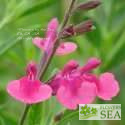
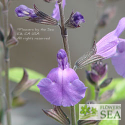
(Azure Hybrid Sage) Despite its name, the flowers of this tiny hybrid aren't really blue. They are a light purple. Due to its size, long bloom time, heat tolerance and drought resistance, Salvia x 'Mesa Azure' is a fine groundcover for areas where summers are hot and dry.
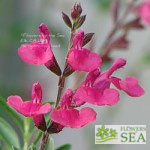
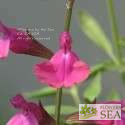
(Plum Wine Autumn Sage) Frilly, lavender-tinged, pink flowers with a pretty white dot at the throat make this another outstanding contribution from North Carolina nurseryman Richard Dufresne.
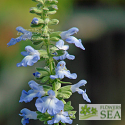
(Big Pitcher Sage) As its scientific name indicates, this sage has very large flowers. They are almost two-tone, changing from deep violet to a light blue or white at their base where they are cupped by dusky purple calyxes.
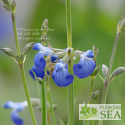
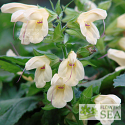
(Kyushu Woodland Sage) We are in love with this short forest sage from Kyushu, Japan. Its clusters of large creamy flowers pale as fresh-churned butter begin blooming in September. Even when not blooming, its foliage is showy in a shady garden.
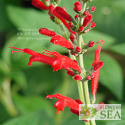
(Cinnabar Sage) Think of this plant as Pineapple Sage on steroids. It grows 5 feet tall and can be twice as wide and bursts with large, intensely red, furry flowers all winter. Our overwintering hummingbirds adore it. This cinnabar-red sage is hard to forget once you see it in full bloom.
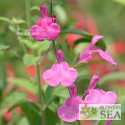
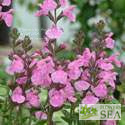
(Trinity Mountain Sage) Heat and drought tolerant, this Salvia microphylla is native to Northeastern Mexico where summers are dry and temperatures can rise to more than 100 degrees F. It can survive winter temperatures down to 0 degrees.
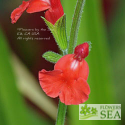
(Big Orange Mountain Sage) When temperatures are cooler in spring and fall, the persimmon-orange flowers of this large Mountain Sage darken. Gray-green foliage, bright green calyxes and reddish-green stems add to the plant's fascinating look, which mixes well with yellows and blues.
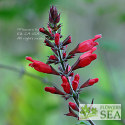
(Mister Jules Hybrid Sage) Long, dark, velvety stems contrast dramatically with the deep red flowers of this hybrid, spreading sage from the University of California, Santa Cruz, Arboretum. The parent plants are Mexican Winter Sage (S. holwayi) -- a superior, spreading groundcover or sprawling shrub -- and Cardinal Sage (S. fulgens), which is an upright shrub with large, deep red flowers.
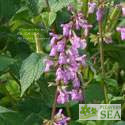
(Temascaltepec Sage) In full bloom, which is all year in mild climates, this mid-sized Salvia has far more flowers than foliage. Each 1/2-inch-long, bright pink bloom has two dark pink/purple spots and a pair of white stripes. The small, slightly furry leaves add to its soft, pleasing look.
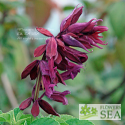
(Sao Borja Scarlet Sage) Three-inch-long, smokey purple blossoms that bloom from spring to fall are a major clue that this heat-tolerant perennial is not your grandmother's Scarlet Sage.
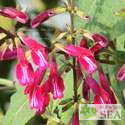
(Violet Calyx Sage) Here's another abundantly blooming sage from the cloud forest slopes of Chiapas, Mexico. Violet beelines mark the lower lip of the crimson blossoms, which are so numerous that it can be difficult to see the foliage at times.
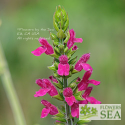
(Shaggy Chiapas Sage) This is a sweetheart! Glowing magenta flowers lure the eye as well as hummingbirds to this heat-tolerant sage. It begins blooming in late summer where weather is warm and in fall where it is cooler.
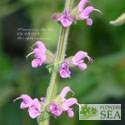
(Royal Crimson Distinction Woodland Sage) Grown for hundreds of years in cottage gardens throughout the world, Salvia nemorosa was described by Carl Linneaus in 1762. This variety's large flower spikes bloom a dark violet-crimson, then age to a softer pink.
The following terms were added to your search to help improve the result. Click here to exclude these extra terms from the search.
- shade, shades
Common terms in this search: door fox mexican sage purplish foliage contrasts attractively violet-to-purple flowers big which grows feet tall wide bloom time autumn darkly dramatic makes particularly attractive entryway accent zorra spanish female well slang prostitute one heard puerto collected front brothel how wrong were upon learning north carolina specialist rich dufresne found state hidalgo asked him about its naming location along what still