
Advanced Search
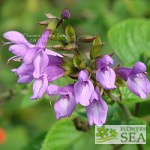
(COOL Lavender Blush Anise Scented Sage) Dusky green and red-edged bracts surround the pale-throated lavender blossoms of Salvia COOL Lavender Blush. It's a magnet for hummingbirds.
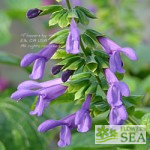
(COOL Lavender Mist Anise Scented Sage) Bright green bracts and rich lavender blossoms sing in Salvia COOL Lavender Mist. Hummingbirds keep this bountiful bloomer buzzing.
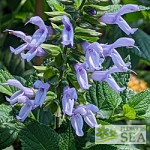
(COOL Periwinkle Anise-Scented Sage) Dusky green bracts cup the lavender-blue blossoms of Salvia COOL Periwinkle that attract hummingbirds. The fragrance of its bright green leaves may remind you of licorice.
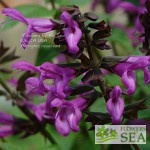
(COOL Fandango Anise Scented Sage) A combination of dark, rosy bracts and magenta blossoms make Salvia COOL Fandango dance. It’s vivid, floriferous, and a hummingbird favorite.
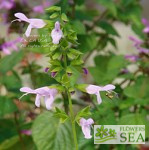
(COOL Pink Lace Anise Scented Sage) Cheerful Kelly-green bracts surround magenta buds that bloom into the soft pink yet magenta-tinged flowers of Salvia COOL Pink Lace. Its bright green leaves have a licorice-like fragrance.
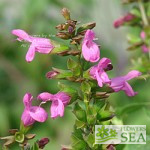
(COOL Wild Strawberry Anise Scented Sage) Prepare yourself for a heaping serving of large flowers the delicious color of strawberry ice cream when you plant Salvia COOL Wild Strawberry.
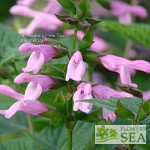
(COOL Shocking Pink Anise-Scented Sage) Dusky green bracts support the pastel magenta blossoms of Salvia COOL Shocking Pink. It’s a hummingbird favorite with bright green, fragrant foliage that may remind you of licorice.
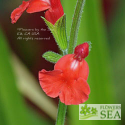
(Big Orange Mountain Sage) When temperatures are cooler in spring and fall, the persimmon-orange flowers of this large Mountain Sage darken. Gray-green foliage, bright green calyxes and reddish-green stems add to the plant's fascinating look, which mixes well with yellows and blues.
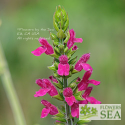
(Shaggy Chiapas Sage) This is a sweetheart! Glowing magenta flowers lure the eye as well as hummingbirds to this heat-tolerant sage. It begins blooming in late summer where weather is warm and in fall where it is cooler.
(Recurved Sage) At home in the shady, high-altitude cloud forests of Southern Mexico and Guatemala, this large, lush sage requires a warm, moist climate. In cool climates, it can handle full sun. However, partial shade is a better choice in most gardens.
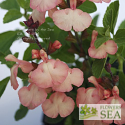
(Glow Peach Mountain Sage) Long blooming Salvia microphylla 'Heatwave Glow' produces prolific quantities of soft peach-to-apricot blossoms along with dense, mid-green foliage.
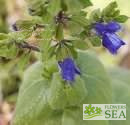
(Little Mexican Sage) This low-growing sage is a shrub in its warmest zones and a perennial in the cooler ones. It's just right for small spaces or tiny gardens. Short and compact, its flowers are similar to but smaller than those of S. mexicana 'Limelight'.
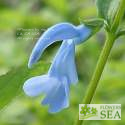
(Cambridge Blue Gentian Sage) Cambridge Blue is one of the most famous varieties of Salvia patens, which was discovered in Central Mexico in 1838. Its powder blue flowers are delightful and cooling in the landscape.
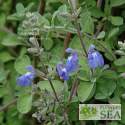
(Snowflake Sage) Wiry, trailing stems of small white leaves make this plant look like fresh snowfall. Numerous, small, sky blue flowers with prominent bee lines further add to the cooling look. This dry-garden plant is native to the mountains of the Chihuahuan desert of North Central Mexico.
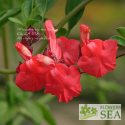
(Big Orange Autumn Sage) Standout color is the big draw for this large growing Autumn Sage. Collected in the mountains of Northern Mexico, it grows well in a wide range of climates, including the hot dry Southwest and the cool moist Pacific Northwest. A difficult color to capture in a photo, it is well described as a warm orange with a scarlet overlay.
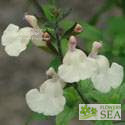
(Glimmering White Mountain Sage) Heatwave Glimmer isn't a mirage. It is a Salvia microphylla that tolerates extremely hot climates as well as cooler regions. It doesn't just survive; it thrives in the heat of Southern California, the Southwest and Texas.
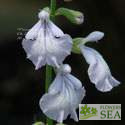
(Heart Leaf Sage) From the rich plains of Northern Argentina comes this delicate looking sage with heart-shaped leaves and pale blue flowers so perfect they seem to be molded in wax. Although a slow grower that requires good garden culture, this Salvia is exquisite.
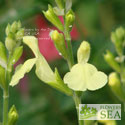
(Elk Lemon Light Jame Sage) We are proud to offer this luminescent, pure yellow Salvia x jamensis -- a color breakthrough from our own breeding program. The bright, light blossoms cool the landscape similar to white flowers, but with colorful impact. The glossy green leaves are quite small - a very attractive and distinctive characteristic.
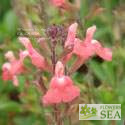
(Salmon Autumn Sage) Creamy salmon-colored flowers with white throats make this elegant Autumn Sage perfect for a pastel garden or as a cooling color in a mixed sage border. Bloom time is spring into fall for this petite Salvia greggii native to the American Southwest and Mexico.
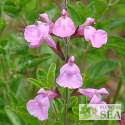
(Glittering Pink Mountain Sage) Mountain Sage (Salvia microphylla) handles hot climates as well as cooler coastal regions. It withstands the high temperatures of Southern California, the Southwest and Texas.
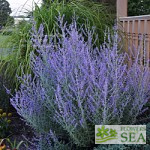
(Rocketman Russian Sage) A cloud of cool, lavender-blue flowers shoot upward from the fine-leafed, gray-green foliage of Salvia yangii ‘Rocketman’. This is a shorter, more upright form of Russian Sage, which was known botanically as Perovskia atriplicifolia until 2019 when the species was reclassified as a Salvia.
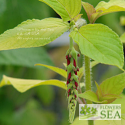

(Cayman Island Sage) Compact and intensely fragrant, this shrubby sage is excellent for containers or the edge of a pathway. Small blue and white flowers mass about its densely branched foliage. It loves rich, moist soil and warm weather.
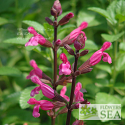
(Mulberry Jam Roseleaf Sage) Magenta flower buds burst into fuzzy, hot pink blossoms in this hybrid sage from the gardens of Betsy Clebsch, author of The New Book of Salvias.
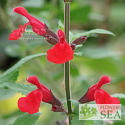
(John Whittlesey Sage) Hardy, vigorous and long blooming, John Whittlesey Sage is a hybrid of D'Arcy's Sage (Salvia darcyi) -- a native of Mexico -- and Mountain Sage (S. microphylla), which is native to the American Southwest and Mexico.
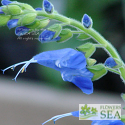
(Creeping Big Leaf Sage) Cobalt blue flowers float in airy clusters above the giant, velvety, green leaves of this South American native. Short and spreading by woody rhizomes, this is an ideal groundcover. As a bold statement in a container, it has no equal.
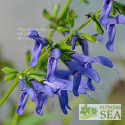
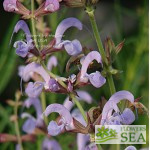
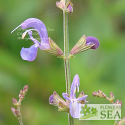
(Blue Turkish Sage) Large velvety gray-green to white leaves in loose rosettes give this sage a distinctive look as does the celestial violet-blue of its flowers. The blossoms seem much too large for this short sage and its thin, candelabra-branched flower spikes.
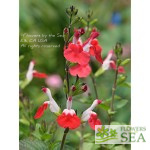
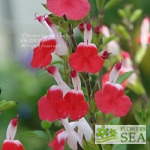
(Hot Lips Sage) What a winner for fascinating flowers! Salvia microphylla ‘Hot Lips’ is a native of Mexico that produces a combination of solid red, solid white, and bicolor red and white blossoms all on the same plant and sometimes at the same time.
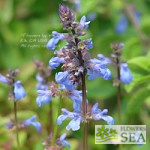
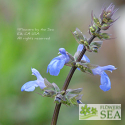
(Ground Ivy Sage) Native to Central Mexico's highlands, this creeping perennial grows at a altitudes of more than 10,000 feet and can handle some chill. Its common name comes from its scalloped yellow-green leaves, which resemble Ground Ivy or Glechoma.
The following terms were added to your search to help improve the result. Click here to exclude these extra terms from the search.
- cool, cooler, cools
Results for cooling from the blog
| Ask Mr. Sage |
| 1. Ask Mr. Sage: Best Time to Plant Drought Resistant CA Natives |
| Drought resistant California native sages thrive when planted in fall. It's easier for roots to become established when soil is warm, air temperatures are cooler and precipitation is increasing. Ask Mr. Sage is a regular feature of the Everything Salvias Blog and is based on calls and emails from customers. |
| 2. Six Herbaceous Chinese Salvias for Shady Summer-to-Fall Bloom |
| Creating a flower garden in partial shade is not as challenging as planting in full shade, yet it requires selecting the right plants. Herbaceous Chinese Salvias can form a harmoniously composed partial-shade garden that soothe the eye with calming pastels. |
| Xeric Choices |
| 3. Xeric Choices: Xeriscape Basics & Ancient Ideas |
| To create a successful xeriscape garden, planning and design are essential. Planning helps you make better choices, which saves time, money and effort as well as water. A little bit of wisdom from ancient Native American practices doesn’t hurt either. While soil improvement is always helpful, it should be moderate for xeric Salvias, such as Autumn Sage and Mealy Cup Sage. Finally, pruning and thinning, strategic groupings of plants for frugal watering and mulching for protection against severe heat or winter chill all were key to ancient Southwestern agriculture as well as modern xeriscaping. |
Common terms in this search: cool lavender blush anise scented sage dusky green red-edged bracts surround pale-throated blossoms its magnet hummingbirds sweet fragrance bright leaves may remind licorice product our plant development program part fbts collection guaranitica hybrids unlike deep saturated blue purple flowers most sages series features surprising pastels native argentina brazil paraguay uruguay wild grows edge streams forest clearings similar other adaptable from