
(Furman's Red Autumn Sage) Selected by noted Texas plantsman W.A. Furman in the 1970s, this hardy Texas native is beautiful and tough withstanding heat, drought and freezing winters. Its flowers, which bloom spring through fall, are a rich, saturated red bordering on magenta.
Averaging growth up to 3 feet tall, but never wider than 2 feet, it adds zing to borders in spaces between lower growing plants such as Salvia x jamensis. It harmonizes well with pastel types of S. x jamensis.
Heat tolerant and drought resistant, Furman's Red is a good background planting or tall groundcover in a dry garden. It readily attracts honeybees and butterflies, but not deer. This is one of the best choices for extreme conditions, seeming to thrive on hot, dry days and cold nights. Plant it in full sun or partial shade in any well-drained soil.
Send to friend
Posted: Thursday, February 4, 2016
Synopsis:
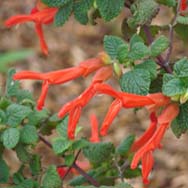
A little bit of a hot color warms the garden landscape; a lot sizzles. Salvias that are red, orange, salmon and intensely pink make eyes snap to attention when grown en masse or as highlights complementing cool-colored perennials. Texas is home to a number of tough, drought-resistant species that can make a garden look hot. In this article, Flowers by the Sea focuses on varieties to light up southern landscapes.
Read the Article
Posted: Friday, May 16, 2014
Synopsis:
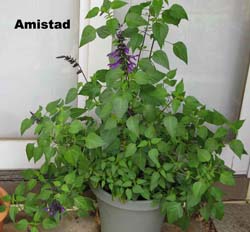
Portraits in Gardening is a new ongoing feature in the Everything Salvias blog of Flowers by the Sea. This first post focuses on Dave and Eleanor Holland's Northern California garden, which beckons bees, butterflies and hummingbirds due to its abundance of sages.
Read the Article
Posted: Sunday, June 25, 2017
Synopsis:
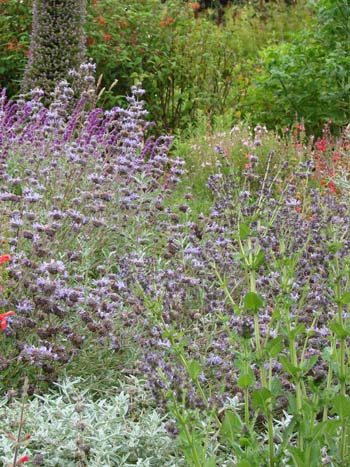
July is a time of lush plant growth and pollinator activity in Salvia gardens. Aside from weeding and taking breaks to watch bees, hummingbirds and other small wildlife, there are many tasks to attend to in the sage garden during July. Flowers by the Sea Farm and Online Nursery offers a list of midsummer tasks to keep your garden buzzing and blooming.
Read the Article
Posted: Saturday, February 13, 2016
Synopsis:
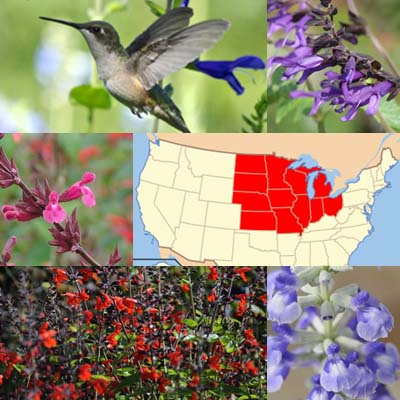
Severe winter chill and summer heat coupled with extreme humidity are challenges that gardeners face in the Midwest. Many Salvias are excellent choices as long-blooming annuals in the region while others -- ones that can withstand cold winters -- are reliable perennials. Flowers by the Sea Online Plant Nursery explains the confusing Midwest boundaries from Ohio west to Kansas and North Dakota south to Missouri. It talks about the range of USDA Plant Hardiness Zones in the region and the kinds of sages that grow best there.
Read the Article
Posted: Friday, March 20, 2015
Synopsis:
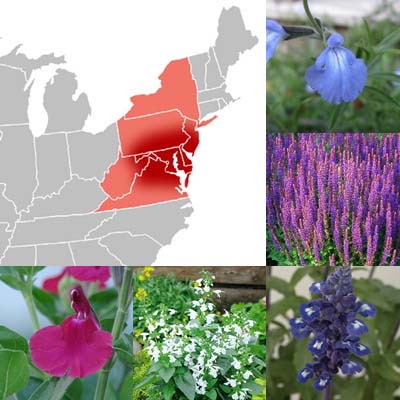
Outside of its cities, the Mid-Atlantic can be described as an overwhelmingly green place. If you love the Mid-Atlantic, you revel in its verdant landscape. However, if you aren't reveling in the predictable planting choices you see in neighbor's yards, it may be time to expand your horizons by exploring the Salvia genus. Flowers by the Sea discusses the boundaries, USDA Plant Hardiness Zones and Salvia choices for the region.
Read the Article
Colors
RHS# 53C
RHS# 46B
RHS# 59C
RHS# 187B
RHS# 143A
Learn more about how we analyze plant colors
We based our analysis of this plant’s floral and foliar color on the internationally standardized color system published by the U.K.’s Royal Horticultural Society. Called the RHS Large Colour Charts, this publication is a boxed set of color swatches arranged in fans and containing all the colors that RHS has identified in horticulture. RHS gives each color a common name and code number.
Each swatch has a small hole punched into it. We place the swatch over a flower petal and compare the blossom’s color to that of the card. When using RHS colors to compare plants that you want to combine in a flowerbed, in bouquets or in some other manner, RHS says to view them indoors in north light. If you are matching our digital swatches to flowers already in your garden, pluck two or three fully open blossoms of each plant that requires analysis.
You may find that the plant you receive from FBTS varies somewhat in color from what appears in our color analysis or our photograph due to a number of factors, including:
- Variations in photographic colors based on lighting level at different times of day
- Differences in the resolution of digital screens
- Seasonal changes in plant color due to changes in temperature and plant cycle and
- pH or soil chemistry that varies from one locale to another and causes color shifts.
Finally, RHS notes that you shouldn’t attempt color matching when your eyes are fatigued.
Here are some guidelines for success with this plant in your garden.
Click on an individual icon for more detailed information.
Exposure

This plant needs or tolerates more than six hours of intense sunlight daily. Many Salvias only thrive in wide-open locations where they receive long hours of full sun. However, full-sun species sometimes tolerate a bit of partial shade. Or a Salvia that loves partial shade may be amenable to spending part of its time in full sun.
In general, this sun/shade adaptability shows up in Salvias that do best in cooler climates when grown in full sun and thrive in hot climates when partial shade is available. So full-sun Salvias sometimes are also categorized as partial-shade plants and vice versa.

This plant can handle extreme heat.
Full-sun Salvias that don’t like any shade are among the most heat tolerant. Heat-loving Salvias also are often drought tolerant. Moisture-conserving features, such as fuzzy leaves, help them stay perky at high temperatures.
Heat-tolerant Salvias are fine choices for western and southern exposures.

This plant grows well in partial shade, such as the kind on the edge of woodlands or under deciduous trees with breaks in the foliage through which dappled sunlight penetrates. Many Salvias thrive in partial shade, including ones that spend part of their day in full sunlight. Some species need partial shade to overcome severe heat and dry soil.
Garden Uses

This plant grows well in an outdoor container, such as on a patio.
Some containerized Salvias leaf out and flower year after year following a period of dormancy. Annuals in containers may die back and appear to grow again when they reseed.
During extreme heat, check the soil in container plantings once or twice daily to be sure it doesn't completely dry out. Feel its surface for coolness, then gently poke a finger into the soil to check for dryness.
Growing Habit

Plant hardiness Zones defined by the U.S. Department of Agriculture tell you the minimum temperatures a plant can withstand in your garden. The USDA divides the nation into winter climate areas from coldest (Zone 1) to warmest (Zone 11).
However, it is sometimes possible to grow a Zone 6 Salvia as a perennial in Zone 5 if you provide preferential care, such as winter mulching and a location sheltered from harsh winds. In contrast, a Zone 9 Salvia may act like a perennial in Zone 10 if given a bit of shade or extra water.

To create a harmonious landscape plan, it is important to consider the heights of individual plants.
Height also affects function. Short Salvias often make excellent ground covers that conserve soil moisture and discourage weeds while also brightening your yard. Medium-height Salvias, such as ones 36 inches tall, often are ideal border plants. A tall Salvia planted singly can highlight a landscape; multiple plantings can form an attractive screen.

By considering the width of a plant, you can determine how many to place in a row or what other plants to grow with it.
For example, a narrow, moderate-height Salvia may look good interplanted with bushier species, kind of like Mutt and Jeff.
In contrast, wide-spreading Salvias are economical for hiding lengths of wall and fence or for creating hedge-like divisions in a yard.

Try this plant to control weeds, limit erosion, conserve soil moisture and add color to your landscape.
From short perennials that form dense mats spread by underground stoloniferous roots to thickets of medium-size shrubs, many Salvias are efficient ground covers.

Plant this herbaceous species in the USDA Zones where it grows as a perennial, returning year after year.
After dying back to the ground at frost, herbaceous perennials emerge in the Spring with soft, new growth. A Salvia that is perennial in one region, may be an annual in another depending on local conditions, such as winter temperatures.
If you live in USDA Zone 5, for example, Salvias in our catalog cited as growing well in Zone 5 or lower will be perennial. Those cited as doing well in Zones 6 or higher may do well in Zone 5, but generally will act like annuals coming back from seed instead of the parent plant’s roots.
Water Needs

This plant needs regular watering based on what is appropriate to your local conditions.
In some extremely hot, arid climates, this may mean daily watering in Summer. Although many drought-resistant Salvias survive on little to no watering due to local rainfall and deep roots meeting their moisture needs, others need regular doses. The size and frequency of the dose depends on your climate.

In the right locale, this plant survives and thrives despite minimal summer water.
Drought resistance is an important characteristic of xeriscapic – dry landscape – plants, a category that includes a multitude of Salvias. Many low-water Salvias are native to parts of the world with little rainfall all year or regions where summers are dry and winters are wet.
Nevertheless, there are also drought-resistant Salvias for places such as Florida where winters are dry and summers are wet.
Blooming Season

This plant reaches peak bloom in Fall or flowers for much of the season.
It may begin flowering much earlier in the year. Bloom time for some Salvias lasts from Spring till first frost. Others begin flowering in Summer and continue into Fall. There are also Salvias that don’t bloom until late Fall and continue into Winter if grown in mild-Winter areas.
There is a great deal of overlap in blooming seasons for Salvias.

This plant reaches peak bloom during Spring or flowers for much of the season.
However, it may begin flowering sooner. Some Spring-blooming Salvias begin flowering in Winter; others start in Spring, keep producing color through summer and may continue on into autumn and first frost. Still others flower only in Spring.
There is a great deal of overlap in blooming seasons for Salvias.

This plant reaches peak bloom in Summer or flowers for much of the season.
Lots of Summer bloomers start flowering in Spring; others begin in Summer and keep up the show of color until frost.
There is a great deal of overlap in blooming seasons for Salvias.
Wildlife

Honeybees love this plant’s nectar. As a honeybee burrows down into a Salvia’s nectar-rich flowers to reach dinner, it accidentally gathers pollen and drops it on the stigma of that blossom or of ones on other nearby Salvias. Fertilization results in seed production.
By growing honeybee favorites, you attract these helpful pollinators to all your flowering plants and increase productivity

This plant attracts butterflies whether for nectar or as a host for their caterpillars. Some butterflies feed on a limited range of flowering plants and only lay eggs on one kind of host plant. Salvia nectar lures adult butterflies. Placing host plants, such as Milkweeds (Asclepias spp.), next to nectar plants builds butterfly habitat. In exchange, the butterflies improve fertility in your garden through pollination.

Unless local forage is in short supply, most deer likely will avoid this plant.
It appears that deer dislike Salvias, in general, due to their volatile oils that make the plants so fragrant and savory in cooking. However, the only completely deer-proof plants are the ones grown beyond reach.