
Advanced Search
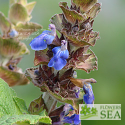
(Michoacan Blue Sage) This unusual and distinctive Mexican sage grows from tuberous roots. It is compact and decidedly vertical with strong, square, winged stems that rocket upward and are topped with clusters of rich blue flowers in large rosy bracts come autumn.
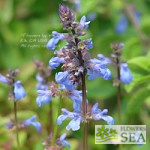
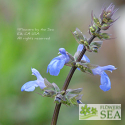
(Ground Ivy Sage) Native to Central Mexico's highlands, this creeping perennial grows at a altitudes of more than 10,000 feet and can handle some chill. Its common name comes from its scalloped yellow-green leaves, which resemble Ground Ivy or Glechoma.
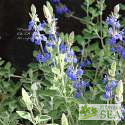
(Marine Blue Sage) The name and origin of this fine cultivar has long been in dispute. It may be a clone or hybrid of the Mexican plant Salvia chamaedryoides var.isochroma. It is one of the prettiest, strongest sages we grow.
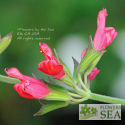
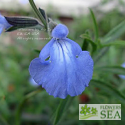
(Prairie Sage) Native to a large part of the central United States, this perennial Salvia is a beloved wildflower, delighting us with large cerulean blue flowers. Hummingbirds and butterflies love it as well.
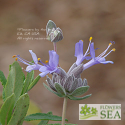
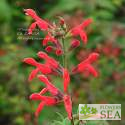
(Cardinal Sage) Aptly named for its cardinal red, 2-inch-long flowers that glisten in the autumn sun, this full-sun sage blooms from fall into winter. Hummingbirds love it, but deer resist its charms. Growing up to 5 feet tall, it makes a fine herbaceous border plant or shrubby screen.
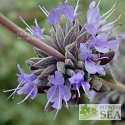
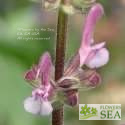
(Jerusalem Sage) This lovely herbaceous perennial is native to Cyprus, Israel, Jordan, Lebanon, Syria, and the West Bank. Its clear pink flowers change at times to a pink highlighted with violet lines and dots. Prominent glandular hairs on the buds, bracts and floral stems exude a fragrance that is delightful on a warm day.
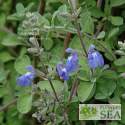
(Snowflake Sage) Wiry, trailing stems of small white leaves make this plant look like fresh snowfall. Numerous, small, sky blue flowers with prominent bee lines further add to the cooling look. This dry-garden plant is native to the mountains of the Chihuahuan desert of North Central Mexico.
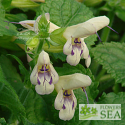
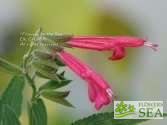
(Hybrid Bolivian Sage) This naturally occurring hybrid is a Bolivian native related to S. orbignaei and S. haenkei. Prettier than its parents, it has large, profuse, long-blooming flowers that are dark pink.
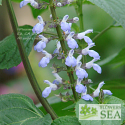
(Silly Mexican Sage) Also known as Salvia roscida, this close relative of Blue Sky Mexican Sage (Salvia caudata 'El Cielo Blue') has thousands of deep violet-blue flowers with prominent white bee lines.
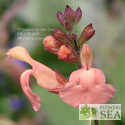
(Yellow Pink Hybrid Jame Sage) Dusty pink with pale yellow throats, the bicolor pastels of this Salvia x jamensis are especially charming up close. 'Yellow Pink' is a compact sage with tiny, smooth foliage.
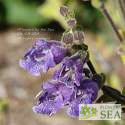
(Dan-shen Gansu) Growing into a large basal rosette of leaves measuring up to 3 feet across, Salvia przewalskii var. mandarinorum is known for its handsome foliage.
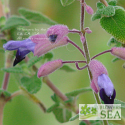
(Pine Mountain Sage) Small but numerous, violet and deep purple flowers surrounded by pink bracts are sprinkled throughout this well-branched,shrubby sage like confections. This is one of the showiest Salvias we grow.
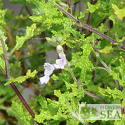

(Autumn Purple Sage) Small but numerous, the flowers of this sage are a variable shade of light purple that is unlike any other we grow. Native to Southern Mexico and Guatemala, this shrub regularly grows up to 5 feet tall (or taller) and 4 feet wide.
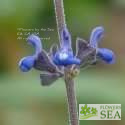
(Chilean Mountain Sage) Formerly known as S. gillesii, this delicate-looking sage with dramatically deep blue flowers is robust in the garden. Its branches are draped with wooly grey foliage featuring rounded, toothed leaves that are pleasantly scented.
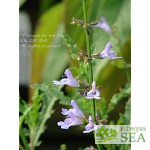
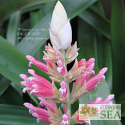
(Pink & White Wagner's Sage) Instead of pink, leaf-life bracts, this variety of Wagner's Sage has white bracts surrounding the hot pink flowers. It blooms from November to March on our coastal Northern California farm where it feeds Anna's hummingbirds all winter long.
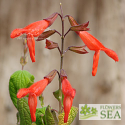
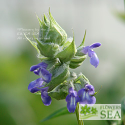
(Purple Stem Sage) Deep purple stems and cobalt blue flowers with pronounced white beelines and dusky gray calyxes cause this sage to command attention.
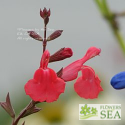
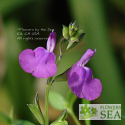
(Royal Purple Autumn Sage) Salvia muelleri is related both to Autumn Sage (S. greggii) and Mountain Sage (S. microphylla), which are closely related species.
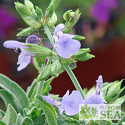
(Greek Sage) Most of the dried culinary sage sold in the United States is Greek Sage. Frescoes on the island of Crete dated to 1400 BC depict this plant, which was used by the Phoenicians and Greeks for cooking and medicine. It is an ancient and beloved friend of mankind.
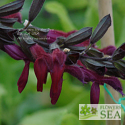
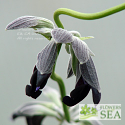
(Purple Bract Peruvian Sage or Concolor Sage) Similar to its wild relative, Peruvian Sage, which is also known as Concolor Sage, this cultivar has foliage that is smooth, apple green on top and fuzzy with silver hairs on the bottom. Major differences appear in the dramatic bracts.
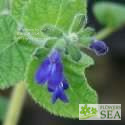
(Mexican Many Flowered Sage) Blooming from late summer into winter, this Mexican cloud-forest native has so many flowers that they are difficult to count. The deep violet blossoms develop distinct, white beelines after opening.
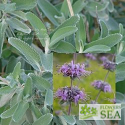
(California Purple Sage or California Gray Sage) This California native is commonly known as Purple Sage for its flowers or Gray Sage for its silvery, velvety foliage. Due also to its hardiness, drought tolerance and ability to attract small wildlife, it is a joy in the dry garden.
The following terms were added to your search to help improve the result. Click here to exclude these extra terms from the search.
- s, sale, sales
Results for sal from the blog
| Ask Mr. Sage |
| 1. Ask Mr. Sage: What Salvias Grow Well in Containers? |
| What kinds of Salvias are good choices for potting? Ask Mr. Sage, a regular feature of our Everything Salvias Blog, says the answer is many. In this post, Mr. Sage suggests some surprising combinations for potting and explains how to navigate the Flowers by the Sea Online Nursery catalog to find Salvias and companion plants appropriate for container gardening. |
| 2. Battles in the Salvia Garden: Controlling Spider Mites - Part I |
| Salvias often suffer when spider mites become legion in gardens. This is Part 1 of a two-part series about understanding and overcoming these dangerous pests. As summer temperatures rise, so do the numbers of the family Tetranychidae -- spider mites -- especially if conditions are dry. Controlling spider mites in your Salvia garden may be as simple as keeping plants hydrated and regularly spraying the little nippers off foliage. Or it may take a number of interventions, including biological controls, such as predatory mites, as well as the use of insecticidal soaps, oils and pesticides |
| 3. Battles in the Salvia Garden: Controlling Spider Mites - Part II |
| Pollinators lose important food sources when Salvias and other nectar-rich flowers are destroyed by spider mites. This is Part 2 of a two-part series about understanding and overcoming these dangerous pests. Along with the non-chemical interventions described in Part 1 of this series, gardeners sometimes need the help of predatory insects and mites, insecticidal soaps and horticultural oils. Pesticides called miticides may also eventually be necessary, but should be the last resort. |
| 4. Battles in the Salvia Garden: Pretty Southern Pink Moth |
| Southern Pink Moth (Pyrausta inornatalis) is diminutive and pretty, but it’s a powerful pest in Salvia gardens. As the common name indicates, it is primarily found in the South. Yet it is flitting into gardens further north. Read more to learn how to identify and control this pest. |
| Cultivating Color |
| 5. Bedding Plant Royalty: Splendid Salvia Splendens |
| If the world were to coronate a Salvia as its favorite annual, there's little doubt that a deep red variety of Scarlet Sage ( Salvia splendens ) would bear the sceptre. It's a long blooming, global favorite sometimes called Bedding Sage or Red Sage. When it was first introduced to horticulture in 1822, it was known as Lee's Scarlet Sage. Flowers by the Sea Online Nursery explains the growth habits and history of Scarlet Sage and suggests numerous favorite cultivars to add grandeur to your garden. |
| Hummingbirds in the Garden |
| 6. 5 Big Orange Bedding Plant Beauties for Hummingbirds |
| You'll hear a lot about red when planting annuals for wildlife gardens, because hummingbirds garden love red, tubular, nectar-rich flowers. But orange is another hummingbird favorite not to be neglected. Flowers by the Sea suggests five long blooming species for your landscape that begin shouting "Orange, orange, orange" in spring when hummingbirds are big-time hungry now, now, now as they head north for the nesting season. |
| Sage Words About Wildlife |
| 7. Sage Words About Wildlife: Birdbath and Hummingbird Feeder Care |
| Sometimes it is difficult for hummingbirds to get all the nectar they need from the garden, even if you have many Salvias. Hummingbird feeders supplement mother nature and attract a crowd of the Family Trochilidae. Water features, including misters, are also good attractants. However, both feeders and water features need to be kept clean so they don't harm hummers. |
| Book Reviews |
| 8. Book Review: Lawn Gone! Low-Maintenance, Sustainable, Attractive Alternatives for Your Yard |
| Lawn Gone by Texas landscaper and garden writer Pam Penick concerns replacement or minimization of lawns through xeriscape, the art of planting attractive waterwise landscapes. Penick redefines suburban yards through designs including perennial groundcovers and small shrubs -- such as Autumn Sages ( Salvia greggii spp.) -- as well as ornamental grasses, sedges and hardscape, including water features. Flowers by the Sea specializes in Salvias and other xeriscapic plants. |
| 9. Blazing Red Sages for Sun and Partial Shade |
| Warm colors tend to take center stage in a landscape as well as brightening the shade. Yet warm colors generally aren't associated with shady sage (Salvia) gardens, because there are far more shade-tolerant sages in the blue to purple range. So we decided to poke around our catalog and pull together some hot choices that thrive in partial shade. To make landscaping even easier, you may want to limit your choice of plants to one color. Massing is dramatic. |
| Book Reviews |
| 10. Book Review: A Field Guide to the Wildflowers of Mexico's Copper Canyon Region |
| Copper Canyon is one of four labyrinthine gorges in Northwest Mexico's state of Chihuahua. The canyon lands are home to the indigenous Tarahumara Indians, who are famous for their reclusive culture, herbal knowledge and habit of easily running ultra marathon distances. The gorges are also home to a fabulous array of wildflowers, including Salvias, that amateur botanist Linda J. Ford documents in " "font-style: italic;">A Field Guide to the Wildflowers of Mexico's Copper Canyon Region." |
| 11. Book Review: Stop. . .and Smell the Mints |
| Randy Collins was surprised when he got hooked on horticulture following retirement. But after a move to South Carolina, he was even more surprised at how deer destroyed his gardens until he began growing lots of mint family ( Lamiaceae ) plants like Salvias. It inspired him to write Stop...and Smell the Mints . |
| 12. Book Review: Nature-Friendly Garden by Marlene A. Condon |
| Reading Marlene A. Condon's Nature-Friendly Garden is like observing a game of toppling dominoes. All the pieces are lined up standing on end in a complex, maze-like pattern. Flick one domino and the whole structure tumbles. Similarly, the author shows how simple choices we make in our gardens have consequences that can build or destroy wildlife habitat. |
Common terms in this search: michoacan blue sage unusual distinctive mexican grows from tuberous roots compact decidedly vertical strong square winged stems rocket upward topped clusters rich flowers large rosy bracts come autumn zone above can leave tubers ground dig them divide would dahlias extend their growing range yard due plant's drought tolerance have been able grow without watering summer needs full sun partial shade