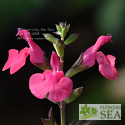
(Blue Chiquita Sage) This unusual and now rare variety was first discovered by the Yucca Do Nursery during their 1997 expedition in Mexico. Growing into a small, tight mound with silvery-blue leaves, it explodes in the fall with pale blue flowers on tall spikes.
Blue Chiquita has been in the nursery trade on and off for many years, and is now quite rare. It is not particularly easy to grow (for us on the coast of Northern California), needing warm dry days but rich soil and adequate water to be at its best. At times the name Salvia longispicata has been used in addition to the common name, but we have been unable to verify its authenticity.
When grown well this is nothing short of spectacular in the fall garden, and is well worth a little extra effort.
Here are some guidelines for success with this plant in your garden.
Click on an individual icon for more detailed information.
Exposure

This plant needs or tolerates more than six hours of intense sunlight daily. Many Salvias only thrive in wide-open locations where they receive long hours of full sun. However, full-sun species sometimes tolerate a bit of partial shade. Or a Salvia that loves partial shade may be amenable to spending part of its time in full sun.
In general, this sun/shade adaptability shows up in Salvias that do best in cooler climates when grown in full sun and thrive in hot climates when partial shade is available. So full-sun Salvias sometimes are also categorized as partial-shade plants and vice versa.

This plant can handle extreme heat.
Full-sun Salvias that don’t like any shade are among the most heat tolerant. Heat-loving Salvias also are often drought tolerant. Moisture-conserving features, such as fuzzy leaves, help them stay perky at high temperatures.
Heat-tolerant Salvias are fine choices for western and southern exposures.

This plant grows well in partial shade, such as the kind on the edge of woodlands or under deciduous trees with breaks in the foliage through which dappled sunlight penetrates. Many Salvias thrive in partial shade, including ones that spend part of their day in full sunlight. Some species need partial shade to overcome severe heat and dry soil.
Garden Uses

This plant grows well in an outdoor container, such as on a patio.
Some containerized Salvias leaf out and flower year after year following a period of dormancy. Annuals in containers may die back and appear to grow again when they reseed.
During extreme heat, check the soil in container plantings once or twice daily to be sure it doesn't completely dry out. Feel its surface for coolness, then gently poke a finger into the soil to check for dryness.

When growing a fragrance garden, this is a good selection.
Most Salvias have pleasant scents, but some are intoxicatingly fragrant. Some are short enough for border plantings that release a heady perfume as you brush against them when strolling along a path. Other taller types make good landscape highlights, particularly by doors where their scent can be enjoyed on entry and exit.
Growing Habit

Plant hardiness Zones defined by the U.S. Department of Agriculture tell you the minimum temperatures a plant can withstand in your garden. The USDA divides the nation into winter climate areas from coldest (Zone 1) to warmest (Zone 11).
However, it is sometimes possible to grow a Zone 6 Salvia as a perennial in Zone 5 if you provide preferential care, such as winter mulching and a location sheltered from harsh winds. In contrast, a Zone 9 Salvia may act like a perennial in Zone 10 if given a bit of shade or extra water.

To create a harmonious landscape plan, it is important to consider the heights of individual plants.
Height also affects function. Short Salvias often make excellent ground covers that conserve soil moisture and discourage weeds while also brightening your yard. Medium-height Salvias, such as ones 36 inches tall, often are ideal border plants. A tall Salvia planted singly can highlight a landscape; multiple plantings can form an attractive screen.

By considering the width of a plant, you can determine how many to place in a row or what other plants to grow with it.
For example, a narrow, moderate-height Salvia may look good interplanted with bushier species, kind of like Mutt and Jeff.
In contrast, wide-spreading Salvias are economical for hiding lengths of wall and fence or for creating hedge-like divisions in a yard.

Plant this herbaceous species in the USDA Zones where it grows as a perennial, returning year after year.
After dying back to the ground at frost, herbaceous perennials emerge in the Spring with soft, new growth. A Salvia that is perennial in one region, may be an annual in another depending on local conditions, such as winter temperatures.
If you live in USDA Zone 5, for example, Salvias in our catalog cited as growing well in Zone 5 or lower will be perennial. Those cited as doing well in Zones 6 or higher may do well in Zone 5, but generally will act like annuals coming back from seed instead of the parent plant’s roots.
Water Needs

This plant needs regular watering based on what is appropriate to your local conditions.
In some extremely hot, arid climates, this may mean daily watering in Summer. Although many drought-resistant Salvias survive on little to no watering due to local rainfall and deep roots meeting their moisture needs, others need regular doses. The size and frequency of the dose depends on your climate.
Blooming Season

This plant reaches peak bloom in Fall or flowers for much of the season.
It may begin flowering much earlier in the year. Bloom time for some Salvias lasts from Spring till first frost. Others begin flowering in Summer and continue into Fall. There are also Salvias that don’t bloom until late Fall and continue into Winter if grown in mild-Winter areas.
There is a great deal of overlap in blooming seasons for Salvias.
Wildlife

Honeybees love this plant’s nectar. As a honeybee burrows down into a Salvia’s nectar-rich flowers to reach dinner, it accidentally gathers pollen and drops it on the stigma of that blossom or of ones on other nearby Salvias. Fertilization results in seed production.
By growing honeybee favorites, you attract these helpful pollinators to all your flowering plants and increase productivity

This plant attracts butterflies whether for nectar or as a host for their caterpillars. Some butterflies feed on a limited range of flowering plants and only lay eggs on one kind of host plant. Salvia nectar lures adult butterflies. Placing host plants, such as Milkweeds (Asclepias spp.), next to nectar plants builds butterfly habitat. In exchange, the butterflies improve fertility in your garden through pollination.

Unless local forage is in short supply, most deer likely will avoid this plant.
It appears that deer dislike Salvias, in general, due to their volatile oils that make the plants so fragrant and savory in cooking. However, the only completely deer-proof plants are the ones grown beyond reach.

Based on our experience and reports from customers, hummingbirds (Trochilidae spp.) love this plant.
Hummingbirds exist only in the Americas where their 300-plus species are particularly fond of the nectar in brightly colored Salvias from the Western Hemisphere. However, if favorites aren’t available, they dine on the nectar of most Salvias.
Hummingbirds repay thoughtful plantings by helping to pollinate your garden
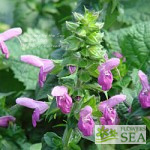
(Autumn Enchanter Japanese Woodland Sage) Salvia glabrescens ‘Autumn Enchanter’ has bicolored orchid pink flowers that are larger and bloom earlier than those of S. glabrescens ‘Shi Ho’. Autumn Enchanter is also more floriferous, blooms longer, and grows more rapidly with greater vigor.
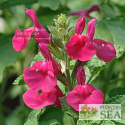
(St. Charles Day Mountain Sage) Especially in spring and fall, masses of red-violet flowers bloom amid the silvery green foliage of Salvia microphylla 'San Carlos Festival'. Put this one into the "must have" column.
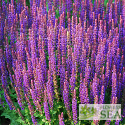
(Burgundy Candles Meadow Sage) When the burgundy buds of Salvia nemorosa 'Burgundy Candles' open, deep violet-blue flowers emerge. They are supported by burgundy and green bracts on purple stems.
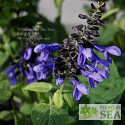
(Costa Rica Blue Sage) Although this handsome plant is often listed as an Anise Leaf Sage (Salvia guaranitica), we think it is a hybrid based on differences in its growth pattern and flowering season.