
Advanced Search
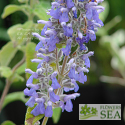
(Grape Scented Sage) With the grape scent of its pale lavender blossoms and its long history of medicinal use, it is no surprise that this sage is so widely distributed.
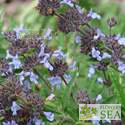
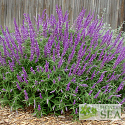
(Santa Barbara Mexican Bush Sage) This compact Mexican Bush Sage was found in the Santa Barbara garden of Kathiann Brown. It is, without a doubt, the finest short Mexican Bush Sage -- hardy, tough and long blooming. Add drought tolerance and dark, rich purple flowers to its list of merits.
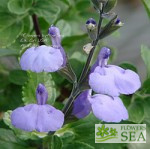
(Elk Blue Moon III Jame Sage) Dark calyxes cup dusky blue flowers that age to lavender and rise up from the veined, mid-green foliage of Salvia x ‘Elk Blue Moon III’.
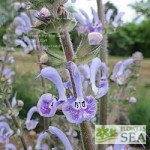
(Shangri-la Sage) Take a close look at Salvia moorcroftiana x indica ‘Shangri-la’ and you’ll notice that its lavender flowers have lighter lower lips with deep purple freckles.
Results for Honeybee from the blog
| Bees in the Garden |
| 1. The Not-So-Secret Lives of Honeybees |
| It's no secret that Honeybees are American immigrants. Yet along with native bees, they descended from meat-eating wasps. All bees make food and flowers possible through pollination. This is the first article in a four-part Bees in the Garden series in the Everything Salvias blog of Flowers by the Sea. The series focuses on identifying and understanding bees, becoming aware of threats to their survival and noting ways gardeners can protect these tiny wildlife. |
| 2. Types of Bees Working in Your Garden |
| America buzzes with bee diversity, including 4,000 native species and many types of nonnative honeybees. Flowers by the Sea details the variety and value of our imperiled bees. This is the second article in a two-part series focused on identifying and understanding bees, becoming aware of threats to their survival and noting ways gardeners can protect these tiny wildlife. It includes tips on how to avoid bee stings. |
| Sage Words About Wildlife |
| 3. How to Find Food for the Bees at Flowers by the Sea |
| Forgive the bad pun, but we almost wouldn't be without bees. These tiny pollinators make it possible for us to eat and experience the flowering beauty of the world around us. Honeybees -- the kind managed by beekeepers -- and thousands of wild species pollinate at least one-third of the plant species we eat. At Flowers by the Sea we've decided to improve our efforts to help the genus Apis . Our first step is to make it easier for you to find plants honeybees frequent by making our catalog easier to search for bee favorites. |
| 4. 15 Select Salvias for Dry, Partial-Shade Gardening |
| Learning how to garden in dry shade requires mediation of the needs of all the plants involved. Dry shade is particularly abundant under trees, because they consume lots of water. Fortunately, numerous drought-resistant Salvias can handle life in dry, partial shade. Flowers by the Sea details basic considerations of dry shade gardening and identifies 15 sages for it. |
| 5. Battles in the Salvia Garden: Controlling Spider Mites - Part II |
| Pollinators lose important food sources when Salvias and other nectar-rich flowers are destroyed by spider mites. This is Part 2 of a two-part series about understanding and overcoming these dangerous pests. Along with the non-chemical interventions described in Part 1 of this series, gardeners sometimes need the help of predatory insects and mites, insecticidal soaps and horticultural oils. Pesticides called miticides may also eventually be necessary, but should be the last resort. |
| Cultivating Color |
| 6. Pantone Pageant: Designer African Violet Salvias and Companions |
| Purples are cool yet quietly passionate. This includes African Violet 16-3520, a spring 2013 designer color created by the Pantone Corporation. Shades in the blue and purple color range are tranquil and soothing yet commanding, because they calm the garden. Here are a number of choices from our catalog that fashionably match Pantone's African Violet. |
| 7. Pretty, Practical Cottage Gardens Rooted in Pandemic History |
| Romantic visions of small, rose-covered houses with thatched roofs and bountifully blooming yards don't tell the story of how cottage gardens came to be in the Middle Ages due to a devastating pandemic. FBTS Farm and Online Nursery talks about cottage gardening past and present. |
| Sacred Sages |
| 8. Sacred Sage: Salvia mellifera -- the Easiest California Native |
| Long before the West Coast was colonized, California Indians used Black Sage ( Salvia mellifera Greene) for food and medicinal purposes. Today, it often is bundled in smudge sticks used like incense during purification rituals. Another reason to consider Black Sage sacred is that, among the state’s native plants, it is one of the most important sources of nectar for pollinators. Nineteenth century botanist and clergyman Edward Lee Greene made the plant’s botanical name official in 1892 when he was the first person to publish it in a scientific journal. Among California's native Salvias, it is the easiest to grow in home gardens. |
| Salvia Small Talk |
| 9. Salvia Small Talk: Why Birds Love Red Flowers |
| Color, shape and smell are characteristics that affect whether a bird or insect will dive into a flower in search of food. Whereas bees seem not to notice red at all, it is the go-to color that most birds look for at mealtime. |
| 10. A Community of Anise Scented Sages We Adore |
| You might expect the foliage of a plant called Anise-Scented Sage (Salvia guaranitica) to smell robustly like licorice, which shares the same fragrance as anise. Some gardeners detect a hint of licorice after crushing a leaf, but many say the foliage merely smells sweet. These popular sages are native to Brazil where indigenous peoples used their leaves as a medicine. Flowers by the Sea grows many varieties in a wide range of sizes and flower colors |
| 11. A New Category - Autumn Sage & Mountain Sage |
| Without a doubt, this group of closely related plants are the most widely grown of the genus. From 'Hot Lips' to 'Texas Wedding', there is something here for everyone. |
| New at FBTS |
| 12. Himalayan Sage Is the Salvia Collector’s Holy Grail: Part 1 |
| For plant collectors, a mystique surrounds rare species like Salvia hians (Himalayan or Kashmir Sage). This is especially true when there is uncertainty about what the plant should look like. Perhaps the most famous image of S. hians is a 2012 photograph of UK plant collector Chris Chadwell next to an abundantly blooming stand of large violet-blue flowers with white lower lips. Why doesn’t the Flowers by the See variety of this rare species look exactly like the plant Chadwell found — a plant that seems to be the Holy Grail of Salvia collectors? We’ll do our best to explain. |
Common terms in this search: grape scented sage scent its pale lavender blossoms long history medicinal use surprise widely distributed indigenous tarahumara people northern mexico have used centuries treat variety infirmities gardener today offers drought resistance heat tolerance along fragrance color although can grow feet tall native habitat generally averages growth wide home gardens nevertheless mighty ability ensure pollination garden because warning powerful hummingbird honeybee