
Advanced Search
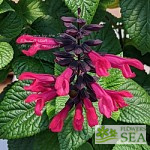
(Jammin Jazz Anise-Scented Sage) Deep chocolate calyxes and stems support the large, hot pink flowers of Salvia BODACIOUS® ‘Jammin’ Jazz’. This new cultivar of Salvia guaranitica has heavily veined, bright green foliage that smells a bit like licorice.
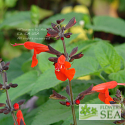
(Forest Fire Tropical Sage) Butterflies love the abundant, fire engine red flowers of this mostly annual sage. It's a popular cultivar of one of the first Salvias used for ornamental purposes -- Tropical Sage. The flowers are dramatically framed by reddish black bracts.
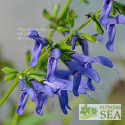
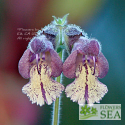
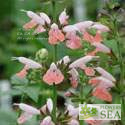
(Brenthurst Tropical Sage)Tropical Sage is popular as an annual throughout America and as a perennial in warm zones. It is particularly beloved in the Deep South where it withstands heat, wind, heavy rains and excessive humidity to bloom prolifically season after season. Brenthurst is a coral-flowered cultivar with dramatic, dark bracts and bright green, heart-shaped leaves.
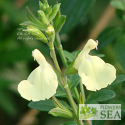
(Elk Lemon Sorbet Jame Sage) Unlike any other we have ever seen, this pale yellow flower seems at times to have a green tint. The foliege is typical of the Salvia microphylla parent - mid sized, round and textured. It is very different in flower and foliege from our popular variety 'Elk Lemon Lite'.
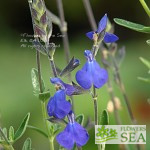
(Elk Blue Note Sage) In Europe and Australia there is a popular and widely used seed grown Salvia variety called 'Blue Note'. Our offering, 'Elk Blue Note', is the result of several generations of careful breeding and selection.
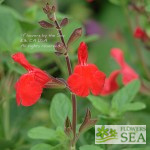
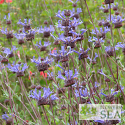
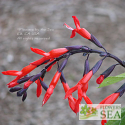
(Big Mexican Scarlet Sage) This heavily blooming Salvia from Mexico has heart-shaped leaves and spectacular flower spikes up to 18 inches long from winter through spring. The blooms are bright red-orange with rich purple-black calyxes.
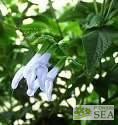
(Argentina Skies Anise-Scented Sage) PLEASE NOTE: A superior variety, 'Elk Argentina Skies' is now available.
The licorice-like fragrance of its foliage and the big whorls of large, sky blue flowers make this a stand-out sage. Tall and wide, it forms a tidy, long blooming background, screen or border.


(Waverly Sage) A pale pink to lavender blush adds delicate color to the white flowers of Waverly Sage, which are supported by plum-colored calyxes. Its mid-green leaves are lance shaped and veined.
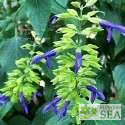
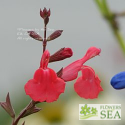
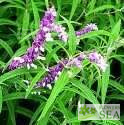
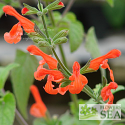
(Elk Super Scarlet Rooster Sage) From the mountains of Mexico we have this stunning Sage, which seems never to be out of bloom. A superior hummingbird plant, the warm orange flowers that cover this shrubby perennial make it a standout in the garden.
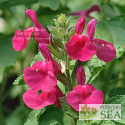
(St. Charles Day Mountain Sage) Especially in spring and fall, masses of red-violet flowers bloom amid the silvery green foliage of Salvia microphylla 'San Carlos Festival'. Put this one into the "must have" column.
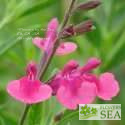
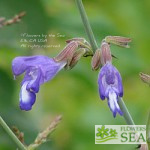
(Mount Olympus Sage) The deep violet and white flowers of Salvia ringens are eyecatching. Their wiry, branched spikes rise up to 5 feet tall from a dark green basal rosette.
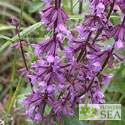
(Judean Sage) Native to the mountains of Judea in Israel, this dark violet flowered, perennial sage is unique among the Palestinian Salvias - as a woodland native it grows well in partial shade. It is a tough, drought-resistant plant with deeply cut & hairy foliage which forms impressive mounds of color in the spring and early summer.
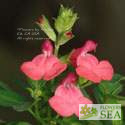
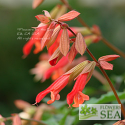
(Ember's Wish Sage) Bright coral-colored, tubular blossoms contrast handsomely with the deep maroon stems, rusty rose calyxes and mid-green foliage of Ember's Wish Sage.
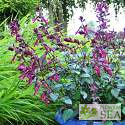
(Love and Wishes Sage) Deep purple calyxes support the magenta-purple, tubular blossoms of Salvia x 'Love and Wishes'. They contrast handsomely with dark stems and mid-green foliage.
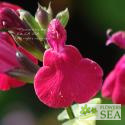
(Killer Cranberry Mountain Sage) Masses of magenta flowers on tall spikes lure honeybees and hummingbirds to the rich nectar of Salvia microphylla 'Killer Cranberry'. Its prolific flowers are a killer attraction for people too.
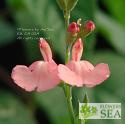
(Dyson's Orangy Pink Hybrid Jame Sage) Many Salvia x jamensis hybrids remind gardeners of sunrise, such as Dyson's Orangy Pink. Light green calyxes faintly striped with red cup its luminous pale salmon pink blossoms with creamy throats.
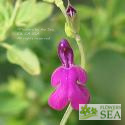
(Navajo Autumn Sage) Even a hint of blue is unusual among Autumn Sage flowers. Salvia greggii 'Navajo Purple' is a rarity due to its magenta-purple blossoms, which hint at natural hybridization including a mystery parent in the blue range, such as Salvia lycioides.
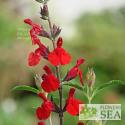
(Radio Red Autumn Sage) Dark calyxes support true red blossoms in Salvia greggii 'Radio Red', a 2015 introduction from the Darwin Perennials division of Ball Seed. Its tiny, smooth, elliptical leaves form a light, airy backdrop for the dramatic flowers.
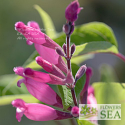
(Boutin Roseleaf Sage) Boutin means "button" in French. Perhaps the creamy, mulberry pink flowers of Salvia involucrata 'Boutin' looked cute as buttons to whoever named the cultivar.
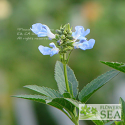
(Dwarf Bog Sage) Intense sky blue flowers with white beelines are set against mid-green foliage in this dwarf Bog Sage that is about half as tall and wide as its parent species when in bloom.
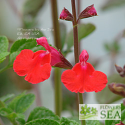
(Majestic Pink Sage) Very large richly colored hot pink blossoms and broad, glossy, intricately textured leaves are part of what makes Salvia x 'Majestic Pink' a standout. This is a complex hybrid involving several Salvia species from the ongoing breeding program at FBTS.
Results for popular from the blog
| Hummingbirds in the Garden |
| 1. 6 Indispensable Hummingbird Flowers for Long, Easy Bloom |
| Hummingbirds are like tiny combat jets dive bombing each other when staking claim to the nectar-rich flowers they need for survival. Fights over nectar habitat can reduce hummingbird gardens to single occupancy. FBTS Farm and Online Nursery details and tells stories about its top six hummingbird flowers. Plant lots of them to accommodate a village of hungry hummers. |
| 2. Annual Salvias that Hummingbirds Adore |
| If a hummingbird could talk, he or she would tell you it's hard work packing for a long journey. Consuming mightily from dawn to dusk, day after day, hummingbirds double their weight before migration. They can't afford to run out of fuel before their next meal. To help hummingbirds, particularly on their northward journey, home gardeners can celebrate the arrival of spring by planting gardens filled with early blooming Salvias and companion plants that are excellent annuals in areas where winters are too chilly for survival as perennials. |
| Getting Started with Salvias |
| 3. Getting Started: Salvias for New England |
| Some people think you only find sage and coyotes out West. But Canis latrans, the Eastern Coyote, slipped into New England in the 1930s, and who knows when all the sages arrived? The New England Wild Flower Society notes that Lyreleaf Sage ( Salvia lyrata ) is the region's only native sage. It's one among many Salvia species grown in the Botanic Garden of Smith College in Massachusetts, which has one of the largest collections of sage in the region. Flowers by the Sea Online Plant Nursery raises hundreds of sages, including many northeastern favorites. |
| 4. Drought-Resistant Beauties: A Guide to the Salvia greggii and S. microphylla Group |
| It can be a long journey from discovery to popularity for a plant. Currently, the most widely sought group of Salvias is the one encompassing S. greggii , and S. microphylla , which are commonly known as Autumn Sage and Mountain Sage. They caught the eye of naturalists traveling the American Southwest and Mexico's Sierra Madre mountains in the mid-to-late 1800s. However, they didn't take root in garden catalogs for well over 100 years. |
| Sacred Sages |
| 5. Sacred Sage: Pineapple Sage |
| Many kinds of Sage were considered sacred in ancient times due to their soothing, medicinal qualities. Pineapple Sage (Salvia elegans), which is native to Mexico and Guatemala, is still a highly regarded folk remedy for relieving anxiety, depression and high blood pressure. It is also one of America's most popular culinary sages and is a highlight of the USDA's National Herb Garden. |
| Sage Experts |
| 6. Sage Experts: Meet Professor Rolando Uria of Argentina |
| Sage Experts is a new feature on our Everything Salvias blog. It focuses on horticulturalists -- both amateurs and professionals -- in settings ranging from botanic gardens to universities. All have expertise in cultivating plants in the Salvia genus. This first profile talks about Argentina's Rolando Uria, an agronomy professor at the University of Buenos Aires and a presenter at the 2013 Salvia Summit II. Uria is well known for discovering Salvia 'Amistad'. |
| Sage Words About Wildlife |
| 7. Sage Words about Wildlife: 4 Seasons of Hummingbird Salvias |
| Regional differences in seasonal temperature and humidity affect the choice of Salvias to plant in hummingbird gardens. The varying seasons in which particular sages bloom and the part of the world where they originated also determine whether they attract hummingbirds. Flowers by the Sea Online Nursery offers suggestions based on regions and seasons. |
| Salvias Down South |
| 8. Salvias Down South: 15 Thirsty Salvias for Florida |
| Flowers by the Sea grows Salvias that are already popular in the Southeast as well as others we would like to introduce to gardeners seeking thirsty flowering plants that can also adjust to dry spells. Many are fine choices for Florida hummingbird gardens. Our suggestions are organized into categories based on moisture tolerance – average and ample -- as well as sun requirements. |
| Cultivating Color |
| 9. True Blue Salvias You Can Rely On for Garden Serenity |
| Forget all the mournful music telling you that blue is the color of sadness. In a Salvia garden filled with hot colors, true blue is a peacemaker -- a reliable harmonizer that commands peace in the garden. This article talks a tiny bit about football, Madonna and the chemistry of true blue flowers. Then it offers a lot of true blue sages for gardens coast to coast from our Flowers by the Sea Online Nursery catalog. |
| 10. 6 Salvias for Shade |
| Most gardeners associate plants in the genus Salvia with full sun, rocky soil, drought and semi-arid native lands. Although a number of sages fit this picture, far more appreciate loamy, fertile garden soil. Some require lots of water. Also, a large number of sages thrive in partial shade, and some tolerate full shade. Here are six of the many shade lovers that Flowers by the Sea grows. |
| Hummingbirds in the Garden |
| 11. A Gardeners Guide to Hummingbird Sage |
| Among the hummers' favorites: Salvia spathacea, commonly known as Hummingbird Sage. As it name suggests, this California native produces the hummingbirds' flower of choice, blooming from late winter through summer -- and sometimes again in Fall -- with rose-pink to magenta blossoms. Available in six varieties, this robust perennial not only attracts hummers with its abundant nectar, it's easy to grow and enhances any landscape with its aromatic blooms and fragrant evergreen foliage. |
| 12. Guide to Fuchsia Cultivation & History |
| Like tiny dancers dressed in fancy skirts, Fuchsia flowers dangle from upright shrubs in long blooming hedges and from trailing branches in hanging baskets. Fuchsias are hummingbird favorites that come in many rosy colors. Read about them in the FBTS Guide to Fuchsia Cultivation & History . |
Common terms in this search: jammin jazz anise-scented sage deep chocolate calyxes stems support large hot pink flowers bodacious 'jammin' jazz' thisnew cultivar guaranitica has heavily veined bright green foliage smells bit like licorice sages which generally have varying shades blue purple native brazil northern argentina paraguay uruguay jammin' perennial combines both soft woody growth but due rapid long bloom time excellent annual where winter