
Advanced Search
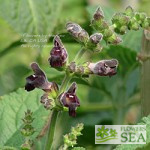
(Black Dan-shen) Growing into a basal rosette of leaves measuring up to 3 feet across, Salvia przewalskii 'CC5795' is known for its handsome foliage and deep purple, almost black flowers.
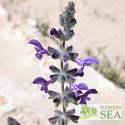
(Wooly Arabian Sage) "Radiant" is the word that garden writer and Salvia specialist Betsy Clebsch uses to describe the halo of white hairs covering the foliage and calyxes of Salvia lanigera.
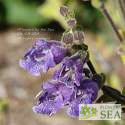
(Dan-shen Gansu) Growing into a large basal rosette of leaves measuring up to 3 feet across, Salvia przewalskii var. mandarinorum is known for its handsome foliage.
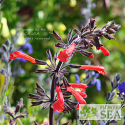
(Venezuelan Red Sage) Purple stems and calyxes so dark that they almost look black contrast dramatically with the deep red-orange flowers of this South American beauty. This tall, spectacular sage has been in cultivation for decades but is still rare in gardens. We'd like to see that change.
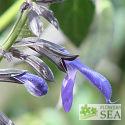
(Door of the Fox Mexican Sage) Purplish foliage contrasts attractively with the violet-to-purple flowers of this big sage, which grows 6 feet tall and 4 feet wide. Bloom time is autumn. This darkly dramatic Mexican Sage makes a particularly attractive entryway accent.
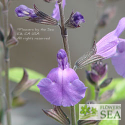
(Azure Hybrid Sage) Despite its name, the flowers of this tiny hybrid aren't really blue. They are a light purple. Due to its size, long bloom time, heat tolerance and drought resistance, Salvia x 'Mesa Azure' is a fine groundcover for areas where summers are hot and dry.
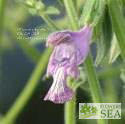
(san ye shu wei cao) So what do all those Pinyin words mean in this sage’s common name? We’ll give you an answer to the best of our ability in a minute. Meanwhile, we need to note that this medicinal Asian sage has handsome foliage and deep violet flowers.
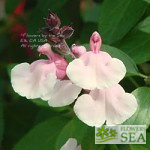
(Elk Crème Anglaise Jame Sage) Framed by minty green foliage, the blossoms of Salvia x ‘Elk Crème Anglaise’ transition from dreamy pale pink throats to white skirts. They look delectable.
Results for uses from the blog
| Ask Mr. Sage |
| 1. Ask Mr. Sage: Why FBTS Uses Foam Packing Peanuts & How to Reuse Them |
| It isn't easy being completely green. Flowers by the Sea explains why polystyrene packing peanuts are essential for shipping and what you can do with them after unpacking your orders. Ecofriendly reuses include donating them to shipping companies and using them to lighten container plantings. Ask Mr. Sage is a Q&A feature based on topics raised in calls and emails to FBTS. |
| 2. Ask Mr. Sage: What Salvias Grow Well in Containers? |
| What kinds of Salvias are good choices for potting? Ask Mr. Sage, a regular feature of our Everything Salvias Blog, says the answer is many. In this post, Mr. Sage suggests some surprising combinations for potting and explains how to navigate the Flowers by the Sea Online Nursery catalog to find Salvias and companion plants appropriate for container gardening. |
| Getting Started with Salvias |
| 3. Getting Started: Salvias for Zone 9 |
| California's small, Mohave Desert city of Barstow averages about 5 inches of rain annually. Across the continent, Pensacola, Florida, has more than double Barstow's population and more than 12 times its amount of rainfall. Yet both cities are part of the U.S. Department of Agriculture's Plant Hardiness Zone 9 where you can plant perennials and shrubs that survive winter lows ranging from 20 to 30 degrees F. Flowers by the Sea takes readers on a triple coast road trip of Zone 9 and suggests plantings for varied growing conditions along the way. |
| New at FBTS |
| 4. Himalayan Sage Is the Salvia Collector's Holy Grail: Part 2 |
| Plants don’t have voices but they have stories to tell, including tales of discovery. It’s easy to see why the early 18th century plant explorer Victor Jacquemont would have paused to collect the rare Salvia hians while traversing broad expanses of northwestern India. This second half of our article about the alluring species digs into its history. |
| 5. Meet Salvia rosmarinus: A New Addition to the Sage Genus |
| Bees adore rosemary, the powerfully resinous Mediterranean native known both as a groundcover spilling over garden slopes and as an accent or tall hedge plant. Plant scientists who closely examined its DNA suggest moving the Rosmarinus genus into the Salvia genus. Flowers by the Sea now grows two kinds of Salvia rosmarinus. |
| Hummingbirds in the Garden |
| 6. A Gardeners Guide to Hummingbird Sage |
| Among the hummers' favorites: Salvia spathacea, commonly known as Hummingbird Sage. As it name suggests, this California native produces the hummingbirds' flower of choice, blooming from late winter through summer -- and sometimes again in Fall -- with rose-pink to magenta blossoms. Available in six varieties, this robust perennial not only attracts hummers with its abundant nectar, it's easy to grow and enhances any landscape with its aromatic blooms and fragrant evergreen foliage. |
| Ask Mr. Sage |
| 7. Ask Mr. Sage: How FBTS Chooses New Salvias |
| Some Salvia collectors want to obtain a broad range of sages including all the new introductions on the market. But Flowers by the Sea can't and doesn't want to grow all the new cultivars available, partly because there is a growing abundance of Salvia introductions. Instead, FBTS focuses on selecting the most superior new plants even when introducing its own hybrids in its series of Rainbow Jame Sages. Ask Mr. Sage is a regular feature based on calls and emails received by FBTS. |
| 8. Battles in the Salvia Garden: Controlling Spider Mites - Part II |
| Pollinators lose important food sources when Salvias and other nectar-rich flowers are destroyed by spider mites. This is Part 2 of a two-part series about understanding and overcoming these dangerous pests. Along with the non-chemical interventions described in Part 1 of this series, gardeners sometimes need the help of predatory insects and mites, insecticidal soaps and horticultural oils. Pesticides called miticides may also eventually be necessary, but should be the last resort. |
| Getting Started with Salvias |
| 9. Getting Started: Salvias for the Mid-Atlantic |
| Outside of its cities, the Mid-Atlantic can be described as an overwhelmingly green place. If you love the Mid-Atlantic, you revel in its verdant landscape. However, if you aren't reveling in the predictable planting choices you see in neighbor's yards, it may be time to expand your horizons by exploring the Salvia genus. Flowers by the Sea discusses the boundaries, USDA Plant Hardiness Zones and Salvia choices for the region. |
| 10. Getting Started: Salvias for Zone 8 |
| Rainfall often is heavy in USDA Plant Hardiness Zone 8. It swings in a deep, broad arc from the West Coast to the Gulf Coast and back up the East Coast to the northeast edge of Virginia. What all its diverse areas have in common climatically is an average low winter temperature of 10 degrees F. Flowers by the Sea Online Nursery discusses growing conditions and how to select Salvias for your part of Zone 8 whether wet or dry. |
| 11. Getting Started: Salvias for Zone 5 |
| To bloom yearly, Salvia perennials and shrubs in USDA Hardiness Zone 5 need to tolerate deep freeze winters with average low temperatures of -20 degrees F. The success of Zone 5 sages also depends on local growing conditions. Learn more at Flowers by the Sea, an online, mail-order Salvia nursery. |
| 12. Getting Started: Types of Salvias for Zone 6 |
| To bloom yearly, Salvia perennials and shrubs in USDA Hardiness Zone 6 need to tolerate chilly winters with average low temperatures of -10 degrees F. The success of Zone 6 sages also depends on local growing conditions. Learn more at Flowers by the Sea, an online, mail-order Salvia nursery. |
Common terms in this search: black dan-shen growing into basal rosette leaves measuring feet across przewalskii 'cc known its handsome foliage deep purple almost flowers summer tall spikes rise above large wrinkled which yellow-green have darkly pigmented petioles scientific name species honors nikolay przhevalsky polish-russian geographer whose century explorations asia increased knowledge about continent's plants wildlife sage traditional medicinal herb from mountains central china therapeutic