
Advanced Search
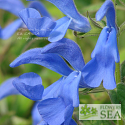
(Blue Angel Gentian Sage) Since the 1838 discovery of this herbaceous species from Central Mexico, Salvia patens has been a mainstay of the perennial garden. Blue Angel is one of the smallest of the full-sized varieties.
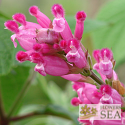
(El Butano Downy Sage) El Butano is a horticulturally rich area of Cumbres de Monterrey National Park in the mountains of Nuevo Leon, Mexico. El Butano Downy Sage was discovered in this area where it grows at elevations of 4,500 to 8,000 feet.
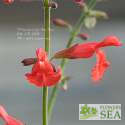
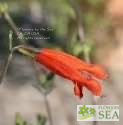
(Silke's Dream Salvia) Large red-orange blossoms combine with heart-shaped, light green, heavily veined leaves in this large, long-blooming sage. It's a subshrub, which means it combines it is a perennial that combines soft, herbaceous growth with some woodiness.
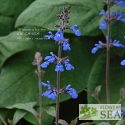
(Sinaloan Blue Sage) It's difficult to say which trait is more attractive about this sage -- the airy spikes of deep, true blue flowers or the fascinating spear-shaped foliage that varies from deep green to purple, forming a tidy mat.
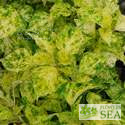
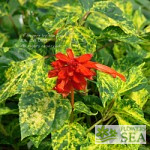
(Variegated Scarlet Sage) Crimson flowers topping bright yellow foliage mottled with deep green make this one of the most spectacular Salvias we grow.
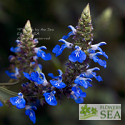
(Bog Sage) Highly adaptable, Salvia uliginosa is ideal for the beginning sage gardener. It isn't fussy about soil type, sun exposure, drainage or frequency of watering.
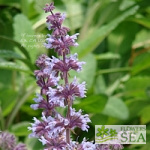
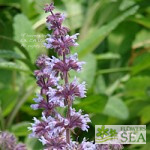
(Lilac Sage) We try not to brag too much, but this is our own variety of Salvia verticillata from home-grown seed, and we think it is spectacular. Butterflies and honeybees also are in love with this long-blooming perennial beauty.
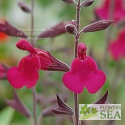
(Raspberry Delight Sage) Dark raspberry-red flowers, burgundy stems and calyxes and deep green foliage make this one of our most attention-grabbing varieties.
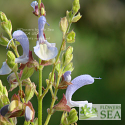
(Rough Blue Sage) Honeybees and butterflies love this deer-resistant shrub, which grows wild on the southwestern Cape of South Africa. It is a member of the most diverse plant community in the world, the fynbos -- an Afrikaans word, meaning "fine bush" and referring to scrub plants or shrubbery.
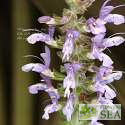
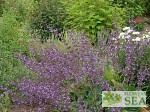
(Balkan Sage) Violet-blue whorls of flowers and plentiful, fuzzy, basal leaves that reach an impressive length of 18 inches are two notable features about this hardy, herbaceous perennial, which is native to the Southeastern Balkan Peninsula.

(Cayman Island Sage) Compact and intensely fragrant, this shrubby sage is excellent for containers or the edge of a pathway. Small blue and white flowers mass about its densely branched foliage. It loves rich, moist soil and warm weather.
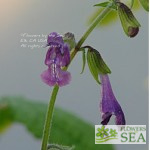
(Yunnan Sage or yun nan shu wei cao) Yunnan Sage's tall spikes of violet-to-purple flowers bloom from summer into fall. Native to Southwestern China's provinces of Yunnan, Guizhou and Sichuan, it grows on shady, grassy hillsides and along forest margins at elevations up to 9,500 feet.
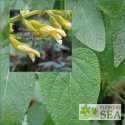
(Silver Leaf Forysthia Sage) It's the foliage of this clone that makes it so different from its parent plant. The leaves are a lovely silver and smaller than the green leaves of the species. However, they both have buttery yellow, Forsythia-like blossoms.
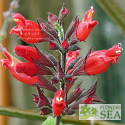
(Winter Mexican Sage) Call it the Snow Queen! From fall through spring, this graceful, colorful sage blooms through 20 degree F weather despite snow and ice. It has lovely, small, dark green leaves and profuse clusters of tubular, cinnabar-red flowers that puff out in the center.
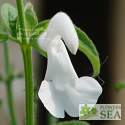
(White Trophy Gentian Sage) White Trophy loves partial shade and is the finest white Salvia patens available, with very large flowers that age to pale blue.
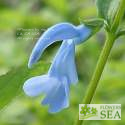
(Cambridge Blue Gentian Sage) Cambridge Blue is one of the most famous varieties of Salvia patens, which was discovered in Central Mexico in 1838. Its powder blue flowers are delightful and cooling in the landscape.
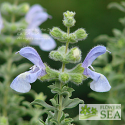
(Blue African Sage or Blousalie) A handsome, densely branched shrub with small, gray leaves, this Salvia puts on a show when in full bloom. The pale blue flowers bloom on foot-long spikes that cover the plant. Each flower has a large, trumpet-shaped, green-and-red bract at its base.
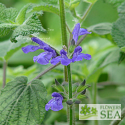
(Blue Bush Sage) Furry, large and heavily textured, the mid-green leaves of Salvia urica contrast attractively with its violet-blue flowers that bloom spring into summer.
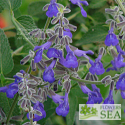
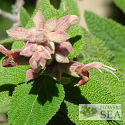
(Wooly Multicolor Sage) In Greek, "lasiantha" means "wooly flower." The flowers of Salvia lasiantha are surrounded by wooly bracts, but are even more notable for transforming from apricot-orange in the morning to reddish-purple later in the day.
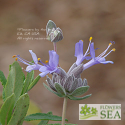
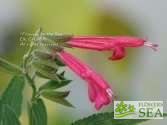
(Hybrid Bolivian Sage) This naturally occurring hybrid is a Bolivian native related to S. orbignaei and S. haenkei. Prettier than its parents, it has large, profuse, long-blooming flowers that are dark pink.
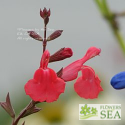
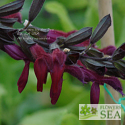
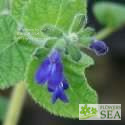
(Mexican Many Flowered Sage) Blooming from late summer into winter, this Mexican cloud-forest native has so many flowers that they are difficult to count. The deep violet blossoms develop distinct, white beelines after opening.
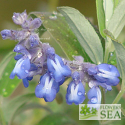
(Blue Ecuadorian Sage) A densely branched shrub with silvery leaves and dusky blue flowers, this rare species was once thought to be Salvia cruickshanksii. In the nursery trade, it sometimes is called Salvia 'Equador'.
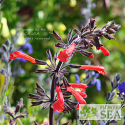
(Venezuelan Red Sage) Purple stems and calyxes so dark that they almost look black contrast dramatically with the deep red-orange flowers of this South American beauty. This tall, spectacular sage has been in cultivation for decades but is still rare in gardens. We'd like to see that change.
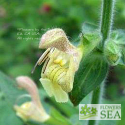
(Himalayan Cloud Sage) Nepal's Muktinath Valley -- a sacred site for Hindus and Buddhists -- is the place to go to see this majestically tall shade perennial in the wild. It grows at altitudes up to 14,000 feet and often emerges while the ground is still snowy.
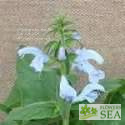
(Patio Sky Blue Gentian Sage) Patio Sky Blue is a handsome, dwarf variety of Salvia patens from Holland. It loves partial shade and is perfect for containers. The sky-blue flowers are larger than those of other Gentian Sages.
Results for cold- from the blog
| 1. Fall Planting: 8 Best-of-Class Sages that Are Easy to Grow |
| "Best of Class" is the title that Flowers by the Sea bestows on plants we honor for being winners in many ways. They are lovely, abundant bloomers and reliable repeat performers that are useful in many landscapes, including low-water gardens designed to have a cottage, woodland or desert look. In the case of the sages ( Salvia spp.) described here, all are easy to grow because they thrive with little fuss. Many are heat tolerant and drought resistant. |
| Getting Started with Salvias |
| 2. Getting Started: Salvias for the Rocky Mountain West |
| High altitude, distance from large bodies of water and powerful chinook winds make the Rocky Mountain West a dry gardening environment even in years of higher than average rain and snow. The region's steep mountains have a major impact on where and how precipitation falls. Instead of a single mountain chain, the Rocky Mountains are made up of 100 separate ranges. Similarly, the Salvia genus contains a broad range of sages, many of which thrive in the climactic extremes of the Mountain West. |
| 3. Getting Started: Salvias for the Southwest |
| Ask anyone to describe the American Southwest, and they're likely to sum it up in three letters : "D-R-Y." Yet precipitation can vary a lot here state by state and even within different parts of the individual states. One thing that is consistent about the story of water throughout the Southwest, is that rain and snow can rapidly swing from famine to feast to misfortune. |
| 4. Getting Started: Salvias for Zone 5 |
| To bloom yearly, Salvia perennials and shrubs in USDA Hardiness Zone 5 need to tolerate deep freeze winters with average low temperatures of -20 degrees F. The success of Zone 5 sages also depends on local growing conditions. Learn more at Flowers by the Sea, an online, mail-order Salvia nursery. |
| 5. Getting Started: Types of Salvias for Zone 6 |
| To bloom yearly, Salvia perennials and shrubs in USDA Hardiness Zone 6 need to tolerate chilly winters with average low temperatures of -10 degrees F. The success of Zone 6 sages also depends on local growing conditions. Learn more at Flowers by the Sea, an online, mail-order Salvia nursery. |
| New at FBTS |
| 6. Himalayan Sage Is the Salvia Collector's Holy Grail: Part 2 |
| Plants don’t have voices but they have stories to tell, including tales of discovery. It’s easy to see why the early 18th century plant explorer Victor Jacquemont would have paused to collect the rare Salvia hians while traversing broad expanses of northwestern India. This second half of our article about the alluring species digs into its history. |
| Sage Words About Wildlife |
| 7. How to Find Food for the Bees at Flowers by the Sea |
| Forgive the bad pun, but we almost wouldn't be without bees. These tiny pollinators make it possible for us to eat and experience the flowering beauty of the world around us. Honeybees -- the kind managed by beekeepers -- and thousands of wild species pollinate at least one-third of the plant species we eat. At Flowers by the Sea we've decided to improve our efforts to help the genus Apis . Our first step is to make it easier for you to find plants honeybees frequent by making our catalog easier to search for bee favorites. |
| Shade Gardening |
| 8. Made for Shade: Japanese Woodland Salvias |
| Sturdy, shade-loving Japanese Salvias are lovely additions to woodland gardens with their lush, large-leafed foliage and delicate-looking flowers in colors including pinks, purples and yellows. They're ideal for bordering shady paths where they invite visitors to pause for close-up views. Flowers by the Sea suggests Japanese species for woodland gardens and organizes them according to their cold hardiness. |
| 9. Pretty, Practical Cottage Gardens Rooted in Pandemic History |
| Romantic visions of small, rose-covered houses with thatched roofs and bountifully blooming yards don't tell the story of how cottage gardens came to be in the Middle Ages due to a devastating pandemic. FBTS Farm and Online Nursery talks about cottage gardening past and present. |
| Quick Digs |
| 10. Quick Digs: Prepping and Overwintering in Salvia Gardens |
| In autumn, even while the days are bright and balmy, you may be wondering how to help favorite Salvias survive local winter temperatures and freeze-thaw cycles. Although we can't offer you foolproof solutions, we provide ideas in this first article of our Quick Digs series on winter mulching Salvias and overwintering them both outside and indoors. |
| Hummingbirds in the Garden |
| 11. Red Birds in a Tree: How a Rare Wildflower Became a Hummingbird Garden Star |
| Red Birds in a Tree, known botanically as Scrophularia macrantha , is a rare, cold-hardy, Wild West perennial with cheery red flowers hummingbirds love. Southwest New Mexico botanist O.B. Metcalfe collected it in 1904. |
| Quick Digs |
| 12. Quick Digs: Planning a Salvia Garden Calendar |
| This is our second article in a Quick Digs series about preparing for spring in Salvia (sage) gardens. It's easier to succeed at almost anything if you make plans and set goals before beginning a project. This is certainly true in Salvia gardening. Creating a gardening calendar ensures greater success in planning. |