
Advanced Search
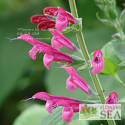
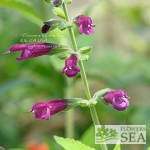
(Envy Hybrid Sage) A natural hybrid found in Peru and Bolivia, the parentage of this special variety is at this point unknown. The uniquely colored flowers are abundant all season long, and the hummingbirds love it.
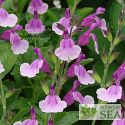
(Elk Chantily Lace Jame Sage) What color are the flowers of this FBTS introduction? Lavender? Periwinkle? Taffy? Yes to all for this hard to describe but easy to love plant.
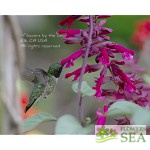
(Skyscraper Dark Purple Sage) Hummingbirds love Salvia x ‘Skyscraper Dark Purple’, which is brand new for 2019, blooms bountifully in shade, and is outstanding as a container plant.
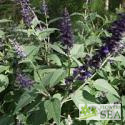
(Anthony Parker Bush Sage) Floriferous spikes of dark blue to purple flowers bloom midsummer to fall on this tidy, mid-height subshrub that grows as wide as it is tall.
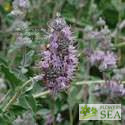
(Bee's Bliss Sage) If you are looking for a California native sage to use as a groundcover, Bee's Bliss is a fine choice. Low-growing, widespreading and colorful, it is ideal for choking weeds.
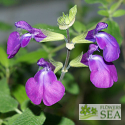
(Christine Yeo Sage) A chance hybrid of two Mexican sages --Salvia microphylla and S. chamaedryoides -- Christine Yeo Sage is long blooming and features deep purple flowers with white eyes.
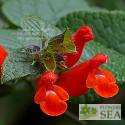
(Southern Mexican Sage) With its graceful, shrubby habit, purplish green leaves and intense tomato-red blooms, this herbaceous perennial makes a delightful display in your garden. It begins blooming in October and continues sporadically through the winter and into spring in frost-free areas.
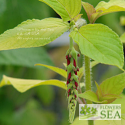
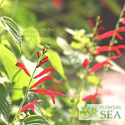
(Honey Melon Pineapple Sage) This is a short Pineapple Sage that is long blooming. It is the earliest and longest flowering of all the many varieties of Salvia elegans. We recommend it for indoor herb gardening as well as for outdoor borders and groundcovers.
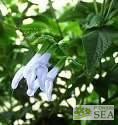
(Argentina Skies Anise-Scented Sage) PLEASE NOTE: A superior variety, 'Elk Argentina Skies' is now available.
The licorice-like fragrance of its foliage and the big whorls of large, sky blue flowers make this a stand-out sage. Tall and wide, it forms a tidy, long blooming background, screen or border.
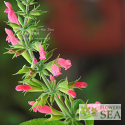
(Karwinski's Sage) From moist mountain areas in Mexico and Central America, this rugged, winter-blooming shrub is found in oak or pine forests at altitudes of 4,000 to 8,000 feet. This may account for this winter bloomer producing a few bright red flowers during short periods of freezing weather with temperatures as low as 20 degrees F.
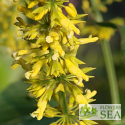
(Forysthia Sage) This statuesque perennial grows up to 10 feet tall, but spreads only 3 feet wide. It is a late bloomer from Mexico's Sierra Madre Oriental mountains where it grows at altitudes of 4,000 to 5,000 feet and tolerates temperatures down to 20 degrees F.
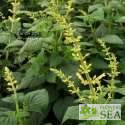
(Red Stem Forsythia Sage) The thick, square, red stems of this variety of Forsythia Sage make it conspicuously different from the species and from everything else in your garden. Its jointed stalks look a little like rhubarb gone mad!
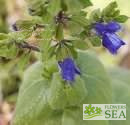
(Little Mexican Sage) This low-growing sage is a shrub in its warmest zones and a perennial in the cooler ones. It's just right for small spaces or tiny gardens. Short and compact, its flowers are similar to but smaller than those of S. mexicana 'Limelight'.
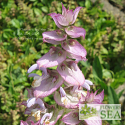
(Clary or Clear Eye Sage or Eyebright) Pink-purple bracts and violet-purple flowers form a pastel cloud over the large, rumpled leaves of Clary Sage in summer. It is a towering beauty growing up to 5 feet tall. Sacred to some due to age-old use in herbal remedies, it is heavenly to look at.
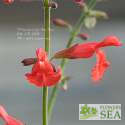
(Silke's Dream Salvia) Large red-orange blossoms combine with heart-shaped, light green, heavily veined leaves in this large, long-blooming sage. It's a subshrub, which means it combines it is a perennial that combines soft, herbaceous growth with some woodiness.
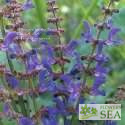
(Romanian Sage) Here's a great selection for mixed Salvia borders in zones with colder winters. This herbaceous perennial features deep violet flowers in large whorls atop tall, branched spikes.
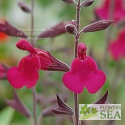
(Raspberry Delight Sage) Dark raspberry-red flowers, burgundy stems and calyxes and deep green foliage make this one of our most attention-grabbing varieties.
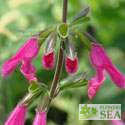
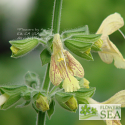
(Jupiter's Distaff) Easy to grow and adaptable to a wide range of conditions, this native of Europe and Asia is our best tall, yellow-flowering perennial. Although its common name compares the flower spikes to wool spindles, they look more like glowing sceptres.
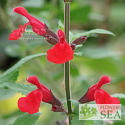
(John Whittlesey Sage) Hardy, vigorous and long blooming, John Whittlesey Sage is a hybrid of D'Arcy's Sage (Salvia darcyi) -- a native of Mexico -- and Mountain Sage (S. microphylla), which is native to the American Southwest and Mexico.
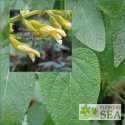
(Silver Leaf Forysthia Sage) It's the foliage of this clone that makes it so different from its parent plant. The leaves are a lovely silver and smaller than the green leaves of the species. However, they both have buttery yellow, Forsythia-like blossoms.
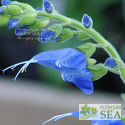
(Tall Big Leaf Sage) Cobalt blue flowers seem to float in airy clusters on 12-inch-tall branching spikes above the bright green, velvety foliage of this South American native. Up to 5-feet tall, tidy and upright in habit, this sage makes a fine background or border planting when massed.
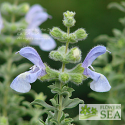
(Blue African Sage or Blousalie) A handsome, densely branched shrub with small, gray leaves, this Salvia puts on a show when in full bloom. The pale blue flowers bloom on foot-long spikes that cover the plant. Each flower has a large, trumpet-shaped, green-and-red bract at its base.
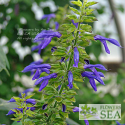
(Byron's Mexican Sage) One of our favorite Mexican Sages, this large variety is reputed to be a hybrid between Salvia mexicana and S. hispanica -- a species of Chia Sage.
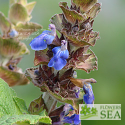
(Michoacan Blue Sage) This unusual and distinctive Mexican sage grows from tuberous roots. It is compact and decidedly vertical with strong, square, winged stems that rocket upward and are topped with clusters of rich blue flowers in large rosy bracts come autumn.
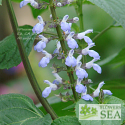
(Silly Mexican Sage) Also known as Salvia roscida, this close relative of Blue Sky Mexican Sage (Salvia caudata 'El Cielo Blue') has thousands of deep violet-blue flowers with prominent white bee lines.

(Autumn Purple Sage) Small but numerous, the flowers of this sage are a variable shade of light purple that is unlike any other we grow. Native to Southern Mexico and Guatemala, this shrub regularly grows up to 5 feet tall (or taller) and 4 feet wide.
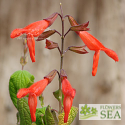
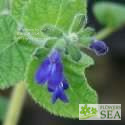
(Mexican Many Flowered Sage) Blooming from late summer into winter, this Mexican cloud-forest native has so many flowers that they are difficult to count. The deep violet blossoms develop distinct, white beelines after opening.
The following terms were added to your search to help improve the result. Click here to exclude these extra terms from the search.
- love, lovers
Results for lover from the blog
| Ask Mr. Sage |
| 1. Ask Mr. Sage: What Is Average Watering? |
| Confusion about watering of plants is understandable, because moisture needs vary so much from one species to another. It also varies based on your local growing conditions. Ask Mr. Sage, a regular feature of the Everything Salvias blog at Flowers by the Sea Online Plant Nursery, explains the differences between the labels drought resistant, average water and water loving classifications for estimating water needs. Some FBTS average water plants also grow well in dry or damp settings. |
| Book Reviews |
| 2. Book Review: Lawn Gone! Low-Maintenance, Sustainable, Attractive Alternatives for Your Yard |
| Lawn Gone by Texas landscaper and garden writer Pam Penick concerns replacement or minimization of lawns through xeriscape, the art of planting attractive waterwise landscapes. Penick redefines suburban yards through designs including perennial groundcovers and small shrubs -- such as Autumn Sages ( Salvia greggii spp.) -- as well as ornamental grasses, sedges and hardscape, including water features. Flowers by the Sea specializes in Salvias and other xeriscapic plants. |
| 3. Book Review: Stop. . .and Smell the Mints |
| Randy Collins was surprised when he got hooked on horticulture following retirement. But after a move to South Carolina, he was even more surprised at how deer destroyed his gardens until he began growing lots of mint family ( Lamiaceae ) plants like Salvias. It inspired him to write Stop...and Smell the Mints . |
| Cultivating Color |
| 4. Cultivating Color: Rare Yellows in the Salvia Garden |
| Among Salvias, one might say yellow represents rarity because, overall, it’s an uncommon flower color for sages. But China and Japan are home to a number of yellow-flowered species, especially shade-loving types. Read more at Everything Salvias. |
| Sage Words About Wildlife |
| 5. Sage Words About Wildlife: Do Deer Devour Salvia? |
| Salvias are not a favorite food for deer. However, they will eat some when plants they consider tasty are in short supply. There is no such thing as deer-proof plants, but you can limit deer damage to your landscaping and vegetable garden by planting lots of sages and other plants that aren't among deer favorites. |
| Getting Started with Salvias |
| 6. Getting Started: Salvias for Zone 8 |
| Rainfall often is heavy in USDA Plant Hardiness Zone 8. It swings in a deep, broad arc from the West Coast to the Gulf Coast and back up the East Coast to the northeast edge of Virginia. What all its diverse areas have in common climatically is an average low winter temperature of 10 degrees F. Flowers by the Sea Online Nursery discusses growing conditions and how to select Salvias for your part of Zone 8 whether wet or dry. |
| Cultivating Color |
| 7. Cultivating Color: Tracking the Elusive History of Autumn & Mountain Sage Warm Pastel Hybrids -- Part I |
| Whether planned or accidental, hybrids happen. This is especially true among the closely related Southwestern and Mexican species of Autumn Sage (Salvia greggii) and Mountain Sage (S. microphylla). They are native to different areas of the Southwest and Mexico, but cross freely when they meet. This story is the first installment in a two-part series initiating our Cultivating Color series. It involves the late Dr. Richard F. Dufresne, a Salvia specialist who helped us track the history of warm-colored S. x jamensis hybrids. |
| Hummingbirds in the Garden |
| 8. Hummingbird Falls Sage: Answers to Your Questions |
| Hummingbirds are vital pollinators that need lots of rich nectar to survive and keep gardens blooming. Salvia BODACIOUS 'Hummingbird Falls' is a unique hanging basket plant that is a natural replacement for plastic nectar feeders. |
| New at FBTS |
| 9. New at FBTS: Salvia Amistad and Friendship from Afar |
| Flowers by the Sea is selling "font-style: italic;">Salvia 'Amistad'. It was a mystery sage to University of Buenos Aires agronomy professor Rolando Uria when he encountered it at an Argentinian plant show in 2005. Discovering its extra-long-blooming characteristic along with the intense violet of its large blossoms, he began sharing it with friends and named it Friendship Sage. |
| Portraits in Gardening |
| 10. Portraits in Gardening: Michael and Kathi Rock's Hummingbird Journey |
| A wedding gift led to Kathi Johnson Rock and Michael Rock's passion for hummingbirds. These Wisconsin birders offer tips and plant suggestions for hummingbird gardeners at FBTS. Although now known as Madison's "Hummingbird People," the Rocks aren't ornithologists or biologists. They are home gardeners and customers of Flowers by the Sea. This article includes a list of favorite hummingbird plants found in the Rocks' gardens. |
| 11. Portraits in Gardening: Michael Kampf |
| Portraits in Gardening is a new blog series from Flowers by the Sea that profiles customers who are passionate about the Salvia genus. This post features Illinois gardener Michael Kampf who has succeeded in growing many kinds of Salvias despite the frigid winters and fiercely hot summers of the Chicago area. He began gardening when 6 years old with encouragement from his mother and fell in love with Salvias at age 12. |
| Sage Experts |
| 12. Sage Experts: Meet Professor Rolando Uria of Argentina |
| Sage Experts is a new feature on our Everything Salvias blog. It focuses on horticulturalists -- both amateurs and professionals -- in settings ranging from botanic gardens to universities. All have expertise in cultivating plants in the Salvia genus. This first profile talks about Argentina's Rolando Uria, an agronomy professor at the University of Buenos Aires and a presenter at the 2013 Salvia Summit II. Uria is well known for discovering Salvia 'Amistad'. |
Common terms in this search: envy hybrid sage natural found peru bolivia parentage special variety point unknown uniquely colored flowers abundant all season long hummingbirds love growing four feet more single shrubby plant good choice colder zones blooming annual frost free climates becomes semi-woody shrub can shaped fit needs grew large number seedlings selected clone superior elk chantily lace jame what color fbts introduction lavender