
Advanced Search
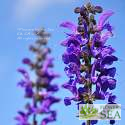
(Wild Meadow Sage) Meadow sages are native to Europe and include many hybrids. This lush, purple-flowered plant is a wild species that most likely is a hybrid of two ancient sages -- Salvia nemorosa and Salvia pratensis.
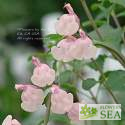
(Stormy Pink Autumn Sage) The dramatic name of this floriferous Autumn Sage is due to the calyxes cupping its smoky apricot-pink blossoms. Some gardeners report gray calyxes and others say dark plum. But for whatever reason, the Stormy Pink that we grow on our Northern California coastal farm has green calyxes with dark stripes.
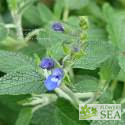
(Furry Colombian Sage) The leaves of this rare shrub are a glossy mid-green on top and fuzzy with hairs underneath, which is why it's commonly called Furry Colombian Sage.
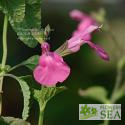
(Rosie O'Grady Mountain Sage) Honeybees and hummingbirds love the large, bright pink flowers of Salvia microphylla 'Rosie O'Grady', a drought-resistant sage. Dense and fragrant, it's large, glossy green leaves are veined and have finely serrated edges. This is a lush choice for dry gardens.
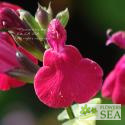
(Killer Cranberry Mountain Sage) Masses of magenta flowers on tall spikes lure honeybees and hummingbirds to the rich nectar of Salvia microphylla 'Killer Cranberry'. Its prolific flowers are a killer attraction for people too.
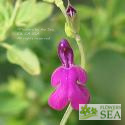
(Navajo Autumn Sage) Even a hint of blue is unusual among Autumn Sage flowers. Salvia greggii 'Navajo Purple' is a rarity due to its magenta-purple blossoms, which hint at natural hybridization including a mystery parent in the blue range, such as Salvia lycioides.
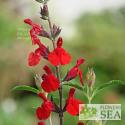
(Radio Red Autumn Sage) Dark calyxes support true red blossoms in Salvia greggii 'Radio Red', a 2015 introduction from the Darwin Perennials division of Ball Seed. Its tiny, smooth, elliptical leaves form a light, airy backdrop for the dramatic flowers.
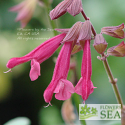
(Wendy's Wish Sage) A new hybrid Salvia from Australia, Wendy's Wish is absolutely spectacular! Quick to bloom, compact and tidy in habit, we believe this to be one of the finest of all Salvia varieties.
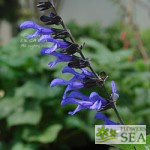
(Rhythm and Blues Anise-Scented Sage) The large, deep bluish-purple flowers of Salvia BODACIOUS ‘Rhythm and Blues’ are shaped like parrot beaks and supported by black calyxes. It's foliage smells sweet with a hint of licorice. It's superior to the old standby Salvia guaranitica 'Black and Blue'.
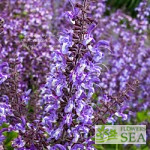
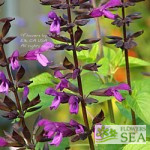
(Smokey Jazz Anise-Scented Sage) The dusky black calyxes of Salvia BODACIOUS® ‘Smokey Jazz’ support large flowers shaped like parrot beaks the unique color of boysenberries — a hue between red and purple.
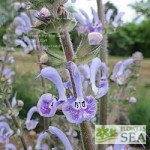
(Shangri-la Sage) Take a close look at Salvia moorcroftiana x indica ‘Shangri-la’ and you’ll notice that its lavender flowers have lighter lower lips with deep purple freckles.
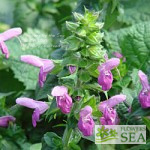
(Autumn Enchanter Japanese Woodland Sage) Salvia glabrescens ‘Autumn Enchanter’ has bicolored orchid pink flowers that are larger and bloom earlier than those of S. glabrescens ‘Shi Ho’. Autumn Enchanter is also more floriferous, blooms longer, and grows more rapidly with greater vigor.
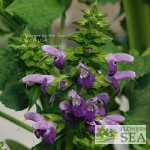
(Autumn Equinox Japanese Woodland Sage) Although similar to the Japanese native Shi Ho Woodland Sage, Salvia glabrescens 'Autumn Equinox' has much larger flowers that are bicolored purple and bloom earlier. Autumn Equinox is also more floriferous, blooms longer, and grows more rapidly with greater vigor.

The following terms were added to your search to help improve the result. Click here to exclude these extra terms from the search.
- nurseries, nurserys
Results for nursery from the blog
| 1. Salvia Summit II: An International Gathering of Sage Thought, March 7 to 10 |
| Salvias thrive in many different climates and parts of the world. Consequently, those who love the genus are an international tribe stretching from Alaska to Argentina and from South Africa to Southern California. Members of the tribe, from Salvia experts to home gardeners, will gather March 7 to 9 at Huntington Botanical Gardens in San Marino, California, for Salvia Summit II. Speakers will include academics, horticulturists, researchers and a forensic scientist specializing in Salvia chemistry. This event follows up on Salvia Summit I, which was held in 2008 on California's Central Coast at Cabrillo College. |
| 2. Salvia Summit III Meets at Tilden Regional Park in October |
| Botanists, horticulturists and gardening enthusiasts who love the Salvia genus are invited to Salvia Summit III – a global conference taking place from Friday, October 7, to Sunday October 9, 2016 in Berkeley, California. Lectures will be held at the Environmental Education Center of Tilden Regional Park, which is on the Berkeley boundary of the 2,079-acre park. |
| Hummingbirds in the Garden |
| 3. 6 Indispensable Hummingbird Flowers for Long, Easy Bloom |
| Hummingbirds are like tiny combat jets dive bombing each other when staking claim to the nectar-rich flowers they need for survival. Fights over nectar habitat can reduce hummingbird gardens to single occupancy. FBTS Farm and Online Nursery details and tells stories about its top six hummingbird flowers. Plant lots of them to accommodate a village of hungry hummers. |
| 4. A Community of Anise Scented Sages We Adore |
| You might expect the foliage of a plant called Anise-Scented Sage (Salvia guaranitica) to smell robustly like licorice, which shares the same fragrance as anise. Some gardeners detect a hint of licorice after crushing a leaf, but many say the foliage merely smells sweet. These popular sages are native to Brazil where indigenous peoples used their leaves as a medicine. Flowers by the Sea grows many varieties in a wide range of sizes and flower colors |
| 5. About our Farm: Growing Sage by the Sea |
| Flowers by the Sea (FBTS) is a small, family farm that raises hundreds of species of Salvia and companion plants, including Plectranthus. We are proud of our beautiful plants, excellent customer service and 100 percent guarantee of satisfaction. |
| Ask Mr. Sage |
| 6. Ask Mr. Sage: What Tropical Sage Should I Select? |
| Selecting the right types of Tropical Sage ( Salvia coccinea ) can be confusing when viewing them in a catalog and seeing similar flower colors. Yet they may differ in cultivation needs, foliage, heat tolerance, and size. Mr. Sage offers ideas for comparing differences and similarities. Ask Mr. Sage is a regular feature of the FBTS Everything Salvias Blog , which responds to questions from customers. |
| 7. Ask Mr. Sage: Where Can You Grow Agastache? |
| Hummingbirds love Agastache. Mr. Sage explains that just because one kind of Agastache is wrong for your climate, it doesn't mean they all are and that the genus is native to most of the United States. Ask Mr. Sage is a regular feature in our Everything Salvias Blog that answers customer questions. |
| 8. Ask Mr. Sage: Why Didn't My Fall Blooming Salvia Flower? |
| When growing Salvias that begin blooming in fall, Mr. Sage says it's important to know when first frost likely will occur in your area. Ask Mr. Sage is a regular feature of the FBTS Everything Salvias Blog. |
| 9. Ask Mr. Sage: What Sages Grow in Clay Soils? |
| Ask Mr. Sage answers questions based on calls and emails that Flowers by the Sea receives, such as concerns about what Salvias will grow in clay soils. This article talks about specific plants for dry and wet clay conditions, how to improve soil drainage and planting on slopes in wet areas. |
| 10. August in the Salvia Garden |
| August is a time when many sages grow rapidly and feed a frenzy of pollinators in need of rich nectar and pollen. It's hot, so you have to be careful not to let plants or yourself wilt. Here are some tips for tasks from watering to planning when tending your garden this month. |
| 11. Battles in the Salvia Garden: Controlling Spider Mites - Part II |
| Pollinators lose important food sources when Salvias and other nectar-rich flowers are destroyed by spider mites. This is Part 2 of a two-part series about understanding and overcoming these dangerous pests. Along with the non-chemical interventions described in Part 1 of this series, gardeners sometimes need the help of predatory insects and mites, insecticidal soaps and horticultural oils. Pesticides called miticides may also eventually be necessary, but should be the last resort. |
| Hummingbirds in the Garden |
| 12. 5 Big Orange Bedding Plant Beauties for Hummingbirds |
| You'll hear a lot about red when planting annuals for wildlife gardens, because hummingbirds garden love red, tubular, nectar-rich flowers. But orange is another hummingbird favorite not to be neglected. Flowers by the Sea suggests five long blooming species for your landscape that begin shouting "Orange, orange, orange" in spring when hummingbirds are big-time hungry now, now, now as they head north for the nesting season. |
Common terms in this search: wild meadow sage sages native europe include many hybrids lush purple-flowered plant species most likely hybrid two ancient nemorosa pratensis candle-like flower spikes long blooming rise above large-leafed forest-green foliage sylvestris vigorous one reliable easily grown growing number keep mind they cross readily similar greggii-s microphylla group prepared surprises latin word indicates woodland well known their cold tolerance add vibrant