
Advanced Search
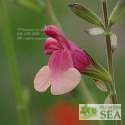
(Shell Dancer Sage) So many sages combine resilience and loveliness. This includes Salvia 'Shell Dancer', which withstands heat and drought yet has delicate looking blossoms and lush green foliage.
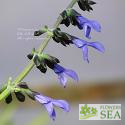
(Huntington Garden Mexican Sage) In areas with mild end-of-year weather, this sage is a tower of nectar for hummingbirds. Large blue-to-purple flowers shaped like open parrot beaks reach out from dark calyxes. Their spikes stretch out horizontally and gently curve upward from the plant's mid-green foliage.
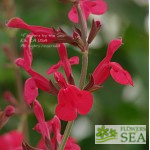
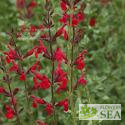
(Windwalker® Royal Red Salvia) Salvia darcyi x S. microphylla 'PWIN03S' is one of the top 2015 plants for USDA Cold Hardiness Zone 5 selected by Colorado's Plant Select®, a nonprofit organization that focuses on promoting plants for low-water gardens.
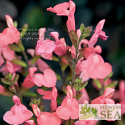
(Blast Pink Mountain Sage) Long blooming Salvia microphylla 'Heatwave Blast' produces prolific quantities of large, dusky salmon-pink blossoms and dense, mid-green foliage.
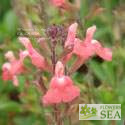
(Salmon Autumn Sage) Creamy salmon-colored flowers with white throats make this elegant Autumn Sage perfect for a pastel garden or as a cooling color in a mixed sage border. Bloom time is spring into fall for this petite Salvia greggii native to the American Southwest and Mexico.
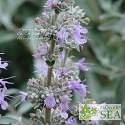
(Gayle Nielson Hybrid Sage) Whorl-like clusters of violet-blue flowers on slender stems as well as its height and width indicate that Gayle Nielson Hybrid Sage is related to some form of Salvia clevelandii.
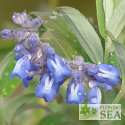
(Blue Ecuadorian Sage) A densely branched shrub with silvery leaves and dusky blue flowers, this rare species was once thought to be Salvia cruickshanksii. In the nursery trade, it sometimes is called Salvia 'Equador'.
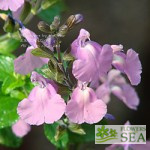
(Elk Smokey Grape Jame Sage) We think the dusky lavender flowers of Salvia x ‘Elk Smokey Grape’ look like the dusty, pale reddish-blue of Malbec grapes. This is a floriferous beauty.
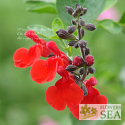
(Red Velvet Mountain Sage) This is one of the most intense red-flowering variety of Mountain Sage we grow. Medium-sized flowers are profuse on this large, vigorous plant -- particularly in spring and fall. Dark stems and calyxes intensify the plant's drama along with glossy green foliage.
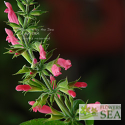
(Giant Karwinski's Sage) San Francisco arborist and gardener extraordinaire Ted Kipping developed this tower of creamy pinkalicious power that hummingbirds love. It's lush with bright green leaves that are large, pebbly and hairy on the underside.
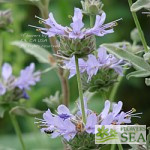
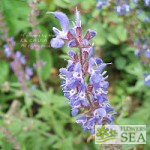
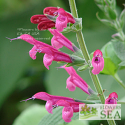
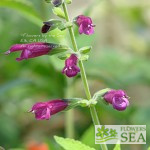
(Envy Hybrid Sage) A natural hybrid found in Peru and Bolivia, the parentage of this special variety is at this point unknown. The uniquely colored flowers are abundant all season long, and the hummingbirds love it.
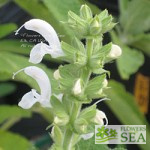
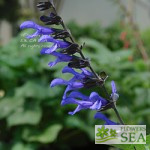
(Rhythm and Blues Anise-Scented Sage) The large, deep bluish-purple flowers of Salvia BODACIOUS ‘Rhythm and Blues’ are shaped like parrot beaks and supported by black calyxes. It's foliage smells sweet with a hint of licorice. It's superior to the old standby Salvia guaranitica 'Black and Blue'.
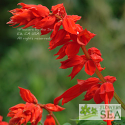
(Faye Chapel Scarlet Sage) A vivid red, the drooping blossoms of this sturdy, long flowering Salvia are large and numerous. Use it singly as a dramatic garden accent or container plant; mass it for a stunning effect. This is an heirloom plant from the Atlantic Coast, where it has been grown as a hummingbird plant for decades.
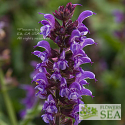
(Lyrical Silvertone Meadow Sage) European Meadow Sages are known for their intense color. However, Salvia nemorosa 'Lyrical Silvertone' is exceptional for its violet-blue and silver two-tone flowers supported by dark calyxes.
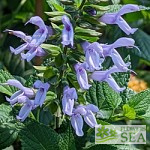
(COOL Periwinkle Anise-Scented Sage) Dusky green bracts cup the lavender-blue blossoms of Salvia COOL Periwinkle that attract hummingbirds. The fragrance of its bright green leaves may remind you of licorice.
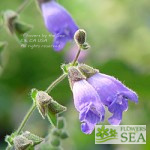
(Himalayan Sage or Kashmir Sage) The word "hians" in Salvia hians means "gaping" and refers to the hanging lip of this sage's flowers, which bloom from late spring through early fall. This may or may not the "true" species as it is described, hence the term aff or affnis in the name, which indicates that this plant is related to, has an affinity to, but is not identical to Salvia hians.
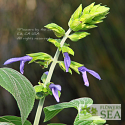
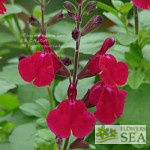
(Elk Raspberry Moose Sage) The deep raspberry flowers of this Salvia x Jamensis look good enough to eat, like spoonfuls of a silky, mouthwatering mousse dessert. Yet the 'moose' in its name isn't a misspelling. It refers to flowers that are larger than normal for a Jame Sage.
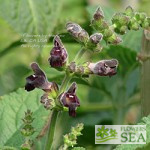
(Black Dan-shen) Growing into a basal rosette of leaves measuring up to 3 feet across, Salvia przewalskii 'CC5795' is known for its handsome foliage and deep purple, almost black flowers.
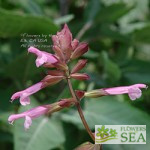
(Kisses and Wishes Sage) Blooming over multiple seasons, Salvia ‘Kisses and Wishes’ bursts with long, luminous, rosy pink blossoms nestled in pink-to-gold bracts. It’s so pretty that it seems unfair to refer to the newest member of the Wish Sages as a “mutation.”
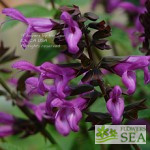
(COOL Fandango Anise Scented Sage) A combination of dark, rosy bracts and magenta blossoms make Salvia COOL Fandango dance. It’s vivid, floriferous, and a hummingbird favorite.
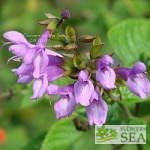
(COOL Lavender Blush Anise Scented Sage) Dusky green and red-edged bracts surround the pale-throated lavender blossoms of Salvia COOL Lavender Blush. It's a magnet for hummingbirds.
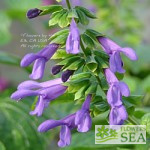
(COOL Lavender Mist Anise Scented Sage) Bright green bracts and rich lavender blossoms sing in Salvia COOL Lavender Mist. Hummingbirds keep this bountiful bloomer buzzing.
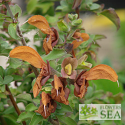
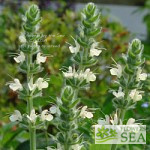
(Austrian Sage) Tall spikes of large, pale yellow flowers rise up from Salvia austriaca’s basal rosette of impressively large leaves. Deeply lobed, like the edges of a lacy collar, the leaves are broader and longer than those of any Salvia we have ever grown.
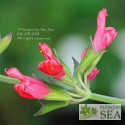
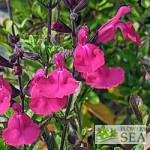
(Brilliance Pink Mountain Sage) Long blooming Salvia microphylla 'Heatwave Brilliance' produces prolific quantities of deep reddish-pink, or cerise, blossoms along with dense, mid-green foliage.
The following terms were added to your search to help improve the result. Click here to exclude these extra terms from the search.
- need, needed
Results for needs from the blog
| Salvia Small Talk |
| 1. Salvia Small Talk: Deep Watering vs. Sprinkling |
| Sprinkling is the fine, misguided art of giving your landscape a quick spray of water that moistens foliage as well as soil. This can cause foliar diseases, such as mildew, while also depriving roots of sufficient water. What a perennial needs is a long gulp applied to the ground and at the edge of its canopy or drip line |
| Hummingbirds in the Garden |
| 2. Red Birds in a Tree: How a Rare Wildflower Became a Hummingbird Garden Star |
| Red Birds in a Tree, known botanically as Scrophularia macrantha , is a rare, cold-hardy, Wild West perennial with cheery red flowers hummingbirds love. Southwest New Mexico botanist O.B. Metcalfe collected it in 1904. |
| Butterflies in the Garden |
| 3. Growing Habitat: Three Tough Milkweeds to Help Monarchs |
| Flowers by the Sea Farm and Online Plant Nursery is serious about wildlife gardening and grows a number of milkweed species considered among the best for supporting Monarch butterflies. Three of the nursery's toughest, loveliest milkweeds are Indian Milkweed (Asclepias eriocarpa), Showy Milkweed (Asclepias speciosa) and Common Milkweed (Asclepias syriaca). Read about the history of milkweeds and the reasons why Monarch butterflies are threatened due to a shortage of these tough yet lovely plants caused by herbicides. Learn how herbicides and pesticides harm Monarchs and other milkweed-loving pollinators. |
| Hummingbirds in the Garden |
| 4. Hummingbirds in the Garden: Attracting Hummingbirds to Your Garden |
| Planting a hummingbird garden filled with nectar-rich, long-blooming Salvias aids preservation of hummingbird species that migrate each year throughout North America. It also gives you a front-row seat to a fascinating aerobatics show. Backyard islands of colorful sages are like gas stations for hummingbirds' long-distance journeys. Salvias can keep your garden whirring with the helicopter-like flight of hummingbirds from spring through autumn and -- in warm climates -- into winter. |
| Container Gardening |
| 5. Container Gardening Basics: Selecting a Good Potting Mix |
| Why is regular garden soil a poor choice for container gardening, and why is sterilized, soilless potting mix better. The term "sterilized" indicates that a potting medium is free of pathogens, weed seed and toxins. "Soilless" means that although it contains organic and inorganic matter, it isn't a garden soil. One of the main reasons to use a soilless mix is that it allows water to drain better in a confined space. Flowers by the Sea explains the basics of potting mixes and why no one recipe fits all needs. |
| 6. Creating Oases in Dry Yards With FBTS Container Gardens |
| Container gardening likely began in ancient Egypt with Pharaoh Ramesses III who created garden cities lined with potted trees and papyrus plants. Ramesses didn't have a mail-order plant nursery like Flowers by the Sea to help him determine what to grow and how to do it. He also didn't have three-day mail delivery. But you don't have minions to help you plan and plant your landscape. So FBTS has designed discounted container kits for a variety of growing conditions, including drought. |
| Ask Mr. Sage |
| 7. Ask Mr. Sage: How to Prevent Root Disease in Plants for Dry Gardens |
| Learn how to prevent root rot and keep dry-garden Salvias healthy by providing optimum growing conditions and avoiding overwatering. Ask Mr. Sage is a Q&A feature based on topics raised in calls and emails to Flowers by the Sea. This one, which concerns a Salvia species that is drought resistant and native to a dry climate, considers how to identify and prevent rot caused by a complex of soil pathogens that attack when roots. |
| Salvia Small Talk |
| 8. Salvia Small Talk: Well-Drained Soil |
| Well-drained soil for Salvias contains a loose mix of clay, coarse sand and organic matter. |
| Book Reviews |
| 9. Book Reviews: Three Top Reads for Dry Gardening |
| Don’t think “drab” when you hear the phrase “dry garden.” With guidance from good books and a willingness to experiment, you can create colorful flowerbeds and landscapes that require little to no supplemental watering. Here is a quick overview of three books that are excellent resources about sustainable dry gardening. |
| New at FBTS |
| 10. Himalayan Sage Is the Salvia Collector's Holy Grail: Part 2 |
| Plants don’t have voices but they have stories to tell, including tales of discovery. It’s easy to see why the early 18th century plant explorer Victor Jacquemont would have paused to collect the rare Salvia hians while traversing broad expanses of northwestern India. This second half of our article about the alluring species digs into its history. |
| 11. Pretty, Practical Cottage Gardens Rooted in Pandemic History |
| Romantic visions of small, rose-covered houses with thatched roofs and bountifully blooming yards don't tell the story of how cottage gardens came to be in the Middle Ages due to a devastating pandemic. FBTS Farm and Online Nursery talks about cottage gardening past and present. |
| Ask Mr. Sage |
| 12. Ask Mr. Sage: Why Didn't My Fall Blooming Salvia Flower? |
| When growing Salvias that begin blooming in fall, Mr. Sage says it's important to know when first frost likely will occur in your area. Ask Mr. Sage is a regular feature of the FBTS Everything Salvias Blog. |
Common terms in this search: shell part cream bottom half lower lip blossom ages suncrest nurseries watsonville california developed suncrests fades western series contains hybrids southwestern species including mountain microphylla autumn greggii salvias pinkish pink dancer has sage many sages combine resilience loveliness includes which withstands heat drought yet delicate fuchsia- looking blossoms lush green foliage dancers bicolor flower waxy texture sheen sophisticated hot bushy