
Advanced Search
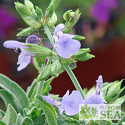
(Greek Sage) Most of the dried culinary sage sold in the United States is Greek Sage. Frescoes on the island of Crete dated to 1400 BC depict this plant, which was used by the Phoenicians and Greeks for cooking and medicine. It is an ancient and beloved friend of mankind.
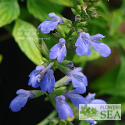
(Arizona Blue Sage) We are so impressed with this top-performing, drought-resistant ground cover that we have rated it best of class. Arizona Blue Sage is adaptable to a variety of shady conditions and blossoms so abundantly that it seems to have as many rich blue flowers as it has leaves. It is native to dry, shaded areas in mountain canyons in Arizona, New Mexico and Texas.
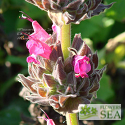
(Little Hummingbird Sage or Pitcher Sage) At one-fourth to one-half the size of our other Hummingbird Sages, this is the smallest variety of Salvia spathacea that we grow.
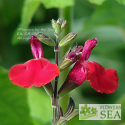
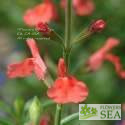
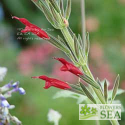
(Red Michoacán Sage) No other Salvia has flowers that are such a deep blood red. The 3-to-4 inch long tubular blossoms of this shade-loving shrub are displayed in clusters at the ends of the stems, which have light green, textured leaves that are almost round.
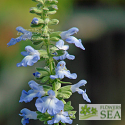
(Big Pitcher Sage) As its scientific name indicates, this sage has very large flowers. They are almost two-tone, changing from deep violet to a light blue or white at their base where they are cupped by dusky purple calyxes.
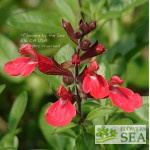
(Lipstick Autumn Sage) Similar to a little bit of lipstick on a pretty face, the rosy flowers of this hardy, heat-tolerant sage add a finishing touch to a perennial Salvia border. The creamy pinkish-red blossoms have a contrasting white throat and are cupped by rosy brown calexes on long spikes.
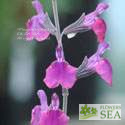
(Diane's Autumn Sage) Chip Schumacher of Hill Country Gardens in Texas selected this lovely Autumn Sage hybrid, which has handsome foliage and abundant two-tone dark purple flowers. This fine variety is often the first Salvia greggii to bloom in spring.
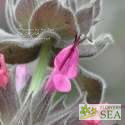
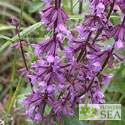
(Judean Sage) Native to the mountains of Judea in Israel, this dark violet flowered, perennial sage is unique among the Palestinian Salvias - as a woodland native it grows well in partial shade. It is a tough, drought-resistant plant with deeply cut & hairy foliage which forms impressive mounds of color in the spring and early summer.
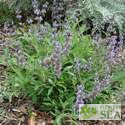
(Dry Earth Black Sage) Black Sage Salvia mellifera is one of the most common and fragrant native shrubs in the California Coast Ranges and is ideal for dry gardens. At 12 inches tall by 5 feet wide, this variety is an excellent groundcover.
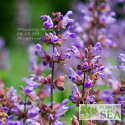
(Wand Sage) Whorls of deep violet blossoms are cupped by dark bracts on the flower spikes of this mid-height herbaceous sage from Turkey. Its foliage is thick, corrugated and fragrant. This plant is lovely and hardy, so it is surprising that it wasn’t introduced to commercial cultivation until 2007.
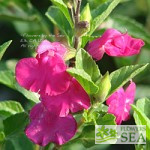
(Telegraph Avenue Dwarf Mountain Sage) Here’s another member of the Turbulent Sixties Series of Southwestern Mountain Sages (Salvia microphylla), which developed from one of nature’s rebels – an accidental hybrid that Monterey Bay Nursery (MBN) named ‘Berzerkeley’ after finding it taking a stand in the nursery’s gravel paving.
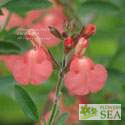
(Tangerine Ballet Hybrid Jame Sage) Soft pinkish-orange flowers with contrasting yellow eyes make this Jame Sage look as tasty as sorbet. Hardy to at least 10 degrees F, Tangerine Ballet is also heat tolerant, drought resistant and long blooming-- all marks of Salvias in the closely related Autumn and Mountain Sage group.
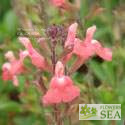
(Salmon Autumn Sage) Creamy salmon-colored flowers with white throats make this elegant Autumn Sage perfect for a pastel garden or as a cooling color in a mixed sage border. Bloom time is spring into fall for this petite Salvia greggii native to the American Southwest and Mexico.
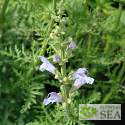
(Xobo Valley Sage) Although petite, the rare Xobo Valley Sage is eyecatching due to its lacy, bright green foliage and powder blue flowers. It's even possible that this long-blooming sage may have caught Nelson Mandela's eye as he grew up in the Wild Coast area of South Africa's Eastern Cape.
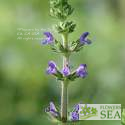
(Wild Sage) Toothed and attractively wrinkled, the gray-green, basal foliage of Wild Sage contrasts prettily with deep lavender-to-purple flowers supported by grassy green bracts. This cold-hardy sage is native to northern Africa and parts of Asia and Europe.
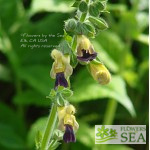
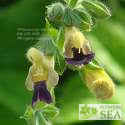
(Purple & Yellow Yunnan Sage or ji ye shu wei cao) Confusion about this plant's scientific name cause it to appear in some sources as Salvia flava var. megalantha. Whatever you call it, this Chinese species from Yunnan Province has enchanting yellow and purple flowers that attract viewers as well as honeybees.
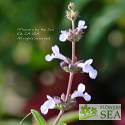
(Pacific Blue Sage) Whorls of deep lavender-blue flowers contrast brightly against the dark maroon stems of this likely hybrid of Salvia brandegeei and Salvia munzii.
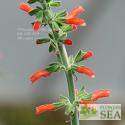
(Cundinamarca Sage) This Colombian Salvia is difficult to obtain outside of its home country. As far as we know, Flowers by the Sea is the first nursery to offer it in the United States.
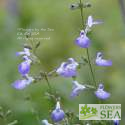
(Summer Skies West Texas Grass Sage) Butterflies and honeybees particularly favor this West Texas mountain native. In contrast to the true blue flowers of regular Salvia reptans, this cultivar has purple blossoms with cloud-like, lavender-to-white throats.
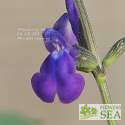
(Nuevo Leon Hybrid Sage) Imagine tiny, smooth, green leaves and deeper lavender-blue flowers than those of Salvia lycioides x greggii 'San Isidro'. With its midnight purple flowers, Nuevo Leon is a dramatic Salvia greggii hybrid.
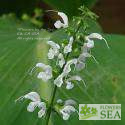
(White Meadow Sage) Whorls of pure white flowers shaped like parrot beaks rise on tall spikes from the wrinkly, basal foliage of Salvia pratensis 'Swan Lake'. The large, mid-green leaves have attractively serrated edges.
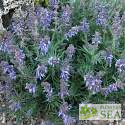
(Yugoslavian Cut Leaf Sage) This is a rare Baltic steppe plant that grows beautifully in sunny locations with little water and excellent drainage. It is endemic to a the Orlova Brdo region of the Former Yugoslav Republic of Macedonia.
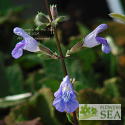
(Turkish Tea Sage) Sometimes an attractive plant is also medically powerful. That's true of the lavender flowered Salvia aucheri, which has strong white beelines. This Turkish native is consumed as an ingredient in teas used as folk remedies for many problems, including abdominal bloating and infections.
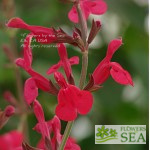
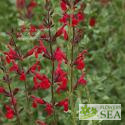
(Windwalker® Royal Red Salvia) Salvia darcyi x S. microphylla 'PWIN03S' is one of the top 2015 plants for USDA Cold Hardiness Zone 5 selected by Colorado's Plant Select®, a nonprofit organization that focuses on promoting plants for low-water gardens.
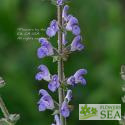
(Iranian Oil Sage) Butterflies and honeybees are drawn to the long blooming, dusky violet-blue flowers of Salvia atropatana. However, deer say no to its charms, due to its essential oils being less than tasty.
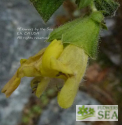
(Campanula Leaf Sage) The deep yellow flowers of Campanulata Leaf Sages are scarce among Salvias. Salvia campanulata CC#7706 is a sunny Himalayan beauty.
The following terms were added to your search to help improve the result. Click here to exclude these extra terms from the search.
- tolerate
Results for tolerates from the blog
| 1. Drought-Resistant Beauties: A Guide to the Salvia greggii and S. microphylla Group |
| It can be a long journey from discovery to popularity for a plant. Currently, the most widely sought group of Salvias is the one encompassing S. greggii , and S. microphylla , which are commonly known as Autumn Sage and Mountain Sage. They caught the eye of naturalists traveling the American Southwest and Mexico's Sierra Madre mountains in the mid-to-late 1800s. However, they didn't take root in garden catalogs for well over 100 years. |
| 2. Fall Cleanup: Plant Placement and Pesky Problems |
| You don’t usually have to fuss over Salvias to give them what they need. Yet the end of fall and other growing seasons are good times to seek solutions to problems that affect plant vigor. It is a time for a call to attention as well as a cleanup call to action. |
| 3. Fall Planting: 8 Sages for Fragrance by Your Front Door |
| Colorful plantings make entryways attractive. Even better are pretty plantings that are fragrant and provide a sensory lift before you journey indoors. Scent wakes up memories and makes us see in a different way. Here are eight sensible suggestions for adding lovely scents to your landscape. |
| Sacred Sages |
| 4. Sacred Sage: Giant Bolivian Sage |
| Of all the mint family's more than 6,500 species worldwide, Giant Bolivian Sage (Salvia dombeyi) has the longest blossoms and tallest growth. Each tubular crimson flower grows up to 5 inches long and has a burgundy calyx at its base.The plant's bright green, heart-shaped leaves are equally long. In South America, the flowers are pollinated by hummingbirds with extremely long beaks. However, Giant Bolivian Sage don't need pollination to flower beautifully for many seasons if growing conditions are right. |
| New at FBTS |
| 5. New at FBTS: Salvia x jamensis 'California Sunset' |
| Viewing the creamy peach-pink and yellow of California Sunset Autumn Sage (Salvia x jamenis 'California Sunset') may remind you of a Georgia O'Keefe painting. Anyone who has viewed sunset dipping into the mountains of New Mexico knows that soft pastels are common to Southwestern sunsets. Similarly, subtle bicolored combinations of pastels are common characteristics of many S. x jamensis species, which are crosses between various Autumn Sages (Salvia greggii spp.) and Mountain Sages (Salvia microphylla spp.). |
| 6. New at FBTS: Hummingbirds Thrive on Margie Griffith Sage |
| A love of birds can grow into a passion for gardening. The reverse is also true. Sometimes these passions result in the development of excellent plants, such as Salvia x 'Margie Griffith' -- a 2017 introduction at Flowers by the Sea Online Nursery. Margie Griffith Sage grows up to 96 inches tall and wide in bloom. In some parts of its USDA Plant Hardiness Zones 8 to 11 it feeds hummingbirds nearly year round. |
| Cultivating Color |
| 7. Pantone Pageant: A Chorus Line of Grayed Jade Designer Salvias |
| Sage is the common name for the uncommonly beautiful Salvia genus. But when designers describe a product as being sage-colored, they mean a shade of gray-green that they say is soothing and that harmonizes with a multitude of colors, including soft pastels, hot oranges and deep purples. A version of sage called "Grayed Jade 14-6011" is one of the Pantone color-matching system's top shades for the design industry this year. This post identifies some Grayed Jade plants in the Flowers by the Sea collection. They are fine peacemakers amid a Salvia garden based on a mixture of Pantone's top greens for 2013, which you can read about in previous articles from our Pantone Pageant series of designer colors in the landscape. |
| Salvias Down South |
| 8. Salvias Down South: 15 Thirsty Salvias for Florida |
| Flowers by the Sea grows Salvias that are already popular in the Southeast as well as others we would like to introduce to gardeners seeking thirsty flowering plants that can also adjust to dry spells. Many are fine choices for Florida hummingbird gardens. Our suggestions are organized into categories based on moisture tolerance – average and ample -- as well as sun requirements. |
| 9. Salvias Down South: Tough Texans Sing the Blues |
| Blue Salvias bring peace to flower gardens. True blues, such as West Texas Grass Sage (Salvia reptans), are especially eye-catching. The same anthocyanins that make berries a healthy dietary choice also give them their colors. Similarly these chemicals create the wide variety of blues, purples and reds in the petals of flowers such as Salvias. Flowers by the Sea offers six varieties of tough Texas sages that can help you create a soulful garden bursting with blue. Drought-resistant and long-blooming, they grow happily in USDA plant hardiness zones 8 to 9, with some flourishing in areas as cool as Zone 4 and as hot as Zone 11. |
| Hummingbirds in the Garden |
| 10. Seeing Red and Loving It: Hummingbirds and Salvia microphylla |
| As with so many aspects of life, the hummingbird-Salvia relationship is circular. It is difficult to have one without the other. Unfortunately, many species of hummingbirds are threatened or endangered. By planting Mountain Sage ( Salvia microphylla ) you invite hummingbirds into your garden, expand their habitat and ensure pollination for abundant blossoming. |
Common terms in this search: greek sage most dried culinary sold united states frescoes island crete dating depict plant used phoenicians greeks cooking medicine ancient beloved friend mankind garden provides pleasant lavender fragrance especially warm days has spikes pink-to-lavender flowers similar sages loves full sun well-drained soil however tolerates moist ground compact which grows inches tall wide good choice fragrant borders patio containers well kitchen