
Advanced Search
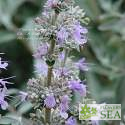
(Gayle Nielson Hybrid Sage) Whorl-like clusters of violet-blue flowers on slender stems as well as its height and width indicate that Gayle Nielson Hybrid Sage is related to some form of Salvia clevelandii.
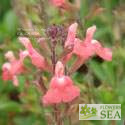
(Salmon Autumn Sage) Creamy salmon-colored flowers with white throats make this elegant Autumn Sage perfect for a pastel garden or as a cooling color in a mixed sage border. Bloom time is spring into fall for this petite Salvia greggii native to the American Southwest and Mexico.

(Elk Buttercup Jame Sage) Red flower buds unfurl into the surprisingly buttery yellow blossoms of Elk Buttercup. Subtly bicolored, the flowers have touches of light pink including fine hairs on the upper lip.
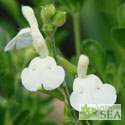
(VIBE® Ignition White Sage) Never before have we seen such a pure white among the species to which Jame Sages are related. We love this purity as well as the bright green calyxes supporting the large flowers of Elk White Ice and giving it an overall crisp look.

(Elk Butter Light Jame Sage) "Clear" is how we describe the translucent quality of Elk Butter Light's creamy yellow blossoms, which are supported by bright green calyxes. Unlike the green-tinged flowers of Elk Lemon Light Jame Sage, these blossoms are paler and one pure color.
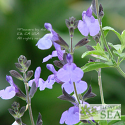
(Elk Blue Moon II Jame Sage) The phrase "blue moon" signifies a rare event. Elk Blue Moon Jame Sage is an unusual combination for a Salvia x jamensis hybrid -- dusky violet flowers with pale-blue throats, dark blue calyxes and mid-green foliage.
Note: This is a new (2014) cultivar that we chose to replace the original 'Elk Blue Moon'. It is a superior grower, and otherwise very similar.


(Elk Cotton Candy Jame Sage) Rosy hairs on the upper lip and pale white throats highlight the translucent, blush pink blossoms of Elk Cotton Candy Jame Sage. Dark, deeply contrasting calyxes support the medium-size flowers.
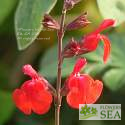
(Flame Autumn Sage) Crimson flowers contrast brightly against deep purple calyxes and stems in Flame Autumn Sage. The leaves -- tiny ellipses without veins -- are soft and shiver in the breeze.
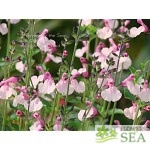
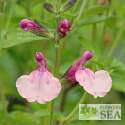
(Dancing Dolls Sage) Sages can be such tough plants. Many, such as Salvia 'Dancing Dolls', withstand heat and drought yet have delicate looking blossoms. Dancing Dolls features cream and rose bicolor flowers.
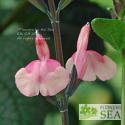
(Fancy Dancer Sage) Sages can be such tough plants withstanding heat and drought. Yet so many, including Salvia 'Fancy Dancer' have delicate looking blossoms. This one has bicolor flowers combining light and hot pink tones.
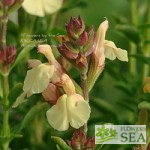
(Golden Girl Sage) Sages can be such tough plants. Many, such as Salvia 'Golden Girl', withstand heat and drought yet have delicate looking blossoms. Golden Girl features yellow flowers with a hint of rosy pink along with dark rose calyxes.
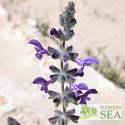
(Wooly Arabian Sage) "Radiant" is the word that garden writer and Salvia specialist Betsy Clebsch uses to describe the halo of white hairs covering the foliage and calyxes of Salvia lanigera.
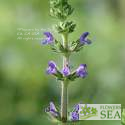
(Wild Sage) Toothed and attractively wrinkled, the gray-green, basal foliage of Wild Sage contrasts prettily with deep lavender-to-purple flowers supported by grassy green bracts. This cold-hardy sage is native to northern Africa and parts of Asia and Europe.
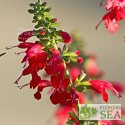
(Lady in Red Tropical Sage) Lady in Red is a variety of Salvia coccinea Juss. ex Murray, which is often called Texas Sage. It is the best red-flowering Tropical Sage that we grow.
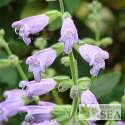
(Mystery Yunnan Sage) Sometimes we come across a beauty that has no name. This lovely species from China's Yunnan province is an excellent example. Aside from lacking scientific and common names, it arrived here as an imported seed with little information about how the plant was discovered.
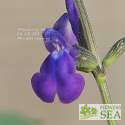
(Nuevo Leon Hybrid Sage) Imagine tiny, smooth, green leaves and deeper lavender-blue flowers than those of Salvia lycioides x greggii 'San Isidro'. With its midnight purple flowers, Nuevo Leon is a dramatic Salvia greggii hybrid.
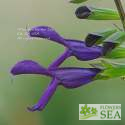
(Betsy's Choice Sage) Life and botany have their beautiful mysteries. Betsy's Choice Sage is one of them. We aren't certain of the parentage or history of this tall, attractive, fast-growing sage. However, we are certain that we love its long, royal purple flowers. Hummingbirds do as well.
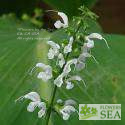
(White Meadow Sage) Whorls of pure white flowers shaped like parrot beaks rise on tall spikes from the wrinkly, basal foliage of Salvia pratensis 'Swan Lake'. The large, mid-green leaves have attractively serrated edges.
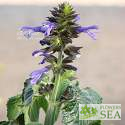
(Lolly's Mexican Sage) Our variety of Salvia mexicana 'Lolly' is the tall kind growing up to about shoulder height. A shorter form is often called "Lollie Jackson" or "Lolly Jackson." Who or what the mysterious Lolly is remains unclear.
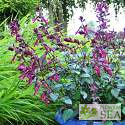
(Love and Wishes Sage) Deep purple calyxes support the magenta-purple, tubular blossoms of Salvia x 'Love and Wishes'. They contrast handsomely with dark stems and mid-green foliage.
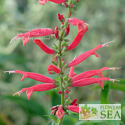
(Frieda Dixon Pineapple Sage) Most varieties of Salvia elegans have bright red flowers. But Frieda Dixon Pineapple Sage, which blooms abundantly beginning in late fall, has softer salmon-pink blossoms set against mid-green, lance-shaped leaves.
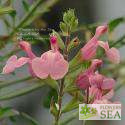
(Elk Twilight's Rosy Glow Jame Sage) Rosy red hairs accentuate the upper lip of each dusky, salmon-pink blossom of this cheery Jame Sage. The flowers are tiny but abundant and are supported by bright green calyxes.
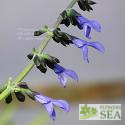
(Huntington Garden Mexican Sage) In areas with mild end-of-year weather, this sage is a tower of nectar for hummingbirds. Large blue-to-purple flowers shaped like open parrot beaks reach out from dark calyxes. Their spikes stretch out horizontally and gently curve upward from the plant's mid-green foliage.
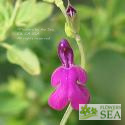
(Navajo Autumn Sage) Even a hint of blue is unusual among Autumn Sage flowers. Salvia greggii 'Navajo Purple' is a rarity due to its magenta-purple blossoms, which hint at natural hybridization including a mystery parent in the blue range, such as Salvia lycioides.
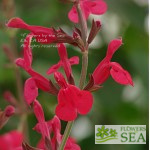
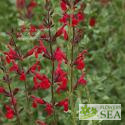
(Windwalker® Royal Red Salvia) Salvia darcyi x S. microphylla 'PWIN03S' is one of the top 2015 plants for USDA Cold Hardiness Zone 5 selected by Colorado's Plant Select®, a nonprofit organization that focuses on promoting plants for low-water gardens.
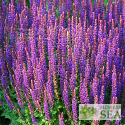
(Burgundy Candles Meadow Sage) When the burgundy buds of Salvia nemorosa 'Burgundy Candles' open, deep violet-blue flowers emerge. They are supported by burgundy and green bracts on purple stems.
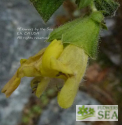
(Campanula Leaf Sage) The deep yellow flowers of Campanulata Leaf Sages are scarce among Salvias. Salvia campanulata CC#7706 is a sunny Himalayan beauty.
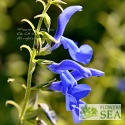
(Giant Gentian Sage) What makes Salvia patens 'De Flores Gigantes' truly giant is the size of its true blue flowers. However, this variety from Argentina is tall as well.
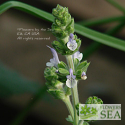
(Strong Spanish Sage) Fuzzy green stems and bracts mature to burgundy on this lovely, lavender flowered sage that roughly doubles in height when blooming. Salvia valentina is a variety of the European native S. nemorosa, a Meadow Sage.
The following terms were added to your search to help improve the result. Click here to exclude these extra terms from the search.
- other
Results for others from the blog
| Book Reviews |
| 1. Book Review: Nature-Friendly Garden by Marlene A. Condon |
| Reading Marlene A. Condon's Nature-Friendly Garden is like observing a game of toppling dominoes. All the pieces are lined up standing on end in a complex, maze-like pattern. Flick one domino and the whole structure tumbles. Similarly, the author shows how simple choices we make in our gardens have consequences that can build or destroy wildlife habitat. |
| Xeric Choices |
| 2. Four Top Drought-Resistant Perennials for Dry Shade |
| Searching for shade-tolerant plants is difficult. Finding ones that grow well in dry conditions, especially as groundcovers, is even more challenging. Flowers by the Sea talks about different types of shade and four drought-resistant perennials for these varying levels of sun exposure. It also explains how to search the company's extensive product menu. |
| Getting Started with Salvias |
| 3. Getting Started: Annual, Perennial and Shrub Sages |
| For beautiful floral display and refreshing greenery, every yard needs a combination of annual bedding plants, perennials and shrubs. Salvias provide a feast of landscaping possibilities. Flowers by the Sea explains all the different types of Salvias, including subshrubs, biennials and tree-like Salvias |
| 4. Getting Started: How Much Sun Salvias Need |
| Answering the question of how much sunlight Salvias need is dependent on the lands and conditions in which they originated. Also called true sages, Salvias may range from full sun to full shade species. But many prefer a combination of sun and shade. Flowers by the Sea is an online, mail-order nursery where you can buy hundreds of different sages. |
| 5. Getting Started: Salvias for the Coastal Southeast |
| True sages are members of the Salvia genus and number in the hundreds. They are native to a wide variety of environments worldwide, which is why some are ideal for the dry gardens of California and others can handle the abundant moisture of the American Southeast. Flowers by the Sea raises many sages that grow well in the Southeast, including some that are either native to the region or have jumped fences from gardens into the wild. |
| 6. Getting Started: Salvias for the Midwest |
| Severe winter chill and summer heat coupled with extreme humidity are challenges that gardeners face in the Midwest. Many Salvias are excellent choices as long-blooming annuals in the region while others -- ones that can withstand cold winters -- are reliable perennials. Flowers by the Sea Online Plant Nursery explains the confusing Midwest boundaries from Ohio west to Kansas and North Dakota south to Missouri. It talks about the range of USDA Plant Hardiness Zones in the region and the kinds of sages that grow best there. |
| New at FBTS |
| 7. Grow a Riot of Color with New Salvia Cottage Garden Collections |
| Cottage gardens make humble homes look spectacular with their densely packed color and foliage. FBTS Cottage Garden Collections are designed to brighten your yard with a riot of Salvias and companion plants. |
| Butterflies in the Garden |
| 8. Growing Habitat: Three Tough Milkweeds to Help Monarchs |
| Flowers by the Sea Farm and Online Plant Nursery is serious about wildlife gardening and grows a number of milkweed species considered among the best for supporting Monarch butterflies. Three of the nursery's toughest, loveliest milkweeds are Indian Milkweed (Asclepias eriocarpa), Showy Milkweed (Asclepias speciosa) and Common Milkweed (Asclepias syriaca). Read about the history of milkweeds and the reasons why Monarch butterflies are threatened due to a shortage of these tough yet lovely plants caused by herbicides. Learn how herbicides and pesticides harm Monarchs and other milkweed-loving pollinators. |
| 9. Guide to Understanding & Using Fertilizer |
| Identifying the kind of fertilizer your flowers need can be a trial-and-error experience. This is especially true if you are growing plants that don’t thrive in fertile soils like loam. Flowers by the Sea Online Nursery hopes to clear up some of the confusion in this Guide to Understanding and Using Fertilizer . |
| Hummingbirds in the Garden |
| 10. How David Verity Cuphea Became a Famous Hummingbird Flower |
| When massed in borders or standing out as a main attraction in a container planting, Cuphea x ‘David Verity’ is a visual feast for people as well as an actual feast for small wildlife. Rich in nectar, the plant’s dainty, cigar-shaped, orange-red flowers nestle amid a cloud of mid-green leaves shaped like tiny garden trowels. |
| 11. Hummingbird Falls Sage: Answers to Your Questions |
| Hummingbirds are vital pollinators that need lots of rich nectar to survive and keep gardens blooming. Salvia BODACIOUS 'Hummingbird Falls' is a unique hanging basket plant that is a natural replacement for plastic nectar feeders. |
| 12. July in the Salvia Garden |
| July is a time of lush plant growth and pollinator activity in Salvia gardens. Aside from weeding and taking breaks to watch bees, hummingbirds and other small wildlife, there are many tasks to attend to in the sage garden during July. Flowers by the Sea Farm and Online Nursery offers a list of midsummer tasks to keep your garden buzzing and blooming. |
Common terms in this search: gayle nielson hybrid sage whorl-like clusters violet-blue flowers slender stems well its height width indicate related some form clevelandii however rest graceful plant parentage uncertain collected tucson arizona garden carl where number california native sages were growing other possible parent species include dorrii mohavensis increase sense mystery surrounding tough sometimes referred either 'trident' reddish-purple bracts support delicate-looking which bloom winter