
Advanced Search
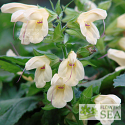
(Kyushu Woodland Sage) We are in love with this short forest sage from Kyushu, Japan. Its clusters of large creamy flowers pale as fresh-churned butter begin blooming in September. Even when not blooming, its foliage is showy in a shady garden.
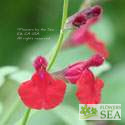
(Cherry Red Mountain Sage) This isn't just another red sage. Brilliant cherry-red flowers with dark purple bracts and cold weather tolerance to USDA Zone 6 make this a valuable landscaping plant.
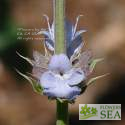
(Starlight Sage) Add sparkle to your dry garden with the pale pastel flowers of this hybrid of two Southern California native plants often seen growing together in the wild — Black Sage (Salvia mellifera) and White Sage (Salvia apiana). Salvia x 'Starlight' is a shrub that blooms early and long, attracting honeybees but not deer.
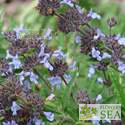
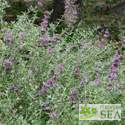
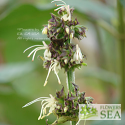
(Tree Sage)Whether you call it a shrub or a tree, Salvia arborsecens rises up to an impressive 12 feet tall and 5 feet wide. Commonly known as Sage Tree, this Salvia grows well in full sun, but prefers partial shade.
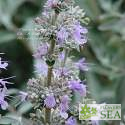
(Gayle Nielson Hybrid Sage) Whorl-like clusters of violet-blue flowers on slender stems as well as its height and width indicate that Gayle Nielson Hybrid Sage is related to some form of Salvia clevelandii.
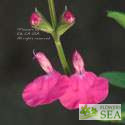
(Wild Watermelon Mountain Sage) Large, watermelon-pink flowers and the fruity fragrance of this long-blooming sage's mid-green, veined leaves make this Mountain Sage a treat to grow.
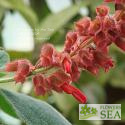
(Giant Colombian Red Mountain Sage) In 1898, physician and medical plant researcher Henry Hurd Rusby (1855-1940) found this towering sage with large, deep red flowers in the Sierra Nevada de Santa Marta mountains of Colombia.
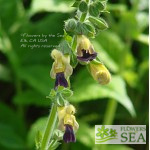
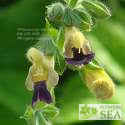
(Purple & Yellow Yunnan Sage or ji ye shu wei cao) Confusion about this plant's scientific name cause it to appear in some sources as Salvia flava var. megalantha. Whatever you call it, this Chinese species from Yunnan Province has enchanting yellow and purple flowers that attract viewers as well as honeybees.
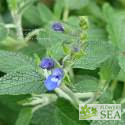
(Furry Colombian Sage) The leaves of this rare shrub are a glossy mid-green on top and fuzzy with hairs underneath, which is why it's commonly called Furry Colombian Sage.
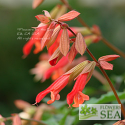
(Ember's Wish Sage) Bright coral-colored, tubular blossoms contrast handsomely with the deep maroon stems, rusty rose calyxes and mid-green foliage of Ember's Wish Sage.
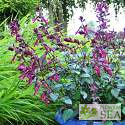
(Love and Wishes Sage) Deep purple calyxes support the magenta-purple, tubular blossoms of Salvia x 'Love and Wishes'. They contrast handsomely with dark stems and mid-green foliage.
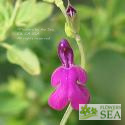
(Navajo Autumn Sage) Even a hint of blue is unusual among Autumn Sage flowers. Salvia greggii 'Navajo Purple' is a rarity due to its magenta-purple blossoms, which hint at natural hybridization including a mystery parent in the blue range, such as Salvia lycioides.
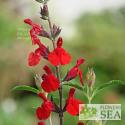
(Radio Red Autumn Sage) Dark calyxes support true red blossoms in Salvia greggii 'Radio Red', a 2015 introduction from the Darwin Perennials division of Ball Seed. Its tiny, smooth, elliptical leaves form a light, airy backdrop for the dramatic flowers.
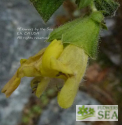
(Campanula Leaf Sage) The deep yellow flowers of Campanulata Leaf Sages are scarce among Salvias. Salvia campanulata CC#7706 is a sunny Himalayan beauty.
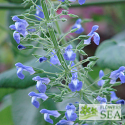
(Amethyst Sage) Growing up to 12 inches long, the triangular basal leaves of Salvia amethystina subsp. ampelophylla are the largest we know among sages. They have long silky hairs on their undersides and are fragrant when bruised.
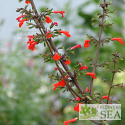
(Tall Red Colombian Sage) Salvia rubescens subsp. dolichothrix may tower over your head when in full bloom with its creamy red trumpet blossoms and dark calyxes. Its leaves are large and attractively textured.
(Campanula Leaf Sage) The deep yellow flowers of Campanula Leaf Sages are scarce among Salvias. If British plant explorer Chris Chadwell is correct, what he has identified as Salvia aff. campanulata 'CC#7713' should be a sunny Himalayan beauty.
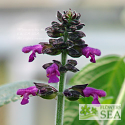
(Columbian Mountain Sage) Deep purple bracts support the small, lighter purple flowers of Salvia cuatrecasana, which is a rare Colombian sage. White beelines mark the flowers of this long-blooming shrub, which is a hummingbird favorite.
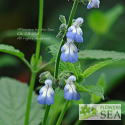
(River Sage) Native to partially shaded streamsides in Argentina and Bolivia, this is one of the few Salvia species that can tolerate wet soil. It makes a fine filler plant in a group of other partial shade growers, its wirey thin stems sending up floral displays here and there, much to the gardener's delight.
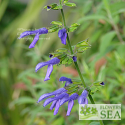
(Margie Griffith Sage) Salvia x 'Margie Griffith' is a big, purple-flowered beauty with glossy green, ribbed foliage. It feeds hummingbirds year round down South and on our coastal, Northern California farm where winter temperatures are moderate.
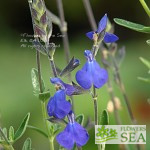
(Elk Blue Note Sage) In Europe and Australia there is a popular and widely used seed grown Salvia variety called 'Blue Note'. Our offering, 'Elk Blue Note', is the result of several generations of careful breeding and selection.
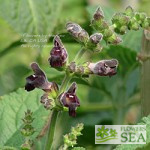
(Black Dan-shen) Growing into a basal rosette of leaves measuring up to 3 feet across, Salvia przewalskii 'CC5795' is known for its handsome foliage and deep purple, almost black flowers.
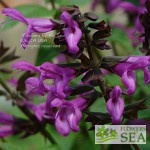
(COOL Fandango Anise Scented Sage) A combination of dark, rosy bracts and magenta blossoms make Salvia COOL Fandango dance. It’s vivid, floriferous, and a hummingbird favorite.
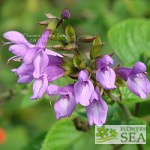
(COOL Lavender Blush Anise Scented Sage) Dusky green and red-edged bracts surround the pale-throated lavender blossoms of Salvia COOL Lavender Blush. It's a magnet for hummingbirds.
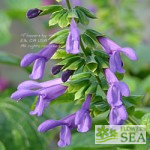
(COOL Lavender Mist Anise Scented Sage) Bright green bracts and rich lavender blossoms sing in Salvia COOL Lavender Mist. Hummingbirds keep this bountiful bloomer buzzing.
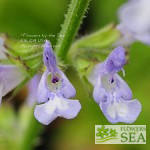
(Cut Leaf African Blue Sage) In botanical names, aurita means “ear shaped.” It’s the ear-like lobes of this sage’s leaves that give the species part of its name Salvia aurita ssp. galpinii. The cut leaf foliage is heavily lobed, mint green and lightly hairy.
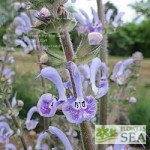
(Shangri-la Sage) Take a close look at Salvia moorcroftiana x indica ‘Shangri-la’ and you’ll notice that its lavender flowers have lighter lower lips with deep purple freckles.
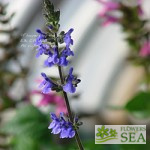
(Paula Flynn Sage) Floral spikes with whorls of bluish-purple flowers rise up amid the slightly relaxed, upright foliage of the mystery plant Salvia ‘Paula Flynn’. It features pebbly, deep green leaves with white, fuzzy undersides.
The following terms were added to your search to help improve the result. Click here to exclude these extra terms from the search.
- collect, collected, collections, collector
Results for collection from the blog
| Celebrity Salvias |
| 1. Celebrity Salvias: Fuzzy, Fancy Salvia Oxyphora |
| A bright, cherry-licorice red, the large, fuzzy blossoms of Salvia oxyphora would make anyone stop and pay attention. Commonly known as Fuzzy Bolivian Sage or Bolivian Spearhead Sage, S. oxyphora has equally unusual foliage that fools the eye. At a distance, the plant’s lance-shaped leaves appear to be a smooth, glassy green. However, they are covered with tiny clear-to-white hairs. They’re also large -- growing up to 5 inches long and 2 inches wide at maturity -- and taper to long, sharp points. It was first collected near Cochabamba, Bolivia, by German botanist Otto Kunst in 1892 |
| Getting Started with Salvias |
| 2. Getting Started: Salvias for the Midwest |
| Severe winter chill and summer heat coupled with extreme humidity are challenges that gardeners face in the Midwest. Many Salvias are excellent choices as long-blooming annuals in the region while others -- ones that can withstand cold winters -- are reliable perennials. Flowers by the Sea Online Plant Nursery explains the confusing Midwest boundaries from Ohio west to Kansas and North Dakota south to Missouri. It talks about the range of USDA Plant Hardiness Zones in the region and the kinds of sages that grow best there. |
| Sacred Sages |
| 3. Sacred Sage: Giant Bolivian Sage |
| Of all the mint family's more than 6,500 species worldwide, Giant Bolivian Sage (Salvia dombeyi) has the longest blossoms and tallest growth. Each tubular crimson flower grows up to 5 inches long and has a burgundy calyx at its base.The plant's bright green, heart-shaped leaves are equally long. In South America, the flowers are pollinated by hummingbirds with extremely long beaks. However, Giant Bolivian Sage don't need pollination to flower beautifully for many seasons if growing conditions are right. |
| New at FBTS |
| 4. Himalayan Sage Is the Salvia Collector's Holy Grail: Part 2 |
| Plants don’t have voices but they have stories to tell, including tales of discovery. It’s easy to see why the early 18th century plant explorer Victor Jacquemont would have paused to collect the rare Salvia hians while traversing broad expanses of northwestern India. This second half of our article about the alluring species digs into its history. |
| Cultivating Color |
| 5. Cultivating Color: Tracking the Elusive History of Autumn & Mountain Sage Warm Pastel Hybrids -- Part I |
| Whether planned or accidental, hybrids happen. This is especially true among the closely related Southwestern and Mexican species of Autumn Sage (Salvia greggii) and Mountain Sage (S. microphylla). They are native to different areas of the Southwest and Mexico, but cross freely when they meet. This story is the first installment in a two-part series initiating our Cultivating Color series. It involves the late Dr. Richard F. Dufresne, a Salvia specialist who helped us track the history of warm-colored S. x jamensis hybrids. |
| Shade Gardening |
| 6. Made for Shade: Japanese Woodland Salvias |
| Sturdy, shade-loving Japanese Salvias are lovely additions to woodland gardens with their lush, large-leafed foliage and delicate-looking flowers in colors including pinks, purples and yellows. They're ideal for bordering shady paths where they invite visitors to pause for close-up views. Flowers by the Sea suggests Japanese species for woodland gardens and organizes them according to their cold hardiness. |
| New at FBTS |
| 7. New at FBTS: Butterflies Love Perennial Echeandia Texensis |
| It isn't surprising that the golden flowers of the drought-resistant, perennial Texas Craglily (Echeandia texensis) are tops for attracting butterflies. The plant was first discovered on Green Island in Laguna Madre, which is at the southernmost tip of Texas. The area is part of the Lower Rio Grande Valley, which is home to 300 butterfly species. Texas Craglily is an adaptable plant that grows well both in dry and somewhat damp conditions and from California to the Southeast. But it is a rare species that may be threatened by land development and the U.S./Mexico border fence. |
| Cultivating Color |
| 8. Pantone Pageant: A Chorus Line of Grayed Jade Designer Salvias |
| Sage is the common name for the uncommonly beautiful Salvia genus. But when designers describe a product as being sage-colored, they mean a shade of gray-green that they say is soothing and that harmonizes with a multitude of colors, including soft pastels, hot oranges and deep purples. A version of sage called "Grayed Jade 14-6011" is one of the Pantone color-matching system's top shades for the design industry this year. This post identifies some Grayed Jade plants in the Flowers by the Sea collection. They are fine peacemakers amid a Salvia garden based on a mixture of Pantone's top greens for 2013, which you can read about in previous articles from our Pantone Pageant series of designer colors in the landscape. |
| Sage Experts |
| 9. Sage Experts: Meet Huntington Gardens Curator Kathy Musial |
| The Sage Experts series focuses on Salvia specialists — both amateurs and professionals -- in settings ranging from botanic gardens to universities. Kathy Musial, curator of live collections at Southern California's Huntington Gardens, is the subject of this profile. If you imagine a great dinner party involving lots of garden talk, Kathy Musial would be an ideal guest who could share her experiences plant trekking in Australia and Chile or co-managing some 14,000 varieties of plants at Huntington. |
| Sacred Sages |
| 10. Sacred Sage: Salvia mellifera -- the Easiest California Native |
| Long before the West Coast was colonized, California Indians used Black Sage ( Salvia mellifera Greene) for food and medicinal purposes. Today, it often is bundled in smudge sticks used like incense during purification rituals. Another reason to consider Black Sage sacred is that, among the state’s native plants, it is one of the most important sources of nectar for pollinators. Nineteenth century botanist and clergyman Edward Lee Greene made the plant’s botanical name official in 1892 when he was the first person to publish it in a scientific journal. Among California's native Salvias, it is the easiest to grow in home gardens. |
| Salvias Down South |
| 11. Salvias Down South: Salvia Success in Florida |
| Florida is one of the wettest states in the nation, yet it is a fine place to grow Salvias if you select shade-tolerant, moisture-loving species and ones native to Florida. Gardeners who are accustomed to growing Salvias in a dry climate face a variety of surprises in Florida gardens. These include recurrent periods of drought, many cloudy days and soil that is so poor it has to be amended for Salvias. |
| Cultivating Color |
| 12. Cultivating Color: Tracking the Elusive History of Autumn & Mountain Sage Warm Pastel Hybrids -- Part II |
| Luminous Salvia x jamensis pastel flowers began warming up nursery catalogs in the late 1990s. Their journey from steep Mexican mountains to American and European gardens began in the mid-19th century with the discovery of Autumn Sage (Salvia greggii). This is the second post in a two-part article about these Jame Sage hybrids of Autumn and Mountain Sage (S. microphylla). It includes descriptions of ten favorite Jame Sages. |
Common terms in this search: kyushu woodland sage love short forest from japan its clusters large creamy flowers pale fresh-churned butter begin blooming september even when not foliage showy shady garden number scientific name where more descriptive appellation usually would plant's collection which assigned botanist gardener first discovers develops new cultivar thank bleddyn sue wynn-jones crug farm wales introducing beauty commercial horticulture grows well either