
Advanced Search
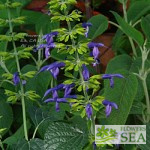
(Russell's Mexican Sage) Expect rapid, tall growth from this Salvia Mexicana . In the ground, Russell’s Mexican Sage can reach up to 10 feet tall and 5 feet wide, providing an effective screen of dark green, heart-shaped foliage. By late autumn it’s bursting with flowers.
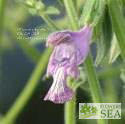
(san ye shu wei cao) So what do all those Pinyin words mean in this sage’s common name? We’ll give you an answer to the best of our ability in a minute. Meanwhile, we need to note that this medicinal Asian sage has handsome foliage and deep violet flowers.
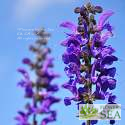
(Wild Meadow Sage) Meadow sages are native to Europe and include many hybrids. This lush, purple-flowered plant is a wild species that most likely is a hybrid of two ancient sages -- Salvia nemorosa and Salvia pratensis.
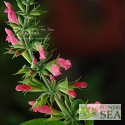
(Giant Karwinski's Sage) San Francisco arborist and gardener extraordinaire Ted Kipping developed this tower of creamy pinkalicious power that hummingbirds love. It's lush with bright green leaves that are large, pebbly and hairy on the underside.
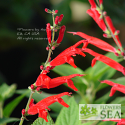
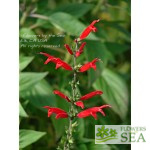
(Elk Sonoran Red Pineapple Sage) A new Pineapple Sage variety that has the traditional fruity fragrance but blooms much earlier in the season than the traditionally grown clone. Short and compact, it resembles the varieties 'Honey Melon' and 'Tangerine' size wise, but has the unmistakable aroma of ripe pineapples.
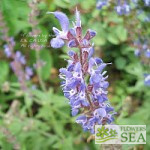
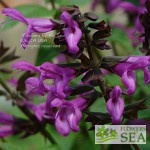
(COOL Fandango Anise Scented Sage) A combination of dark, rosy bracts and magenta blossoms make Salvia COOL Fandango dance. It’s vivid, floriferous, and a hummingbird favorite.
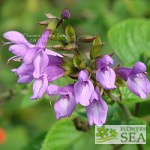
(COOL Lavender Blush Anise Scented Sage) Dusky green and red-edged bracts surround the pale-throated lavender blossoms of Salvia COOL Lavender Blush. It's a magnet for hummingbirds.
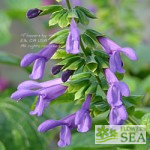
(COOL Lavender Mist Anise Scented Sage) Bright green bracts and rich lavender blossoms sing in Salvia COOL Lavender Mist. Hummingbirds keep this bountiful bloomer buzzing.
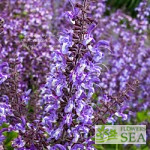
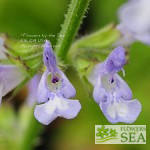
(Cut Leaf African Blue Sage) In botanical names, aurita means “ear shaped.” It’s the ear-like lobes of this sage’s leaves that give the species part of its name Salvia aurita ssp. galpinii. The cut leaf foliage is heavily lobed, mint green and lightly hairy.
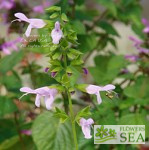
(COOL Pink Lace Anise Scented Sage) Cheerful Kelly-green bracts surround magenta buds that bloom into the soft pink yet magenta-tinged flowers of Salvia COOL Pink Lace. Its bright green leaves have a licorice-like fragrance.
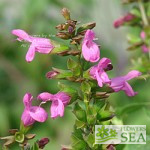
(COOL Wild Strawberry Anise Scented Sage) Prepare yourself for a heaping serving of large flowers the delicious color of strawberry ice cream when you plant Salvia COOL Wild Strawberry.
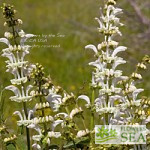
(Woolly White Sage) Salvia candidissima has tidy, upright stems covered with whorls of creamy white blossoms shaped like tiny parrot beaks. They rise from a mid-green rosette of leaves that become fuzzier and whiter as summer heat increases.
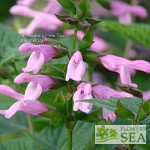
(COOL Shocking Pink Anise-Scented Sage) Dusky green bracts support the pastel magenta blossoms of Salvia COOL Shocking Pink. It’s a hummingbird favorite with bright green, fragrant foliage that may remind you of licorice.
The following terms were added to your search to help improve the result. Click here to exclude these extra terms from the search.
- forests
Results for forest from the blog
| Ask Mr. Sage |
| 1. Ask Mr. Sage: What Tropical Sage Should I Select? |
| Selecting the right types of Tropical Sage ( Salvia coccinea ) can be confusing when viewing them in a catalog and seeing similar flower colors. Yet they may differ in cultivation needs, foliage, heat tolerance, and size. Mr. Sage offers ideas for comparing differences and similarities. Ask Mr. Sage is a regular feature of the FBTS Everything Salvias Blog , which responds to questions from customers. |
| Celebrity Salvias |
| 2. Celebrity Salvias: Fuzzy, Fancy Salvia Oxyphora |
| A bright, cherry-licorice red, the large, fuzzy blossoms of Salvia oxyphora would make anyone stop and pay attention. Commonly known as Fuzzy Bolivian Sage or Bolivian Spearhead Sage, S. oxyphora has equally unusual foliage that fools the eye. At a distance, the plant’s lance-shaped leaves appear to be a smooth, glassy green. However, they are covered with tiny clear-to-white hairs. They’re also large -- growing up to 5 inches long and 2 inches wide at maturity -- and taper to long, sharp points. It was first collected near Cochabamba, Bolivia, by German botanist Otto Kunst in 1892 |
| New at FBTS |
| 3. Upcoming at FBTS: Hummingbirds Love Cute Cupheas |
| Bright orange, tube-shaped blossoms cover Cuphea x 'David Verity' like tiny windsocks blowing in a breeze and beckoning hummingbirds. Similar to Salvias, Cupheas are rich sources of nectar that fuel hummingbird migration. At Flowers by the Sea, we are always interested in expanding choices for creating wildlife habitat. So we are growing a wide variety of Cupheas for sale this coming spring, including David Verity. |
| Getting Started with Salvias |
| 4. Getting Started: Salvias for the Mid-Atlantic |
| Outside of its cities, the Mid-Atlantic can be described as an overwhelmingly green place. If you love the Mid-Atlantic, you revel in its verdant landscape. However, if you aren't reveling in the predictable planting choices you see in neighbor's yards, it may be time to expand your horizons by exploring the Salvia genus. Flowers by the Sea discusses the boundaries, USDA Plant Hardiness Zones and Salvia choices for the region. |
| 5. Getting Started: Types of Salvias for Zone 6 |
| To bloom yearly, Salvia perennials and shrubs in USDA Hardiness Zone 6 need to tolerate chilly winters with average low temperatures of -10 degrees F. The success of Zone 6 sages also depends on local growing conditions. Learn more at Flowers by the Sea, an online, mail-order Salvia nursery. |
| 6. Getting Started: Types of Salvias for Zone 7 |
| Winter temperatures can seem moderate, then dip to freezing in USDA Hardiness Zone 7, which covers a broad range of locations from Washington State to Washington, D.C. To succeed, Salvia perennials and shrubs need to tolerate temperature shifts and local growing conditions. Learn more at Flowers by the Sea, an online, mail-order Salvia nursery. |
| Cultivating Color |
| 7. Gray and Silver Foliage Lights Up the Landscape Day and Night |
| It isn't easy describing green in the garden. Foliage can span greens so pale they are almost white to blue-greens so deep they murmur the forest primeval. Amid this range, you'll find shimmering silver- and gray-leaf species. To locate these types of Salvias and companion plants in the Flowers by the Sea catalog, please visit our " Gray and Silver Leaf Plants" category in the FBTS catalog menu. This article includes a small sampler of our selection. |
| Butterflies in the Garden |
| 8. Growing Habitat: Three Tough Milkweeds to Help Monarchs |
| Flowers by the Sea Farm and Online Plant Nursery is serious about wildlife gardening and grows a number of milkweed species considered among the best for supporting Monarch butterflies. Three of the nursery's toughest, loveliest milkweeds are Indian Milkweed (Asclepias eriocarpa), Showy Milkweed (Asclepias speciosa) and Common Milkweed (Asclepias syriaca). Read about the history of milkweeds and the reasons why Monarch butterflies are threatened due to a shortage of these tough yet lovely plants caused by herbicides. Learn how herbicides and pesticides harm Monarchs and other milkweed-loving pollinators. |
| New at FBTS |
| 9. New at FBTS: Butterflies Love Perennial Echeandia Texensis |
| It isn't surprising that the golden flowers of the drought-resistant, perennial Texas Craglily (Echeandia texensis) are tops for attracting butterflies. The plant was first discovered on Green Island in Laguna Madre, which is at the southernmost tip of Texas. The area is part of the Lower Rio Grande Valley, which is home to 300 butterfly species. Texas Craglily is an adaptable plant that grows well both in dry and somewhat damp conditions and from California to the Southeast. But it is a rare species that may be threatened by land development and the U.S./Mexico border fence. |
| 10. New at FBTS: Elegant Salvia valentina |
| Flowers by the Sea Online Salvia Nursery has fallen hard for the delicate look but rugged constitution of wildflower sages from Valencia on Spain's Mediterranean coast, especially Strong Spanish Sage (Salvia valentina). S. valentina has upright form and looks elegant dressed up in tall spikes of deep lavender, double-lipped flowers from spring into summer. It's a meadow sage with fuzzy bracts and stems that mature from green to rich Pantone Marsala. |
| Cultivating Color |
| 11. Pantone Pageant Cheerful Lemon Zest and Nectarine Designer Salvias |
| Let there be light; let there be brightness. Yellows and oranges are cheerful colors to combine in a grouping of perennials. Pantone's spring 2013 designer colors -- golden yellow Lemon Zest 13-0756 and its hot orange Nectarine 16-1360 -- are fun colors to match to sages ( Salvia spp.) that can turn up the light in a garden whether sunny or shady. Two groupings for sunny or shady gardens are offered |
| 12. Paperless Catalog Conserves Resources and Lowers Prices |
| Don't expect a catalog in your mailbox from Flowers by the Sea, because we have never printed one and refuse to do so. Print catalogs are tree-munching dinosaurs on their way to extinction due to the rapidly changing world of digital technology. Online catalogs are environmentally friendly and save our customers money, because we can keep our plant prices low. |
Common terms in this search: expect rapid tall growth from mexicana ground russells mexican sage can reach feet wide providing effective screen dark green heart-shaped foliage late autumn its bursting flowers floriferous panicles clear blue blossoms calyxes major attraction heat-tolerant does well full sun partial shade usda zones cooler parts winter range may best grow lush beauty large container beneficially positioned protection wind cold freezes