
Advanced Search
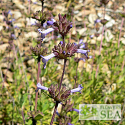
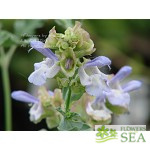
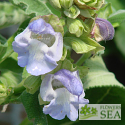
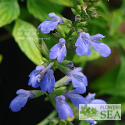
(Arizona Blue Sage) We are so impressed with this top-performing, drought-resistant ground cover that we have rated it best of class. Arizona Blue Sage is adaptable to a variety of shady conditions and blossoms so abundantly that it seems to have as many rich blue flowers as it has leaves. It is native to dry, shaded areas in mountain canyons in Arizona, New Mexico and Texas.
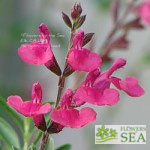
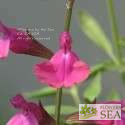
(Plum Wine Autumn Sage) Frilly, lavender-tinged, pink flowers with a pretty white dot at the throat make this another outstanding contribution from North Carolina nurseryman Richard Dufresne.
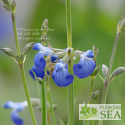
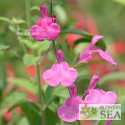
(Trinity Mountain Sage) Heat and drought tolerant, this Salvia microphylla is native to Northeastern Mexico where summers are dry and temperatures can rise to more than 100 degrees F. It can survive winter temperatures down to 0 degrees.
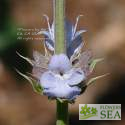
(Starlight Sage) Add sparkle to your dry garden with the pale pastel flowers of this hybrid of two Southern California native plants often seen growing together in the wild — Black Sage (Salvia mellifera) and White Sage (Salvia apiana). Salvia x 'Starlight' is a shrub that blooms early and long, attracting honeybees but not deer.
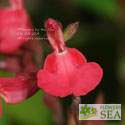
(Furman's Red Autumn Sage) Selected by noted Texas plantsman W.A. Furman in the 1970s, this hardy Texas native is beautiful and tough withstanding heat, drought and freezing winters. Its flowers, which bloom spring through fall, are a rich, saturated red bordering on magenta.
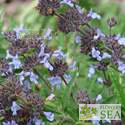
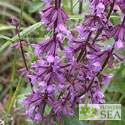
(Judean Sage) Native to the mountains of Judea in Israel, this dark violet flowered, perennial sage is unique among the Palestinian Salvias - as a woodland native it grows well in partial shade. It is a tough, drought-resistant plant with deeply cut & hairy foliage which forms impressive mounds of color in the spring and early summer.
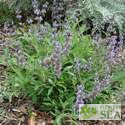
(Dry Earth Black Sage) Black Sage Salvia mellifera is one of the most common and fragrant native shrubs in the California Coast Ranges and is ideal for dry gardens. At 12 inches tall by 5 feet wide, this variety is an excellent groundcover.
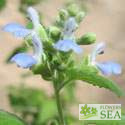
(Mejorana) In Spanish, Mejorana means ‘marjoram.” Similar to oregano-type Marjoram – another Mint family member -- this sage is used to flavor meat dishes. Our cultivar, which is native to Texas and Mexico, has lovely bluish-purple flowers that bloom summer to fall amid fragrant, fine, furry green foliage.
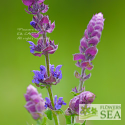
(Stem Clasping Violet Sage) Like a candelabra lit up with whorls of violet blossoms, the erect, branching flower spikes of Salvia amplexicaulis make this native of Southeastern Europe shine. On the Grecian island of Thassos, it brightens areas near the beach.
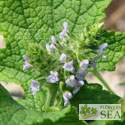
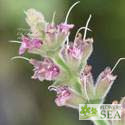
(Eig's Sage)Bicolor ruby and pale pink flowers bloom winter to spring on this small sage that is native to Northern Israel. Salvia eigii is at home in the silty, gravelly loam of low fallow fields near rivers. So it does best in rich soil aerated with plenty of humus.
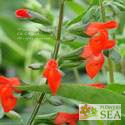
(Eyelash Sage) All Salvia blepharophylla varieties are native to Mexico, but this one was hybridized in Germany by plant breeder Christiaan Unger. Hairs on the edge of the sageâs dark green leaves give it the appearance of having eyelashes. It is a compact, slightly mounding Salvia that spreads gradually by underground stolons.
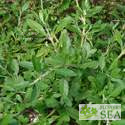
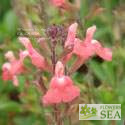
(Salmon Autumn Sage) Creamy salmon-colored flowers with white throats make this elegant Autumn Sage perfect for a pastel garden or as a cooling color in a mixed sage border. Bloom time is spring into fall for this petite Salvia greggii native to the American Southwest and Mexico.
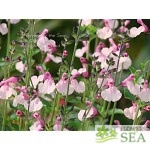
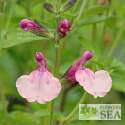
(Dancing Dolls Sage) Sages can be such tough plants. Many, such as Salvia 'Dancing Dolls', withstand heat and drought yet have delicate looking blossoms. Dancing Dolls features cream and rose bicolor flowers.
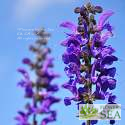
(Wild Meadow Sage) Meadow sages are native to Europe and include many hybrids. This lush, purple-flowered plant is a wild species that most likely is a hybrid of two ancient sages -- Salvia nemorosa and Salvia pratensis.
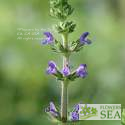
(Wild Sage) Toothed and attractively wrinkled, the gray-green, basal foliage of Wild Sage contrasts prettily with deep lavender-to-purple flowers supported by grassy green bracts. This cold-hardy sage is native to northern Africa and parts of Asia and Europe.
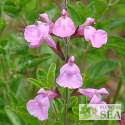
(Glittering Pink Mountain Sage) Mountain Sage (Salvia microphylla) handles hot climates as well as cooler coastal regions. It withstands the high temperatures of Southern California, the Southwest and Texas.
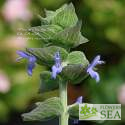
(Dark Flowered Bolivian Sage) Here is a water-loving beauty with dusky blue flowers --a native of the moist Yungas piedmont forests of Northwestern Argentina and Bolivia. Salvia atrocyanea is well adapted to both full sun and partial shade.
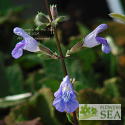
(Turkish Tea Sage) Sometimes an attractive plant is also medically powerful. That's true of the lavender flowered Salvia aucheri, which has strong white beelines. This Turkish native is consumed as an ingredient in teas used as folk remedies for many problems, including abdominal bloating and infections.
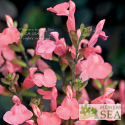
(Blast Pink Mountain Sage) Long blooming Salvia microphylla 'Heatwave Blast' produces prolific quantities of large, dusky salmon-pink blossoms and dense, mid-green foliage.
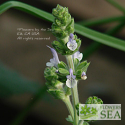
(Strong Spanish Sage) Fuzzy green stems and bracts mature to burgundy on this lovely, lavender flowered sage that roughly doubles in height when blooming. Salvia valentina is a variety of the European native S. nemorosa, a Meadow Sage.
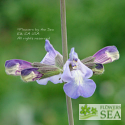
(Puna Sage) The deep violet-blue flowered Salvia calolophos has white beelines and oblong, mid-green leaves. It is a high-altitude native of northern Argentina.
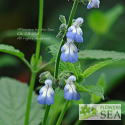
(River Sage) Native to partially shaded streamsides in Argentina and Bolivia, this is one of the few Salvia species that can tolerate wet soil. It makes a fine filler plant in a group of other partial shade growers, its wirey thin stems sending up floral displays here and there, much to the gardener's delight.
The following terms were added to your search to help improve the result. Click here to exclude these extra terms from the search.
- natives
Results for native from the blog
| Hummingbirds in the Garden |
| 1. Hummingbirds in the Garden: Attracting Hummingbirds to Your Garden |
| Planting a hummingbird garden filled with nectar-rich, long-blooming Salvias aids preservation of hummingbird species that migrate each year throughout North America. It also gives you a front-row seat to a fascinating aerobatics show. Backyard islands of colorful sages are like gas stations for hummingbirds' long-distance journeys. Salvias can keep your garden whirring with the helicopter-like flight of hummingbirds from spring through autumn and -- in warm climates -- into winter. |
| Getting Started with Salvias |
| 2. Getting Started: Salvias for the Southwest |
| Ask anyone to describe the American Southwest, and they're likely to sum it up in three letters : "D-R-Y." Yet precipitation can vary a lot here state by state and even within different parts of the individual states. One thing that is consistent about the story of water throughout the Southwest, is that rain and snow can rapidly swing from famine to feast to misfortune. |
| Bees in the Garden |
| 3. The Not-So-Secret Lives of Honeybees |
| It's no secret that Honeybees are American immigrants. Yet along with native bees, they descended from meat-eating wasps. All bees make food and flowers possible through pollination. This is the first article in a four-part Bees in the Garden series in the Everything Salvias blog of Flowers by the Sea. The series focuses on identifying and understanding bees, becoming aware of threats to their survival and noting ways gardeners can protect these tiny wildlife. |
| Hummingbirds in the Garden |
| 4. A Gardeners Guide to Hummingbird Sage |
| Among the hummers' favorites: Salvia spathacea, commonly known as Hummingbird Sage. As it name suggests, this California native produces the hummingbirds' flower of choice, blooming from late winter through summer -- and sometimes again in Fall -- with rose-pink to magenta blossoms. Available in six varieties, this robust perennial not only attracts hummers with its abundant nectar, it's easy to grow and enhances any landscape with its aromatic blooms and fragrant evergreen foliage. |
| Ask Mr. Sage |
| 5. Ask Mr. Sage: How to Select Plants for Garden Triumph |
| Planning for Salvia garden success requires following the rule of selecting the right plant for the right place. Desert sages aren't appropriate for the damp Southeast. Moisture-loving ones aren't right for desert climates where they need lots of watering to survive. Flowers by the Sea Farm and Online Nursery offers tips for selecting plants based on local climate. Ask Mr. Sage is a regular feature of the FBTS Everything Salvias Blog. |
| Getting Started with Salvias |
| 6. Getting Started: Salvias for the Coastal Southeast |
| True sages are members of the Salvia genus and number in the hundreds. They are native to a wide variety of environments worldwide, which is why some are ideal for the dry gardens of California and others can handle the abundant moisture of the American Southeast. Flowers by the Sea raises many sages that grow well in the Southeast, including some that are either native to the region or have jumped fences from gardens into the wild. |
| 7. Plant Safari Salvia in the South African Fynbos -- Part 2 |
| Flowers by the Sea is a home away from home for a number of South African Salvias that enjoy our moderate, Mediterranean climate. None are endangered species, but all face the threat of land development in the Western Cape's Fynbos Biome -- unparalleled for its variety of medicinal and ornamental native plants found nowhere else in the world. Preservationists are working to balance changes in land use and to maintain biodiversity in the CFR. Brutal poaching of rhinoceroses is one of the toughest problems they face. |
| Sage Words About Wildlife |
| 8. Sage Words About Wildlife: Hummingbirds Love Lobelias |
| Top-10 lists of hummingbird favorites almost always contain Salvia and Lobelia, because each genus is nectar rich and offers many species in bright reds, oranges and pinks. Hummingbirds have a weak sense of smell, but bright colors, such as those of Lobelias, lure them to flowerbeds. They are particularly devoted to the types grown at Flowers by the Sea. |
| Salvias Down South |
| 9. Salvias Down South: 8 Must-Have Salvias for the Southwest |
| You don’t have to be a fine artist to create a work of beauty in the garden. By selecting hardy, vibrantly colored native Salvias that can withstand Southwestern weather ranging from sullen heat and drought to raging rainstorms, you become a landscape painter. FBTS Online Nursery carries many choices for your palette. |
| Cultivating Color |
| 10. True Blue Salvias You Can Rely On for Garden Serenity |
| Forget all the mournful music telling you that blue is the color of sadness. In a Salvia garden filled with hot colors, true blue is a peacemaker -- a reliable harmonizer that commands peace in the garden. This article talks a tiny bit about football, Madonna and the chemistry of true blue flowers. Then it offers a lot of true blue sages for gardens coast to coast from our Flowers by the Sea Online Nursery catalog. |
| Sacred Sages |
| 11. White Sage |
| Bees and hummingbirds love the perennial subshrub Sacred White Sage (Salvia apiana) with its soaring spikes of white-to-lavender flowers that visually cool the landscape along with its large rosettes of lance-shaped, greenish-white foliage. Sacred White Sage is far more than a pretty native plant of California. Historically, it provided food and medicine for a number of Native American tribes along the Pacific Coast. Today, bundles of Sacred White Sage leaves are still tied together to create torch-like wands called smudge sticks for fragrant purification ceremonies far beyond the Native American community. |
| Xeric Choices |
| 12. Xeric Choices: Xeriscape Basics & Ancient Ideas |
| To create a successful xeriscape garden, planning and design are essential. Planning helps you make better choices, which saves time, money and effort as well as water. A little bit of wisdom from ancient Native American practices doesn’t hurt either. While soil improvement is always helpful, it should be moderate for xeric Salvias, such as Autumn Sage and Mealy Cup Sage. Finally, pruning and thinning, strategic groupings of plants for frugal watering and mulching for protection against severe heat or winter chill all were key to ancient Southwestern agriculture as well as modern xeriscaping. |
Common terms in this search: munz's sage densely branched fragrant drought-resistant shrub named botanist philip munz rancho santa ana botanic garden pomona college native northern baja california coastal mountains san diego large lavender-to-violet flowers bloom from june through august amid extremely aromatic bright green foliage widely adaptable but excels warm semi-arid places emulate its homelands attractive plant gardens dry areas usda zones inches tall wide