
Advanced Search
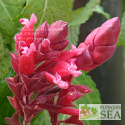
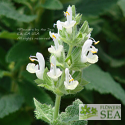
(Mauretania Tingitana Sage) Native to Northern Africa and Saudi Arabia, this sage gets by on little water. and has a long history of cultivation going back 400 years. It wove throughout various countries in the Middle East and North Africa before arriving in Europe in the 1700s and was first described scientifically in 1777.
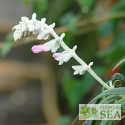
(Pink Mexican Bush Sage) Although native to Mexico and Central America, this elegant variety of Salvia leucantha was hybridized in South Africa. It is compact, long blooming and profusely covered by soft pink flowers surrounded by velvety white bracts.
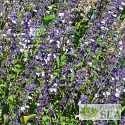
(Phyllis' Fancy Sage) The parentage of this lavender-flowered hybrid sage is unknown. However, it may be a cross between Mexican Bush Sage (Salvia leucantha) and Chiapas Sage (S. chiapensis).
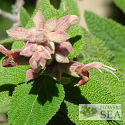
(Wooly Multicolor Sage) In Greek, "lasiantha" means "wooly flower." The flowers of Salvia lasiantha are surrounded by wooly bracts, but are even more notable for transforming from apricot-orange in the morning to reddish-purple later in the day.
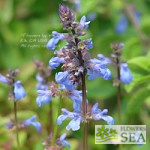
(Ground Ivy Sage) Native to Central Mexico's highlands, this creeping perennial grows at a altitudes of more than 10,000 feet and can handle some chill. Its common name comes from its scalloped yellow-green leaves, which resemble Ground Ivy or Glechoma.
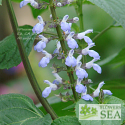
(Silly Mexican Sage) Also known as Salvia roscida, this close relative of Blue Sky Mexican Sage (Salvia caudata 'El Cielo Blue') has thousands of deep violet-blue flowers with prominent white bee lines.
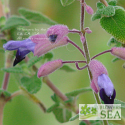
(Pine Mountain Sage) Small but numerous, violet and deep purple flowers surrounded by pink bracts are sprinkled throughout this well-branched,shrubby sage like confections. This is one of the showiest Salvias we grow.
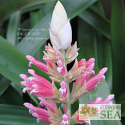
(Pink & White Wagner's Sage) Instead of pink, leaf-life bracts, this variety of Wagner's Sage has white bracts surrounding the hot pink flowers. It blooms from November to March on our coastal Northern California farm where it feeds Anna's hummingbirds all winter long.
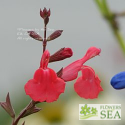
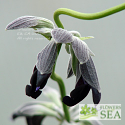
(Purple Bract Peruvian Sage or Concolor Sage) Similar to its wild relative, Peruvian Sage, which is also known as Concolor Sage, this cultivar has foliage that is smooth, apple green on top and fuzzy with silver hairs on the bottom. Major differences appear in the dramatic bracts.
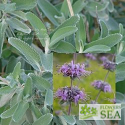
(California Purple Sage or California Gray Sage) This California native is commonly known as Purple Sage for its flowers or Gray Sage for its silvery, velvety foliage. Due also to its hardiness, drought tolerance and ability to attract small wildlife, it is a joy in the dry garden.
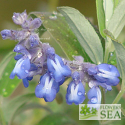
(Blue Ecuadorian Sage) A densely branched shrub with silvery leaves and dusky blue flowers, this rare species was once thought to be Salvia cruickshanksii. In the nursery trade, it sometimes is called Salvia 'Equador'.
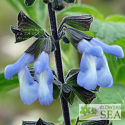
(Confused Argentine Sage) Similar in many ways to the indispensable garden favorites of the Anise Scented Sage (Salvia guaranitica spp.) group, this plant is a perfect companion for its better known cousin.
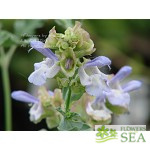
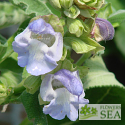
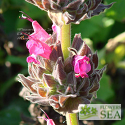
(Little Hummingbird Sage or Pitcher Sage) At one-fourth to one-half the size of our other Hummingbird Sages, this is the smallest variety of Salvia spathacea that we grow.
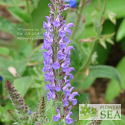
(The Queen's Sage) Regal spikes of lavender-to-purple flowers give weight to this sage's common name. It provides a stately show of bloom during summer in USDA Zones 6 to 10. Cold hardy and heat tolerant, this impressive perennial comes from the mountains of Turkey.
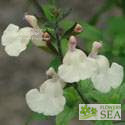
(Glimmering White Mountain Sage) Heatwave Glimmer isn't a mirage. It is a Salvia microphylla that tolerates extremely hot climates as well as cooler regions. It doesn't just survive; it thrives in the heat of Southern California, the Southwest and Texas.
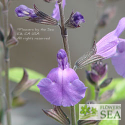
(Azure Hybrid Sage) Despite its name, the flowers of this tiny hybrid aren't really blue. They are a light purple. Due to its size, long bloom time, heat tolerance and drought resistance, Salvia x 'Mesa Azure' is a fine groundcover for areas where summers are hot and dry.
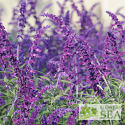
(Midnight Mexican Bush Sage) The typical Mexican Bush Sage has purple flowers surrounded by furry white bracts. This clone from the San Francisco Peninsula has deep purple flowers, calyxes and stems. It is a good groundcover due to a mounding habit, smaller size and generous amounts of flowers.
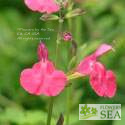
(Pink Preference Autumn Sage) Two-tone, hot pink flowers and contrasting bracts make this Autumn Sage stand out. This drought tolerant Autumn Sage from Central Texas is also compact, rugged, heat tolerant and capable of handling Zone 6 chill.
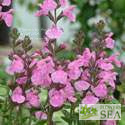
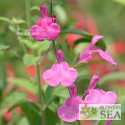
(Trinity Mountain Sage) Heat and drought tolerant, this Salvia microphylla is native to Northeastern Mexico where summers are dry and temperatures can rise to more than 100 degrees F. It can survive winter temperatures down to 0 degrees.
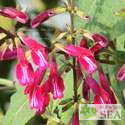
(Violet Calyx Sage) Here's another abundantly blooming sage from the cloud forest slopes of Chiapas, Mexico. Violet beelines mark the lower lip of the crimson blossoms, which are so numerous that it can be difficult to see the foliage at times.
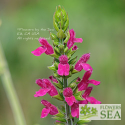
(Shaggy Chiapas Sage) This is a sweetheart! Glowing magenta flowers lure the eye as well as hummingbirds to this heat-tolerant sage. It begins blooming in late summer where weather is warm and in fall where it is cooler.
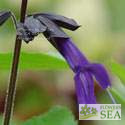
(Friendship Sage) Thank you Rolando Uria of the University of Buenos Aries for this very fine plant. Discovered in 2005 at a plant show in Argentina, this truly unique hybrid sage has generated a great deal of excitement in the Salvia world.
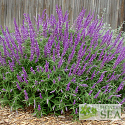
(Santa Barbara Mexican Bush Sage) This compact Mexican Bush Sage was found in the Santa Barbara garden of Kathiann Brown. It is, without a doubt, the finest short Mexican Bush Sage -- hardy, tough and long blooming. Add drought tolerance and dark, rich purple flowers to its list of merits.
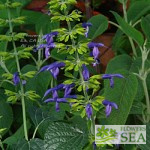
(Russell's Mexican Sage) Expect rapid, tall growth from this Salvia Mexicana . In the ground, Russell’s Mexican Sage can reach up to 10 feet tall and 5 feet wide, providing an effective screen of dark green, heart-shaped foliage. By late autumn it’s bursting with flowers.
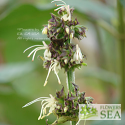
(Tree Sage)Whether you call it a shrub or a tree, Salvia arborsecens rises up to an impressive 12 feet tall and 5 feet wide. Commonly known as Sage Tree, this Salvia grows well in full sun, but prefers partial shade.

(Anatolian Cushion Sage) Rising up only 6 to 8 inches, this is a pixie-sized sage that loves gritty soils. It is perfect for dry gardens with gritty soils in USDA Zones 5 to 9. In fact, it seems to love the colder zones best. We think it is particularly fond of frozen ground in winter, because that helps keep its roots from getting too damp.
The following terms were added to your search to help improve the result. Click here to exclude these extra terms from the search.
- larger
Results for large from the blog
| 1. Leonotis: Mint Family Members that Roar in the Landscape |
| Orange is an aggressive color in the garden. It doesn't purr. The fuzzy, shaggy, hot orange flowers of Lion's Ear ( Leonotis ) growl for attention. Their stems are so tall that they may reach up to 6 feet, towering over the foliage like gawky Dr. Seuss blossoms. You'll find them at Flowers by the Sea Online Nursery. |
| New at FBTS |
| 2. New at FBTS: Salvia Amistad and Friendship from Afar |
| Flowers by the Sea is selling "font-style: italic;">Salvia 'Amistad'. It was a mystery sage to University of Buenos Aires agronomy professor Rolando Uria when he encountered it at an Argentinian plant show in 2005. Discovering its extra-long-blooming characteristic along with the intense violet of its large blossoms, he began sharing it with friends and named it Friendship Sage. |
| 3. New at FBTS: Suncrest Salvias |
| Drought-resistant, heat-tolerant, vibrantly colored Suncrest Salvias (sages) have arrived at Flowers by the Sea and will be available for shipping in April. Suncrest Salvias are floriferous hybrids of species native to the American Southwest and Mexico, including Mountain Sage (Salvia microphylla), Autumn Sage (Salvia greggii), Jame Sage (Salvia x jamensis) and Royal Purple Autumn Sage (Salvia muelleri). |
| 4. New Product Filtering Tool Helps You with Decision Making |
| Flowers by the Sea now offers a powerful, do-it-yourself, product-filtering tool that makes plant selection easier and faster. It sets up a matrix of choices to help customers sort possible selections for their gardens based on USDA cold hardiness zones, sun exposure, mature height and spread of plants, soil type and water needs. This article explains how the tool works and provides examples of how to use it. |
| 5. One-Pot Herb Garden Brings Sage and Summer Memories Indoors |
| Growing a one-pot herb garden indoors is a fragrant reminder of summer. While some herbs need plenty of water, others - such as Culinary Sage (Salvia officinalis spp.) - need little. Aside from controlling soil moisture, keys to success include plant selection, pot size and drainage, appropriate potting mix, sufficient sunlight and indoor pruning to control growth. |
| New at FBTS |
| 6. New at FBTS: Salvia x jamensis 'California Sunset' |
| Viewing the creamy peach-pink and yellow of California Sunset Autumn Sage (Salvia x jamenis 'California Sunset') may remind you of a Georgia O'Keefe painting. Anyone who has viewed sunset dipping into the mountains of New Mexico knows that soft pastels are common to Southwestern sunsets. Similarly, subtle bicolored combinations of pastels are common characteristics of many S. x jamensis species, which are crosses between various Autumn Sages (Salvia greggii spp.) and Mountain Sages (Salvia microphylla spp.). |
| Cultivating Color |
| 7. Pantone Pageant: Emerald Designer Salvias |
| Emerald and other cool shades of green are among the hot colors for 2013, according to Pantone, a design-industry leader. Flowers by the Sea doesn't generally think of greens or of any colors in nature as being in or out. However, we think it is fun and fresh to consider garden design from a different perspective. Emerald is Pantone's top color for the year. This article about emerald-colored Salvias begins a pageant of sorts down the runway of our blog, showing how the Pantone color matching system can be used to shape landscaping decisions. |
| 8. Pantone Pageant: Shady Salvias on a Mixed Blue Designer Patio |
| Got shade? Go ahead and get blue about it in the garden. We'll hold your hand, listen to your concerns and help you pick just the right shady salvias in hues to match the 2013 designer colors Dusk Blue and Monaco Blue from Pantone. |
| 9. Pantone Pageant: "Tender Shoots Green" Designer Salvias |
| Lime is the kind of bright, cheerful color that practically shouts, “Hey, look at me!” Limelight Mexican Sage (Salvia Mexicana ‘Limelight’) is the kind of plant that makes you say, “Hey, look at that! Let’s plant it.” It brightens the landscape with its startling contrast of chartreuse-lime foliage and deep violet-blue flowers. Limelight is a poster plant for “Tender Shoots 14-0446” by Pantone color corporation. |
| 10. Plant Safari Salvia in the South African Fynbos -- Part 1 |
| Twenty-six species of Salvia are native to South Africa and of these, 10 grow nowhere else in the world. Salvias play an important role in providing habitat and food for wildlife as well as brightening the semi-arid landscape in the Western Cape province of South Africa. Some are used in cooking or provide material for herbal remedies used in the alternative medicines taken by many South Africans. Flowers by the Sea grows a number of tough yet lovely South African Salvias. |
| Portraits in Gardening |
| 11. Portraits in Gardening: Michael Kampf |
| Portraits in Gardening is a new blog series from Flowers by the Sea that profiles customers who are passionate about the Salvia genus. This post features Illinois gardener Michael Kampf who has succeeded in growing many kinds of Salvias despite the frigid winters and fiercely hot summers of the Chicago area. He began gardening when 6 years old with encouragement from his mother and fell in love with Salvias at age 12. |
| 12. Portraits in Gardening: Ward Dasey |
| Portraits in Gardening is a blog series from Flowers by the Sea that profiles customers who are passionate about the Salvia genus. This article focuses on wildlife gardener, birder and dedicated volunteer Ward W. Dasey III, who grows Salvias at New Jersey's Palmyra Cove Nature Park. Dasey and nature-loving friends proposed the park to make bird watching easier on the Delaware River. |
Common terms in this search: wagner's sage from november march produces lavish hot pink flowers bracts our northern california coastal farm superb source food anna's hummingbirds live here during winter tall sub-shrub which means has both woody soft herbaceous perennial growth comes cloud forests southern mexico central america tropical beauty spectacular historically been one few native plants cultivated home gardens people its lands large plant