
Advanced Search
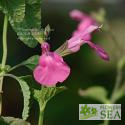
(Rosie O'Grady Mountain Sage) Honeybees and hummingbirds love the large, bright pink flowers of Salvia microphylla 'Rosie O'Grady', a drought-resistant sage. Dense and fragrant, it's large, glossy green leaves are veined and have finely serrated edges. This is a lush choice for dry gardens.
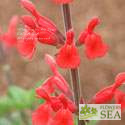
(Vermilion Bluffs® Mexican Sage) The brilliant red flowers of Vermilion Bluffs bloom abundantly from August to October. This variety of the Mexican native Salvia darcyi is cold hardy to Zone 5b at altitudes up to 5,500 feet.
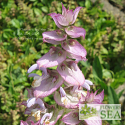
(Clary or Clear Eye Sage or Eyebright) Pink-purple bracts and violet-purple flowers form a pastel cloud over the large, rumpled leaves of Clary Sage in summer. It is a towering beauty growing up to 5 feet tall. Sacred to some due to age-old use in herbal remedies, it is heavenly to look at.
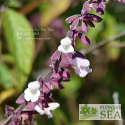
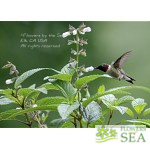
(Waverly Sage) A pale pink to lavender blush adds delicate color to the white flowers of Waverly Sage, which are supported by plum-colored calyxes. Its mid-green leaves are lance shaped and veined.
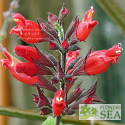
(Winter Mexican Sage) Call it the Snow Queen! From fall through spring, this graceful, colorful sage blooms through 20 degree F weather despite snow and ice. It has lovely, small, dark green leaves and profuse clusters of tubular, cinnabar-red flowers that puff out in the center.
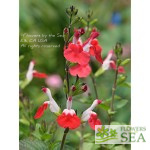
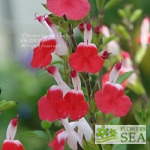
(Hot Lips Sage) What a winner for fascinating flowers! Salvia microphylla ‘Hot Lips’ is a native of Mexico that produces a combination of solid red, solid white, and bicolor red and white blossoms all on the same plant and sometimes at the same time.
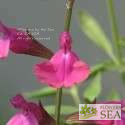
(Plum Wine Autumn Sage) Frilly, lavender-tinged, pink flowers with a pretty white dot at the throat make this another outstanding contribution from North Carolina nurseryman Richard Dufresne.
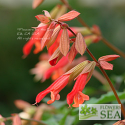
(Ember's Wish Sage) Bright coral-colored, tubular blossoms contrast handsomely with the deep maroon stems, rusty rose calyxes and mid-green foliage of Ember's Wish Sage.
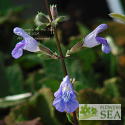
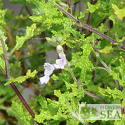
(Turkish Tea Sage) Sometimes an attractive plant is also medically powerful. That's true of the lavender flowered Salvia aucheri, which has strong white beelines. This Turkish native is consumed as an ingredient in teas used as folk remedies for many problems, including abdominal bloating and infections.
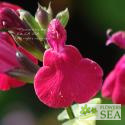
(Killer Cranberry Mountain Sage) Masses of magenta flowers on tall spikes lure honeybees and hummingbirds to the rich nectar of Salvia microphylla 'Killer Cranberry'. Its prolific flowers are a killer attraction for people too.
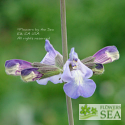
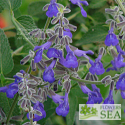
(Puna Sage) The deep violet-blue flowered Salvia calolophos has white beelines and oblong, mid-green leaves. It is a high-altitude native of northern Argentina.

(Vermilion Bluffs® Mexican Sage) The brilliant red flowers of Vermilion Bluffs bloom abundantly from August to October. This variety of the Mexican native Salvia darcyi is cold hardy to Zone 5b at altitudes up to 5,500 feet.
The following terms were added to your search to help improve the result. Click here to exclude these extra terms from the search.
- d, did, die, died
Results for dies from the blog
| Salvia Small Talk |
| 1. Salvia Small Talk: Annual, Biennial, Perennial |
| FBTS quickly explains the differences between annual, biennial and perennial Salvias |
| Ask Mr. Sage |
| 2. Ask Mr. Sage: How Should I Prune my Salvias? |
| Flowers by the Sea Online Nursery specializes in Salvias and often receives questions about how to prune them. Although getting good at pruning takes practice, Salvias rebound quickly if you make mistakes. A key to successful pruning is understanding the varying needs of four main categories of sages. Ask Mr. Sage is a regular feature of the FBTS Everything Salvias Blog. |
| 3. Ask Mr. Sage: How Should I Space Salvias When Planting |
| By spacing Salvias properly when planting, you avoid problems caused either by overcrowding or leaving too much space around individual plants. Most Salvias are healthier with good air circulation. Crowding leads to the spread of fungal diseases and pests, such as spider mites. Too wide of spacing may cause branches to break in high winds. By paying attention to plant measurements before planting, you can create a good spacing plan. Ask Mr. Sage is a Q&A feature based on topics raised in calls and emails to FBTS. |
| 4. Ask Mr. Sage: What to Do When a New Plant Fails |
| Ask Mr. Sage answers questions based on calls and emails that Flowers by the Sea receives, including ones concerning problems with plants customers have purchased. This article covers our unconditional guarantee to refund or credit purchases without making customers jump through hoops. It also touches on the process FBTS goes through in trying to diagnose plant ailments. |
| Cultivating Color |
| 5. Pantone Pageant Cheerful Lemon Zest and Nectarine Designer Salvias |
| Let there be light; let there be brightness. Yellows and oranges are cheerful colors to combine in a grouping of perennials. Pantone's spring 2013 designer colors -- golden yellow Lemon Zest 13-0756 and its hot orange Nectarine 16-1360 -- are fun colors to match to sages ( Salvia spp.) that can turn up the light in a garden whether sunny or shady. Two groupings for sunny or shady gardens are offered |
| Salvia Small Talk |
| 6. Salvia Small Talk: Deadheading Herbaceous Rosette-Growing Salvias |
| Deadheading flowers is usually a light form of pruning in late spring and summer. But some rosette-forming herbaceous Salvias like meadow sages need heavier pruning during the growing season to look tidy and bloom more than once. |
| Salvias Down South |
| 7. Salvias Down South: 15 Thirsty Salvias for Florida |
| Flowers by the Sea grows Salvias that are already popular in the Southeast as well as others we would like to introduce to gardeners seeking thirsty flowering plants that can also adjust to dry spells. Many are fine choices for Florida hummingbird gardens. Our suggestions are organized into categories based on moisture tolerance – average and ample -- as well as sun requirements. |
| 8. Salvias Down South: How Salvias Behave in Florida |
| Salvias that grow well in Florida may behave differently from one region of the state to another. This may mystify gardeners who have just moved to Florida or have moved to a different area in the state. Based primarily on seasonal variations in temperature, the four main regions are North, Central, South and Tropical Florida. |
| 9. Battles in the Salvia Garden: Pretty Southern Pink Moth |
| Southern Pink Moth (Pyrausta inornatalis) is diminutive and pretty, but it’s a powerful pest in Salvia gardens. As the common name indicates, it is primarily found in the South. Yet it is flitting into gardens further north. Read more to learn how to identify and control this pest. |
| Cultivating Color |
| 10. Bedding Plant Royalty: Splendid Salvia Splendens |
| If the world were to coronate a Salvia as its favorite annual, there's little doubt that a deep red variety of Scarlet Sage ( Salvia splendens ) would bear the sceptre. It's a long blooming, global favorite sometimes called Bedding Sage or Red Sage. When it was first introduced to horticulture in 1822, it was known as Lee's Scarlet Sage. Flowers by the Sea Online Nursery explains the growth habits and history of Scarlet Sage and suggests numerous favorite cultivars to add grandeur to your garden. |
| Book Reviews |
| 11. Book Review: Nature-Friendly Garden by Marlene A. Condon |
| Reading Marlene A. Condon's Nature-Friendly Garden is like observing a game of toppling dominoes. All the pieces are lined up standing on end in a complex, maze-like pattern. Flick one domino and the whole structure tumbles. Similarly, the author shows how simple choices we make in our gardens have consequences that can build or destroy wildlife habitat. |
| Celebrity Salvias |
| 12. Celebrity Salvias: Fuzzy, Fancy Salvia Oxyphora |
| A bright, cherry-licorice red, the large, fuzzy blossoms of Salvia oxyphora would make anyone stop and pay attention. Commonly known as Fuzzy Bolivian Sage or Bolivian Spearhead Sage, S. oxyphora has equally unusual foliage that fools the eye. At a distance, the plant’s lance-shaped leaves appear to be a smooth, glassy green. However, they are covered with tiny clear-to-white hairs. They’re also large -- growing up to 5 inches long and 2 inches wide at maturity -- and taper to long, sharp points. It was first collected near Cochabamba, Bolivia, by German botanist Otto Kunst in 1892 |
Common terms in this search: rosie o'grady mountain sage honeybees hummingbirds love large bright pink flowers microphylla 'rosie o'grady' drought-resistant dense fragrant it's glossy green leaves veined have finely serrated edges lush choice dry gardens sometimes confused its close relative autumn greggii they look similar but one apparent difference has tiny completely smooth both species long flowering heat tolerant drought resistant native american southwest number