
Advanced Search
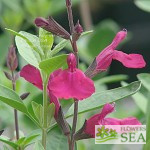
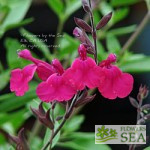
(Raspberry Autumn Sage) Dark calyxes and stems contrast intensely with the bright berry-colored flowers of Salvia greggii ‘Raspberry’. It's one of our fastest growing, earliest blooming Autumn Sages and has fragrant foliage.
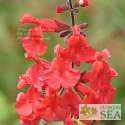
(Scarlet Spires Sage) This is a brilliant cross between the sturdy D'Arcy's Sage (Salvia darcyi) and the beautifully colored 'Raspberry Delight' Littleleaf Sage (Salvia microphylla 'Raspberry Delight').
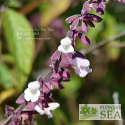
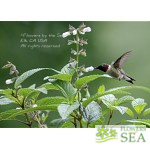
(Waverly Sage) A pale pink to lavender blush adds delicate color to the white flowers of Waverly Sage, which are supported by plum-colored calyxes. Its mid-green leaves are lance shaped and veined.
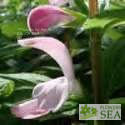
(Patio Rose Gentian Sage) Patio Rose is a lovely, dwarf variety of Salvia patens from Holland. It needs partial shade and is perfect for containers. The rose-colored flowers are larger than those of other Gentian Sages.
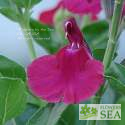
(Elk Pomegranate Autumn Sage) We're proud to say that this is an FBTS cultivar. It is one of the finest dark flowered, compact Autumn Sage varieties we have seen. Its extraordinarily large, raspberry blossoms bloom from spring into fall.
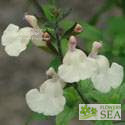
(Glimmering White Mountain Sage) Heatwave Glimmer isn't a mirage. It is a Salvia microphylla that tolerates extremely hot climates as well as cooler regions. It doesn't just survive; it thrives in the heat of Southern California, the Southwest and Texas.
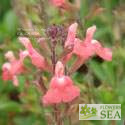
(Salmon Autumn Sage) Creamy salmon-colored flowers with white throats make this elegant Autumn Sage perfect for a pastel garden or as a cooling color in a mixed sage border. Bloom time is spring into fall for this petite Salvia greggii native to the American Southwest and Mexico.
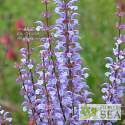
(Red Veined Sage) In 1827, John Wilkes referred to Salvia haematodes as "Bloody Sage" in his Encyclopaedia Londinensis, Volume 22. This might seem mysterious when first viewing the sage's upright yet somewhat relaxed spikes of whorled, violet-colored flowers.
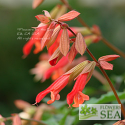
(Ember's Wish Sage) Bright coral-colored, tubular blossoms contrast handsomely with the deep maroon stems, rusty rose calyxes and mid-green foliage of Ember's Wish Sage.
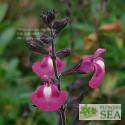
(Elk Plum Parfait Jame Sage) It's a toss-up as to which are more dramatic -- the deep purple calyxes so dark they almost look black or the plum-colored flowers with pronounced white beelines. Elk Plum Parfait is a rare treat.
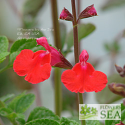
(Majestic Pink Sage) Very large richly colored hot pink blossoms and broad, glossy, intricately textured leaves are part of what makes Salvia x 'Majestic Pink' a standout. This is a complex hybrid involving several Salvia species from the ongoing breeding program at FBTS.
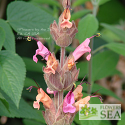
(Apricot Rose Hummingbird Sage) Large clusters of warm, apricot colored blossoms that age to a warm pink top the tall, thick flower spikes of this sage. This variety was selected from our warm apricot to peach seed strain and has truly unique coloration.
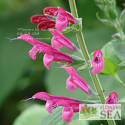
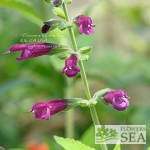
(Envy Hybrid Sage) A natural hybrid found in Peru and Bolivia, the parentage of this special variety is at this point unknown. The uniquely colored flowers are abundant all season long, and the hummingbirds love it.
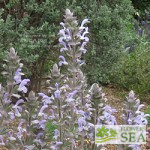
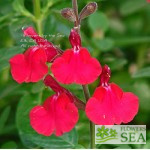
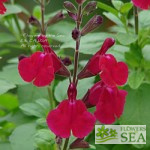
(Elk Raspberry Moose Sage) The deep raspberry flowers of this Salvia x Jamensis look good enough to eat, like spoonfuls of a silky, mouthwatering mousse dessert. Yet the 'moose' in its name isn't a misspelling. It refers to flowers that are larger than normal for a Jame Sage.
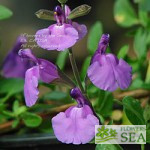
(Elk Grape Ape Jame Sage) Bountiful flowers that are larger than normal for Jame Sage cover Salvia x ‘Elk Grape Ape’ in a cloud of purple that is sort of amethyst to pinot gris in color.
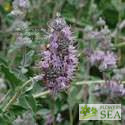
(Bee's Bliss Sage) If you are looking for a California native sage to use as a groundcover, Bee's Bliss is a fine choice. Low-growing, widespreading and colorful, it is ideal for choking weeds.
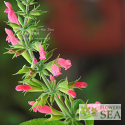
(Karwinski's Sage) From moist mountain areas in Mexico and Central America, this rugged, winter-blooming shrub is found in oak or pine forests at altitudes of 4,000 to 8,000 feet. This may account for this winter bloomer producing a few bright red flowers during short periods of freezing weather with temperatures as low as 20 degrees F.
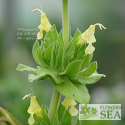
(Yellow Hummingbird Sage or Yellow Pitcher Sage) The Santa Barbara Botanic Garden introduced this rare yellow variety of fragrant Hummingbird Sage. Similar to other varieties of this species, Avis Keedy is alluring to butterflies, honeybees and hummingbirds.
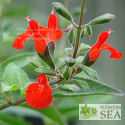
(Painted Lady Eyelash Sage) Small, eyelash-like hairs on the edge of its leaves give this Mexican native part of its name. A compact, gently mounding Salvia, it spreads gradually by underground stolons.
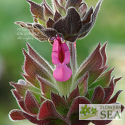
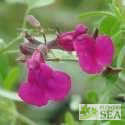
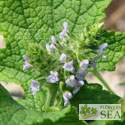
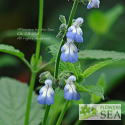
(River Sage) Native to partially shaded streamsides in Argentina and Bolivia, this is one of the few Salvia species that can tolerate wet soil. It makes a fine filler plant in a group of other partial shade growers, its wirey thin stems sending up floral displays here and there, much to the gardener's delight.
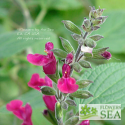
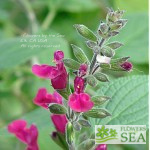
(Elk Red-Violet Hybrid Sage) A very special new hybrid Sage, featuring small but very numerous deep red-violet flowers on a vigorous, easy to grow plant. Loved by bees, butterflies and hummingbirds. A FBTS introduction.
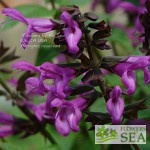
(COOL Fandango Anise Scented Sage) A combination of dark, rosy bracts and magenta blossoms make Salvia COOL Fandango dance. It’s vivid, floriferous, and a hummingbird favorite.
Results for colored from the blog
| Cultivating Color |
| 1. Cultivating Color: Tracking the Elusive History of Autumn & Mountain Sage Warm Pastel Hybrids -- Part I |
| Whether planned or accidental, hybrids happen. This is especially true among the closely related Southwestern and Mexican species of Autumn Sage (Salvia greggii) and Mountain Sage (S. microphylla). They are native to different areas of the Southwest and Mexico, but cross freely when they meet. This story is the first installment in a two-part series initiating our Cultivating Color series. It involves the late Dr. Richard F. Dufresne, a Salvia specialist who helped us track the history of warm-colored S. x jamensis hybrids. |
| Container Gardening |
| 2. Container Gardening Basics: Selecting and Arranging Pots |
| Assembling a new planter with fresh potting soil and young plants is a feel-good activity similar to moving into a new home. Each pot and property is full of promise. Placing a single plant or a grouping in the right size of pot is like selecting a starter home for it that will encourage healthy growth. The type of material a pot is made from also affects development. Flowers by the Sea Online Salvia Nursery explains how to choose correct pot sizes as well as pot styles, sizes, colors and arrangements. Don't miss The Flowerpot Men music video! |
| Cultivating Color |
| 3. Cultivating Color: New FBTS Tools Aid Garden Design |
| Have we got tools for you! No, we aren't selling Ginzu clippers, rust-free shovels, a miraculous compost-in-minutes machine or anything requiring payments. We're talking about a set of color tools for accurately visualizing and comparing the floral and foliage colors of Salvias. As you wander through the riot of hues in our online catalog at Flowers by the Sea, these tools aid plant selection and landscape planning. Beginning in fall 2014, we began identifying the colors of all FBTS plants based on the internationally standardized color system published by the U.K.'s Royal Horticultural Society. This improves descriptions of plant colors and makes color comparisons of plants easier for garden design. |
| 4. Fall Planting: 8 Best-of-Class Sages that Are Easy to Grow |
| "Best of Class" is the title that Flowers by the Sea bestows on plants we honor for being winners in many ways. They are lovely, abundant bloomers and reliable repeat performers that are useful in many landscapes, including low-water gardens designed to have a cottage, woodland or desert look. In the case of the sages ( Salvia spp.) described here, all are easy to grow because they thrive with little fuss. Many are heat tolerant and drought resistant. |
| 5. In the Native Garden: Colorful California Salvias Plus a Cousin |
| Native plants, including California's many indigenous sages, are like the boys or girls next door who were overlooked until outsiders discovered their good looks and other fine attributes. Flowers by the Sea grows hardy, drought-resistant California Salvias that are native to a broad swath of the West Coast ranging from Northern Baja to Southern Oregon. Many tolerate heat. They are well suited to waterwise landscapes, including dry gardens. |
| Sage Experts |
| 6. Sage Experts: Meet Salvia Researcher Jesús Guadalupe González-Gallegos |
| The FBTS Sage Experts series focuses on Salvia specialists -- both amateurs and professionals -- in settings ranging from botanic gardens to universities. This article focuses on Jesús Guadalupe González-Gallegos of the University of Guadalajara, an expert in the taxonomy of Salvias native to Western Mexico. He discusses the megadiversity of Mexican flora and problems involving incorrect identification of sage species. |
| Hummingbirds in the Garden |
| 7. A Gardeners Guide to Hummingbird Sage |
| Among the hummers' favorites: Salvia spathacea, commonly known as Hummingbird Sage. As it name suggests, this California native produces the hummingbirds' flower of choice, blooming from late winter through summer -- and sometimes again in Fall -- with rose-pink to magenta blossoms. Available in six varieties, this robust perennial not only attracts hummers with its abundant nectar, it's easy to grow and enhances any landscape with its aromatic blooms and fragrant evergreen foliage. |
| 8. Annual Salvias that Hummingbirds Adore |
| If a hummingbird could talk, he or she would tell you it's hard work packing for a long journey. Consuming mightily from dawn to dusk, day after day, hummingbirds double their weight before migration. They can't afford to run out of fuel before their next meal. To help hummingbirds, particularly on their northward journey, home gardeners can celebrate the arrival of spring by planting gardens filled with early blooming Salvias and companion plants that are excellent annuals in areas where winters are too chilly for survival as perennials. |
| Ask Mr. Sage |
| 9. Ask Mr. Sage: What Tropical Sage Should I Select? |
| Selecting the right types of Tropical Sage ( Salvia coccinea ) can be confusing when viewing them in a catalog and seeing similar flower colors. Yet they may differ in cultivation needs, foliage, heat tolerance, and size. Mr. Sage offers ideas for comparing differences and similarities. Ask Mr. Sage is a regular feature of the FBTS Everything Salvias Blog , which responds to questions from customers. |
| Celebrity Salvias |
| 10. Celebrity Salvias: Hot Heatwave Hybrids from Australia |
| Waterwise landscapes don't have to be cactus gardens if you grow leafy, colorful drought-resistant Salvias, such as Australian Heatwave™ Mountain Sages, which are crosses of Salvia microphylla and S. greggii . Hybridizers Howard Bentley and Steve Eggleton of Plant Growers Australia used these tough American and Mexican native plants to create their series. One goal was to aid water conservation during their nation's hot, dry summers. |
| Xeric Choices |
| 11. Colorful Salvias Break Myth of Dry Garden Drabness |
| Dry gardens are flowerbeds or entire landscapes based on ornamental perennials that require little to no watering once well rooted. Many Salvias are excellent, drought-resistant choices for these gardens. Flowers by the Sea Farm and Online Nursery talks about dry garden myths as well as low-water plants. |
| 12. Drought-Resistant Beauties: A Guide to the Salvia greggii and S. microphylla Group |
| It can be a long journey from discovery to popularity for a plant. Currently, the most widely sought group of Salvias is the one encompassing S. greggii , and S. microphylla , which are commonly known as Autumn Sage and Mountain Sage. They caught the eye of naturalists traveling the American Southwest and Mexico's Sierra Madre mountains in the mid-to-late 1800s. However, they didn't take root in garden catalogs for well over 100 years. |
Common terms in this search: raspberry autumn sage dark calyxes stems contrast intensely bright berry-colored flowers greggii 'raspberry' isone our fastest growing earliest blooming sages while taking close-up look luscious blossoms enjoy pleasant resinous fragrance its fine mid-green foliage although needs least six hours direct sun daily appreciates bit shade hottest time day location morning afternoon optimal drought resistant due being native dry regions texas