
Advanced Search
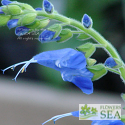
(Creeping Big Leaf Sage) Cobalt blue flowers float in airy clusters above the giant, velvety, green leaves of this South American native. Short and spreading by woody rhizomes, this is an ideal groundcover. As a bold statement in a container, it has no equal.
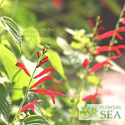
(Honey Melon Pineapple Sage) This is a short Pineapple Sage that is long blooming. It is the earliest and longest flowering of all the many varieties of Salvia elegans. We recommend it for indoor herb gardening as well as for outdoor borders and groundcovers.
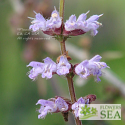
(Japanese Woodland Sage or Shu Wei Cao) This short, lavender-flowered, ornamental sage has purple-to-green foliage. In Asia, this woodland plant has long been an important medicinal herb, used in the treatment of conditions such as diabetes.
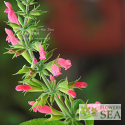
(Karwinski's Sage) From moist mountain areas in Mexico and Central America, this rugged, winter-blooming shrub is found in oak or pine forests at altitudes of 4,000 to 8,000 feet. This may account for this winter bloomer producing a few bright red flowers during short periods of freezing weather with temperatures as low as 20 degrees F.
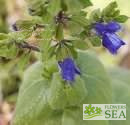
(Little Mexican Sage) This low-growing sage is a shrub in its warmest zones and a perennial in the cooler ones. It's just right for small spaces or tiny gardens. Short and compact, its flowers are similar to but smaller than those of S. mexicana 'Limelight'.
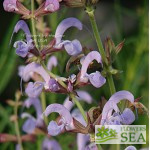
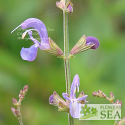
(Blue Turkish Sage) Large velvety gray-green to white leaves in loose rosettes give this sage a distinctive look as does the celestial violet-blue of its flowers. The blossoms seem much too large for this short sage and its thin, candelabra-branched flower spikes.
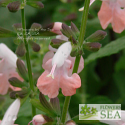
(Coral Nymph Tropical Sage) What a cutie! This award-winning cultivar of Tropical Sage is short and compact yet has a multitude of pastel salmon flowers larger than those of its bigger cousins. It is perfect for annual flower beds or patio containers.
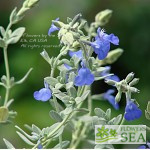
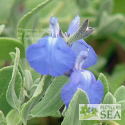
(Silver Germander Sage) With its compact habit, brilliant silver-white leaves and large, sky blue flowers, this is an outstanding heat-tolerant choice for dry, sunny gardens. We consider this to be one of the finest short ground covers for these conditions.
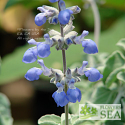
(Cedros Island Sage) From the Island of Cedars off the coast of Baja California Sur comes this delightful xeric sage with deep violet-blue flowers and silvery foliage. The square-shaped, 1-inch-long leaves are densely covered with downy, short, white hairs providing moisture retention.
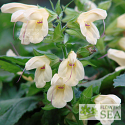
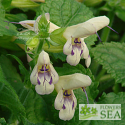
(Kyushu Woodland Sage) We are in love with this short forest sage from Kyushu, Japan. Its clusters of large creamy flowers pale as fresh-churned butter begin blooming in September. Even when not blooming, its foliage is showy in a shady garden.
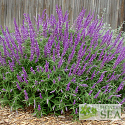
(Santa Barbara Mexican Bush Sage) This compact Mexican Bush Sage was found in the Santa Barbara garden of Kathiann Brown. It is, without a doubt, the finest short Mexican Bush Sage -- hardy, tough and long blooming. Add drought tolerance and dark, rich purple flowers to its list of merits.
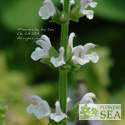
(Iranian Sage) Mixed in with short perennials that bloom over a wide range of seasons, Salvia staminea makes an attractive contribution to short borders during its summer bloom time. Our strain has dark bracts surrounding pastel white-to-blue-to-lavender flowers. The dark green, branching foliage has oblong to oval-shaped leaves.
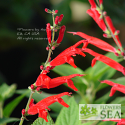
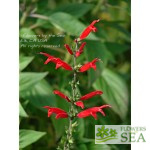
(Elk Sonoran Red Pineapple Sage) A new Pineapple Sage variety that has the traditional fruity fragrance but blooms much earlier in the season than the traditionally grown clone. Short and compact, it resembles the varieties 'Honey Melon' and 'Tangerine' size wise, but has the unmistakable aroma of ripe pineapples.
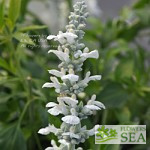
(White Flame Sage) Like bright white candle flames, the short vigorously upright flower spikes of petite Salvia x ‘White Flame’ light up flowerbeds.
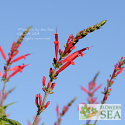
(Pineapple Sage) An indispensable fall-blooming addition to the garden, this tender perennial is, perhaps, the best of all hummingbird plants. When in bloom, it is covered in 3-inch-long red flowers.
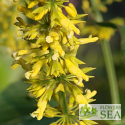
(Forysthia Sage) This statuesque perennial grows up to 10 feet tall, but spreads only 3 feet wide. It is a late bloomer from Mexico's Sierra Madre Oriental mountains where it grows at altitudes of 4,000 to 5,000 feet and tolerates temperatures down to 20 degrees F.
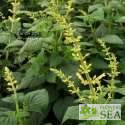
(Red Stem Forsythia Sage) The thick, square, red stems of this variety of Forsythia Sage make it conspicuously different from the species and from everything else in your garden. Its jointed stalks look a little like rhubarb gone mad!
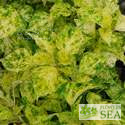
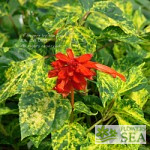
(Variegated Scarlet Sage) Crimson flowers topping bright yellow foliage mottled with deep green make this one of the most spectacular Salvias we grow.
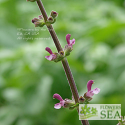
(Mid-East Sage) Native to the mountains shared by Israel and Lebanon, this tidy sage is drought resistant, heat tolerant and long blooming. Its basal foliage rises up and spreads only about 18 inches, but it has long flower spikes.
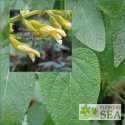
(Silver Leaf Forysthia Sage) It's the foliage of this clone that makes it so different from its parent plant. The leaves are a lovely silver and smaller than the green leaves of the species. However, they both have buttery yellow, Forsythia-like blossoms.
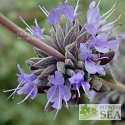
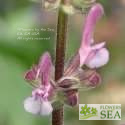
(Jerusalem Sage) This lovely herbaceous perennial is native to Cyprus, Israel, Jordan, Lebanon, Syria, and the West Bank. Its clear pink flowers change at times to a pink highlighted with violet lines and dots. Prominent glandular hairs on the buds, bracts and floral stems exude a fragrance that is delightful on a warm day.
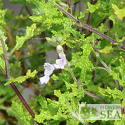
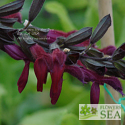
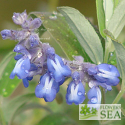
(Blue Ecuadorian Sage) A densely branched shrub with silvery leaves and dusky blue flowers, this rare species was once thought to be Salvia cruickshanksii. In the nursery trade, it sometimes is called Salvia 'Equador'.
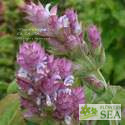
(Italian Clary Sage) Clary Sages are well known for their use in folk remedies, aromatherapy and cosmetics. Glowing purple bracts frame the spectacular white blooms of this cultivar on 5-foot-tall spikes. It is a delight for honeybees, hummingbirds and butterflies.
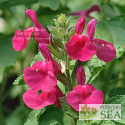
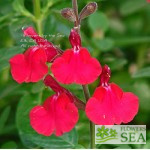
(St. Charles Day Mountain Sage) Especially in spring and fall, masses of red-violet flowers bloom amid the silvery green foliage of Salvia microphylla 'San Carlos Festival'. Put this one into the "must have" column.
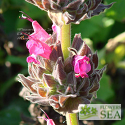
(Little Hummingbird Sage or Pitcher Sage) At one-fourth to one-half the size of our other Hummingbird Sages, this is the smallest variety of Salvia spathacea that we grow.
Results for short from the blog
| Hummingbirds in the Garden |
| 1. How David Verity Cuphea Became a Famous Hummingbird Flower |
| When massed in borders or standing out as a main attraction in a container planting, Cuphea x ‘David Verity’ is a visual feast for people as well as an actual feast for small wildlife. Rich in nectar, the plant’s dainty, cigar-shaped, orange-red flowers nestle amid a cloud of mid-green leaves shaped like tiny garden trowels. |
| 2. In the Native Garden: Colorful California Salvias Plus a Cousin |
| Native plants, including California's many indigenous sages, are like the boys or girls next door who were overlooked until outsiders discovered their good looks and other fine attributes. Flowers by the Sea grows hardy, drought-resistant California Salvias that are native to a broad swath of the West Coast ranging from Northern Baja to Southern Oregon. Many tolerate heat. They are well suited to waterwise landscapes, including dry gardens. |
| Cultivating Color |
| 3. Pantone Pageant: Emerald Designer Salvias |
| Emerald and other cool shades of green are among the hot colors for 2013, according to Pantone, a design-industry leader. Flowers by the Sea doesn't generally think of greens or of any colors in nature as being in or out. However, we think it is fun and fresh to consider garden design from a different perspective. Emerald is Pantone's top color for the year. This article about emerald-colored Salvias begins a pageant of sorts down the runway of our blog, showing how the Pantone color matching system can be used to shape landscaping decisions. |
| Business Buzz |
| 4. Buying Salvias Online from FBTS: How to Order & What to Expect - Updated |
| When you purchase plants online, it's understandable to feel a bit nervous. After all, a tender green life is being sent to you in a box. Will it survive the journey in healthy condition? Also, how secure will your credit card information and other data be? Furthermore, how do you sort through all those plants in the online catalog? Flowers by the Sea provides answers. |
| New at FBTS |
| 5. New Product Filtering Tool Helps You with Decision Making |
| Flowers by the Sea now offers a powerful, do-it-yourself, product-filtering tool that makes plant selection easier and faster. It sets up a matrix of choices to help customers sort possible selections for their gardens based on USDA cold hardiness zones, sun exposure, mature height and spread of plants, soil type and water needs. This article explains how the tool works and provides examples of how to use it. |
| Cultivating Color |
| 6. Pantone Pageant: Designer African Violet Salvias and Companions |
| Purples are cool yet quietly passionate. This includes African Violet 16-3520, a spring 2013 designer color created by the Pantone Corporation. Shades in the blue and purple color range are tranquil and soothing yet commanding, because they calm the garden. Here are a number of choices from our catalog that fashionably match Pantone's African Violet. |
| Quick Digs |
| 7. Quick Digs: Inventorying Salvias and Tools for Spring Gardening |
| This is the first article in our new Quick Digs series about preparing for spring in Salvia gardens. As spring approaches and daylight grows longer, first steps for preparing Salvia gardening include recording sages already planted before planning new purchases, repotting cuttings and seedlings, inventorying garden tools and turning the compost heap. When the first new growth arrives, you'll be prepared to remove weeds before they choke sages and other perennials that are re-emerging. |
| 8. Quick Digs: Planning a Salvia Garden Calendar |
| This is our second article in a Quick Digs series about preparing for spring in Salvia (sage) gardens. It's easier to succeed at almost anything if you make plans and set goals before beginning a project. This is certainly true in Salvia gardening. Creating a gardening calendar ensures greater success in planning. |
| Salvias Down South |
| 9. Salvias Down South: 8 Must-Have Salvias for the Southwest |
| You don’t have to be a fine artist to create a work of beauty in the garden. By selecting hardy, vibrantly colored native Salvias that can withstand Southwestern weather ranging from sullen heat and drought to raging rainstorms, you become a landscape painter. FBTS Online Nursery carries many choices for your palette. |
| Butterflies in the Garden |
| 10. Salvias Down South: Southern California Butterfly Favorites |
| Wildscaping a butterfly-friendly garden in Southern California is an act of kindness, especially toward imperiled species. Gardeners from Santa Barbara southward may want to group coastal sage and chaparral plants in their butterfly gardens, because those are among favorite sources of nectar for adult butterflies and host plants for caterpillars. Sages are popular nectar choices. Plants, such as Milkweeds and Impatiens, that work well both as nectar providers and caterpillar hosts are important additions. |
| 11. About our Farm: Growing Sage by the Sea |
| Flowers by the Sea (FBTS) is a small, family farm that raises hundreds of species of Salvia and companion plants, including Plectranthus. We are proud of our beautiful plants, excellent customer service and 100 percent guarantee of satisfaction. |
| 12. A New Category - Autumn Sage & Mountain Sage |
| Without a doubt, this group of closely related plants are the most widely grown of the genus. From 'Hot Lips' to 'Texas Wedding', there is something here for everyone. |
Common terms in this search: creeping big leaf sage cobalt blue flowers float airy clusters -inch spikes above velvety green leaves south american native from summer into fall short spreading woody rhizomes ideal groundcover foliage herbaceous perennial looks similar sweet potato dramatic container border raised planter its giant heart-shaped cascading over sides some gardeners grow houseplant fast-growing adaptable almost full sun cool climates shade however