
Advanced Search
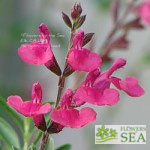
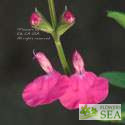
(Wild Watermelon Mountain Sage) Large, watermelon-pink flowers and the fruity fragrance of this long-blooming sage's mid-green, veined leaves make this Mountain Sage a treat to grow.
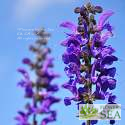
(Wild Meadow Sage) Meadow sages are native to Europe and include many hybrids. This lush, purple-flowered plant is a wild species that most likely is a hybrid of two ancient sages -- Salvia nemorosa and Salvia pratensis.
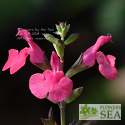
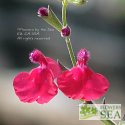
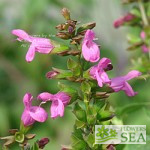
(COOL Wild Strawberry Anise Scented Sage) Prepare yourself for a heaping serving of large flowers the delicious color of strawberry ice cream when you plant Salvia COOL Wild Strawberry.
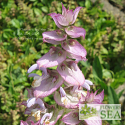
(Clary or Clear Eye Sage or Eyebright) Pink-purple bracts and violet-purple flowers form a pastel cloud over the large, rumpled leaves of Clary Sage in summer. It is a towering beauty growing up to 5 feet tall. Sacred to some due to age-old use in herbal remedies, it is heavenly to look at.
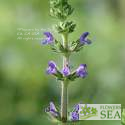
(Wild Sage) Toothed and attractively wrinkled, the gray-green, basal foliage of Wild Sage contrasts prettily with deep lavender-to-purple flowers supported by grassy green bracts. This cold-hardy sage is native to northern Africa and parts of Asia and Europe.
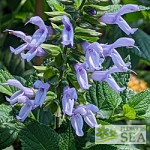
(COOL Periwinkle Anise-Scented Sage) Dusky green bracts cup the lavender-blue blossoms of Salvia COOL Periwinkle that attract hummingbirds. The fragrance of its bright green leaves may remind you of licorice.
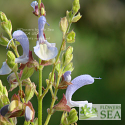
(Rough Blue Sage) Honeybees and butterflies love this deer-resistant shrub, which grows wild on the southwestern Cape of South Africa. It is a member of the most diverse plant community in the world, the fynbos -- an Afrikaans word, meaning "fine bush" and referring to scrub plants or shrubbery.
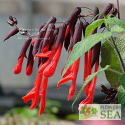
(Giant Bolivian Sage) Hailing from Peru and Bolivia, this tender specimen is found at altitudes of 9,000 feet in the wild. This multi-stemmed, woody-based, climbing Salvia needs support. Hummingbirds love its 5-inch-long, crimson flowers, which are the longest grown by any Salvia and flower from late summer through autumn.
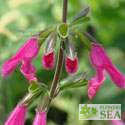
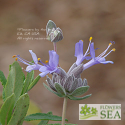
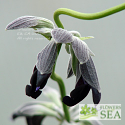
(Purple Bract Peruvian Sage or Concolor Sage) Similar to its wild relative, Peruvian Sage, which is also known as Concolor Sage, this cultivar has foliage that is smooth, apple green on top and fuzzy with silver hairs on the bottom. Major differences appear in the dramatic bracts.
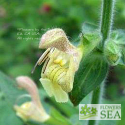
(Himalayan Cloud Sage) Nepal's Muktinath Valley -- a sacred site for Hindus and Buddhists -- is the place to go to see this majestically tall shade perennial in the wild. It grows at altitudes up to 14,000 feet and often emerges while the ground is still snowy.
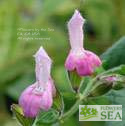
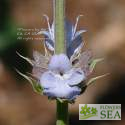
(Starlight Sage) Add sparkle to your dry garden with the pale pastel flowers of this hybrid of two Southern California native plants often seen growing together in the wild — Black Sage (Salvia mellifera) and White Sage (Salvia apiana). Salvia x 'Starlight' is a shrub that blooms early and long, attracting honeybees but not deer.
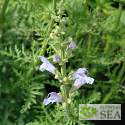
(Xobo Valley Sage) Although petite, the rare Xobo Valley Sage is eyecatching due to its lacy, bright green foliage and powder blue flowers. It's even possible that this long-blooming sage may have caught Nelson Mandela's eye as he grew up in the Wild Coast area of South Africa's Eastern Cape.
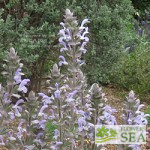
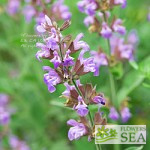
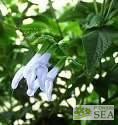
(Argentina Skies Anise-Scented Sage) PLEASE NOTE: A superior variety, 'Elk Argentina Skies' is now available.
The licorice-like fragrance of its foliage and the big whorls of large, sky blue flowers make this a stand-out sage. Tall and wide, it forms a tidy, long blooming background, screen or border.
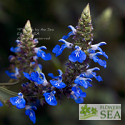
(Bog Sage) Highly adaptable, Salvia uliginosa is ideal for the beginning sage gardener. It isn't fussy about soil type, sun exposure, drainage or frequency of watering.
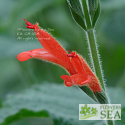
(Tubular Chilean Sage) Foggy days and moderate temperatures are the norm for this low-altitude, coastal mountain sage from northern Chile and Peru. It is grown as much for its handsome foliage as for the deep cranberry of its tiny, tubular flowers.
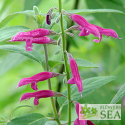
(Pink Tehuacan Sage) Large clusters of big, fuzzy, hot magenta-pink flowers top the elegant foliage of this Mexican sage. It is long blooming beginning in late spring and does well in full sun or partial shade. We want to help spread this rare sage that deserves to be widely planted.
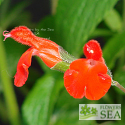
(Eyelash Sage) Small, eyelash-like hairs on the edge of its leaves give this Mexican native part of its name. A compact, gently mounding Salvia, it spreads gradually by underground stolons.
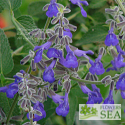
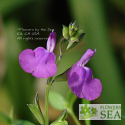
(Royal Purple Autumn Sage) Salvia muelleri is related both to Autumn Sage (S. greggii) and Mountain Sage (S. microphylla), which are closely related species.
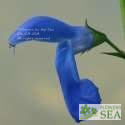
(Giant Gentian Sage) "Wow!" is what most people say when they see this large Gentian Sage from Central Mexico. Growing to 4 feet tall, it has long, graceful spikes of 3-inch deep, royal blue flowers that are highly visible and easily accessible to hummingbirds.
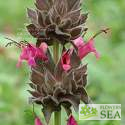
(Giant Hummingbird Sage or Pitcher Sage) Powerline Pink is the largest variety of Salvia spathacea that we grow. Its large, dark pink flowers are surrounded by bracts so furry that they look silvery.
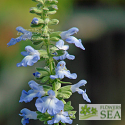
(Big Pitcher Sage) As its scientific name indicates, this sage has very large flowers. They are almost two-tone, changing from deep violet to a light blue or white at their base where they are cupped by dusky purple calyxes.
Results for wild from the blog
| Bees in the Garden |
| 1. Types of Bees Working in Your Garden |
| America buzzes with bee diversity, including 4,000 native species and many types of nonnative honeybees. Flowers by the Sea details the variety and value of our imperiled bees. This is the second article in a two-part series focused on identifying and understanding bees, becoming aware of threats to their survival and noting ways gardeners can protect these tiny wildlife. It includes tips on how to avoid bee stings. |
| Salvias Down South |
| 2. Salvias Down South: 15 Sages to Pink Up Landscapes |
| Winter is a good time for warm thoughts about rosy colors pinking up the landscape. Not only is pink pleasant, but it is soothing. As psychologists discovered in the late 20th century, it's also the color of calm and is used in serenity gardens. Flowers by the Sea details a variety of pink sages here, some of which bloom in winter. |
| Xeric Choices |
| 3. Drought Praise: Hot Pink and Purple Autumn Bloomers |
| Late summer is a good time to plant at the coolest times of day. Settling in Autumn Sage ( Salvia greggii ) and Mountain Sage ( S. microphylla ) before Indian summer will give their roots a chance for strong growth so they can withstand winter's chill and leaf out again next spring. These drought-resistant species are closely related and hybridize freely when they meet. They also cross with other sages they encounter. FBTS details seven pink and purple varieties that bloom off and on spring to fall. |
| Sage Words About Wildlife |
| 4. How to Find Food for the Bees at Flowers by the Sea |
| Forgive the bad pun, but we almost wouldn't be without bees. These tiny pollinators make it possible for us to eat and experience the flowering beauty of the world around us. Honeybees -- the kind managed by beekeepers -- and thousands of wild species pollinate at least one-third of the plant species we eat. At Flowers by the Sea we've decided to improve our efforts to help the genus Apis . Our first step is to make it easier for you to find plants honeybees frequent by making our catalog easier to search for bee favorites. |
| New at FBTS |
| 5. New at FBTS: Elegant Salvia valentina |
| Flowers by the Sea Online Salvia Nursery has fallen hard for the delicate look but rugged constitution of wildflower sages from Valencia on Spain's Mediterranean coast, especially Strong Spanish Sage (Salvia valentina). S. valentina has upright form and looks elegant dressed up in tall spikes of deep lavender, double-lipped flowers from spring into summer. It's a meadow sage with fuzzy bracts and stems that mature from green to rich Pantone Marsala. |
| 6. Texas and Southwestern Native Plants for Butterflies, Honeybees and Hummingbirds |
| Many gardeners and wildlife lovers in states with recurrent drought choose to increase the number of native plants in their yards. This is especially true of Texas, where statewide drought began in 2010 and hasn't yet abated. Native plants appeal to local wildlife, including pollinators. To help gardeners from Texas and the Southwest who want to create wildlife habitat, Flowers by the Sea (FBTS) suggests Salvias appropriate for Texas and Southwest gardens. |
| New at FBTS |
| 7. Himalayan Sage Is the Salvia Collector’s Holy Grail: Part 1 |
| For plant collectors, a mystique surrounds rare species like Salvia hians (Himalayan or Kashmir Sage). This is especially true when there is uncertainty about what the plant should look like. Perhaps the most famous image of S. hians is a 2012 photograph of UK plant collector Chris Chadwell next to an abundantly blooming stand of large violet-blue flowers with white lower lips. Why doesn’t the Flowers by the See variety of this rare species look exactly like the plant Chadwell found — a plant that seems to be the Holy Grail of Salvia collectors? We’ll do our best to explain. |
| Celebrity Salvias |
| 8. Celebrity Salvias: Fuzzy, Fancy Salvia Oxyphora |
| A bright, cherry-licorice red, the large, fuzzy blossoms of Salvia oxyphora would make anyone stop and pay attention. Commonly known as Fuzzy Bolivian Sage or Bolivian Spearhead Sage, S. oxyphora has equally unusual foliage that fools the eye. At a distance, the plant’s lance-shaped leaves appear to be a smooth, glassy green. However, they are covered with tiny clear-to-white hairs. They’re also large -- growing up to 5 inches long and 2 inches wide at maturity -- and taper to long, sharp points. It was first collected near Cochabamba, Bolivia, by German botanist Otto Kunst in 1892 |
| Xeric Choices |
| 9. Colorful Salvias Break Myth of Dry Garden Drabness |
| Dry gardens are flowerbeds or entire landscapes based on ornamental perennials that require little to no watering once well rooted. Many Salvias are excellent, drought-resistant choices for these gardens. Flowers by the Sea Farm and Online Nursery talks about dry garden myths as well as low-water plants. |
| Getting Started with Salvias |
| 10. Getting Started: Salvias for New England |
| Some people think you only find sage and coyotes out West. But Canis latrans, the Eastern Coyote, slipped into New England in the 1930s, and who knows when all the sages arrived? The New England Wild Flower Society notes that Lyreleaf Sage ( Salvia lyrata ) is the region's only native sage. It's one among many Salvia species grown in the Botanic Garden of Smith College in Massachusetts, which has one of the largest collections of sage in the region. Flowers by the Sea Online Plant Nursery raises hundreds of sages, including many northeastern favorites. |
| 11. Getting Started: Salvias for the Coastal Southeast |
| True sages are members of the Salvia genus and number in the hundreds. They are native to a wide variety of environments worldwide, which is why some are ideal for the dry gardens of California and others can handle the abundant moisture of the American Southeast. Flowers by the Sea raises many sages that grow well in the Southeast, including some that are either native to the region or have jumped fences from gardens into the wild. |
| Cultivating Color |
| 12. Cultivating Color: Tracking the Elusive History of Autumn & Mountain Sage Warm Pastel Hybrids -- Part I |
| Whether planned or accidental, hybrids happen. This is especially true among the closely related Southwestern and Mexican species of Autumn Sage (Salvia greggii) and Mountain Sage (S. microphylla). They are native to different areas of the Southwest and Mexico, but cross freely when they meet. This story is the first installment in a two-part series initiating our Cultivating Color series. It involves the late Dr. Richard F. Dufresne, a Salvia specialist who helped us track the history of warm-colored S. x jamensis hybrids. |
Common terms in this search: wild thing autumn sage native west texas where collected cold-tolerant has perky upright flowers coral pink darker throat overall vigorous plant dense deep green foliage butterflies honeybees hummingbirds love hardy least degrees heat tolerant sun loving but adaptable bit shade long blooming from spring into fall small-leafed burgundy stems tidy compact habit make heart sing recommend even without its numerous